Inverter Charger Guide: How It Works in Solar Systems
Solar power seems simple from the roof. Panels catch sunlight, and electricity flows into your home, cabin, RV, or workshop. Add batteries, though, and you meet controllers, breakers, switches, and enough wiring terms to cool your coffee.
An inverter charger is one of the most useful pieces in that setup. It turns stored battery energy into electricity your appliances can use, then helps recharge the batteries when utility power, shore power, or a generator becomes available.
This guide explains how the device works, how to size it, and what to check before buying. You only need a clear picture of how the parts cooperate.
What Is an Inverter Charger?
An inverter charger combines two jobs in one device.
The inverter takes direct current, or DC, from the batteries and changes it into alternating current, or AC, for household appliances.
The charger side works in reverse. When AC power arrives from the grid, a generator, or an RV hookup, it converts that energy into DC to recharge the batteries.
Think of it as an energy interpreter. Your batteries speak DC, while most appliances speak AC. The U.S. Department of Energy’s explanation of solar inverters also notes that modern inverters may monitor performance and communicate with other equipment.
How an Inverter Charger Works in a Solar System
When batteries supply the system, the inverter converts their DC energy into AC and sends it to connected outlets or circuits.
When utility, shore, or generator power appears, the unit can transfer the loads to that source while charging the batteries. An automatic switch usually manages the change quietly.
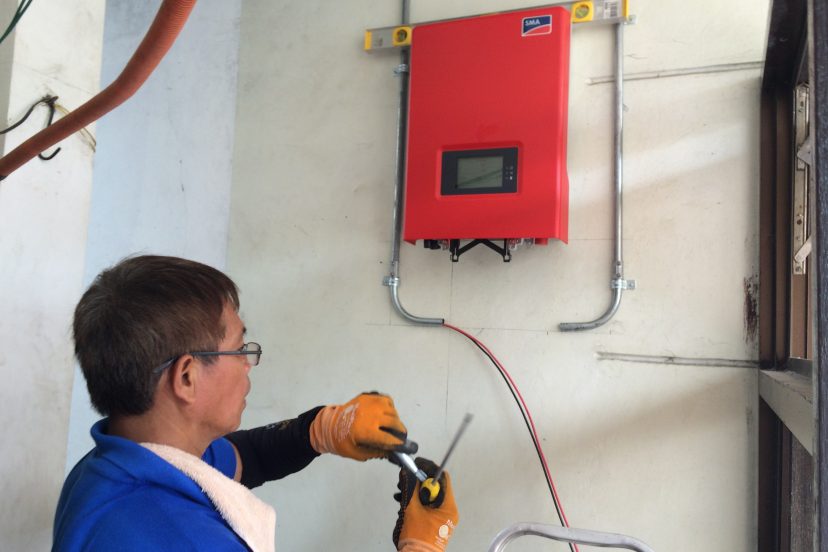
Solar panels usually charge batteries through a separate solar charge controller. However, some hybrid models combine an MPPT controller, AC charger, inverter, and transfer functions in one enclosure. That can simplify installation, although one device then handles several jobs.
Inverter Charger vs Inverter vs Charge Controller
The names sound similar, but their roles are different:
- Inverter: Changes battery DC into appliance-ready AC.
- Battery charger: Converts incoming AC into charging DC.
- Solar charge controller: Regulates energy moving from solar panels to batteries.
- Inverter charger: Combines an inverter and AC battery charger.
- Hybrid inverter: May also include solar charging and energy-management features.
Follow the direction of the energy. The inverter moves battery power toward appliances. The charger moves outside AC power toward the battery. The solar charge controller manages the route from the panels.
Why Solar Systems Use an Inverter Charger
An inverter charger becomes especially helpful when your system uses several power sources.
Picture an off-grid cabin: panels handle daytime needs, batteries cover the evening, and a generator helps after cloudy days. The inverter charger keeps those sources cooperating.
This flexibility suits RVs, boats, tiny homes, and backup systems. During an outage, a properly designed setup may keep selected loads running.
Solar panels alone usually shut down when the grid fails to protect utility workers. The Department of Energy’s guide to solar power and resilience explains why batteries, suitable inverters, controls, and isolation equipment are required for outage operation.
Main Types of Inverter Chargers
Low-Frequency Models
Low-frequency inverter chargers often use larger transformers. They are heavier, but many handle demanding startup surges well.
That suits refrigerators, pumps, compressors, and tools that demand a strong burst at startup.
High-Frequency Models
High-frequency units are lighter and often suit RVs, vans, boats, and tight spaces.
Surge performance varies, so read the specifications carefully before a large pump tests its courage.
Hybrid Solar Inverters
A hybrid inverter may combine solar charging, AC charging, power conversion, and source priorities.
Fewer boxes can save space and simplify wiring. However, one failure may affect several system functions at once.
Pure Sine Wave vs Modified Sine Wave
A pure sine wave inverter charger is a better option for the majority of contemporary systems.
Its output resembles utility electricity, making it suitable for sensitive electronics, motors, medical devices, and electronically controlled appliances.
Modified sine wave power may run basic loads, but some devices can buzz, become hotter, lose efficiency, or behave strangely. Saving money feels less rewarding when the refrigerator sounds as though it joined a garage band.
They often cost more, but offer wider compatibility.
Key Specifications to Compare
Do not choose an inverter charger by continuous wattage alone. Check:
- Battery voltage: 12V, 24V, or 48V
- Continuous and surge output
- Surge duration
- Charger amperage
- AC input and output voltage
- Transfer-switch rating
- Supported battery chemistries
- Idle consumption and efficiency
- Monitoring options
- Certifications, warranty, and support
Also confirm the AC format. A model may provide 120V, 120/240V split phase, or 230V. The right choice depends on your appliances, electrical panel, local standards, and country.
How to Size an Inverter Charger
List the appliances you expect to run together and add their normal wattage. Then identify anything with a motor, compressor, or large startup demand.
Suppose your active loads total 1,800 watts. A 2,000-watt unit leaves little room, while a properly designed 3,000-watt model may better handle startup demand.
Battery voltage matters too. Producing 3,000 watts from a 12V bank can require well over 250 amps after losses. A 48V bank delivers the same power at lower current, reducing voltage drop and easing cable sizing.
Bigger is not always better. Oversized equipment costs more and may draw more power while idle. Consider surge demand, battery limits, cable length, temperature, local codes, and manufacturer guidance.
Matching the Inverter Charger to Your Batteries
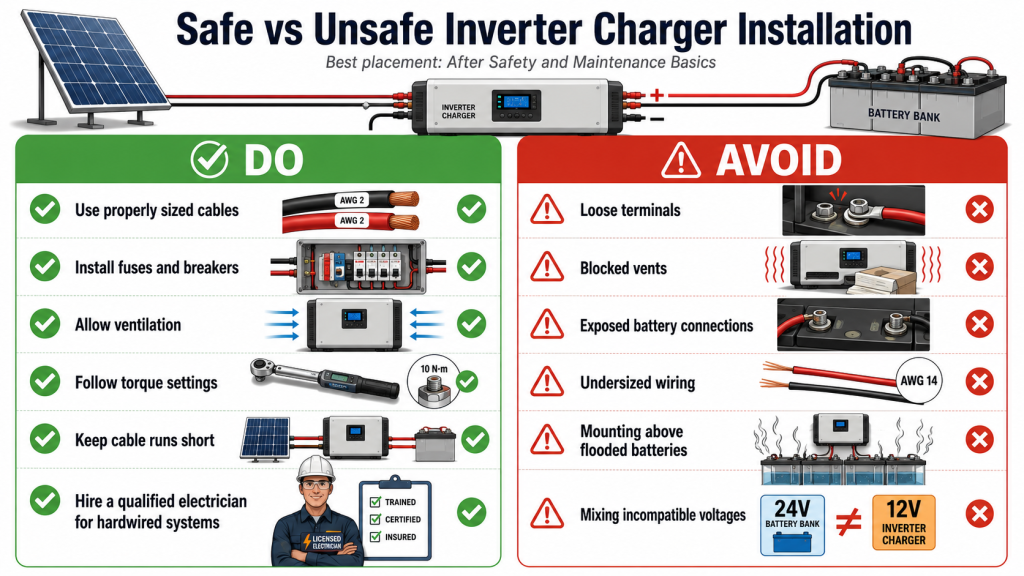
The inverter charger’s DC voltage must match the battery bank. A 24V model cannot serve a 12V bank simply because the discount looked charming.
Battery chemistry matters too. Flooded lead-acid, AGM, gel, and lithium iron phosphate batteries require different charging profiles and voltage limits.
Choose settings approved by the battery manufacturer. With lithium systems, check whether the inverter charger needs to communicate with the battery management system, or BMS.
That connection may share charge, temperature, current, and fault data. Never bypass protective controls to force incompatible equipment together.
Efficiency and Standby Power
Every conversion loses some energy as heat, and efficiency changes with the load.
A large inverter may be efficient near its preferred range but wasteful when powering only a router or phone charger overnight.
Check idle consumption. Power-saving mode may reduce standby draw, though tiny loads may not wake the inverter reliably.
Heat also affects performance. Follow mounting-clearance requirements, keep vents clean, and avoid enclosed spaces that trap warm air.
Installation Tools and Wiring
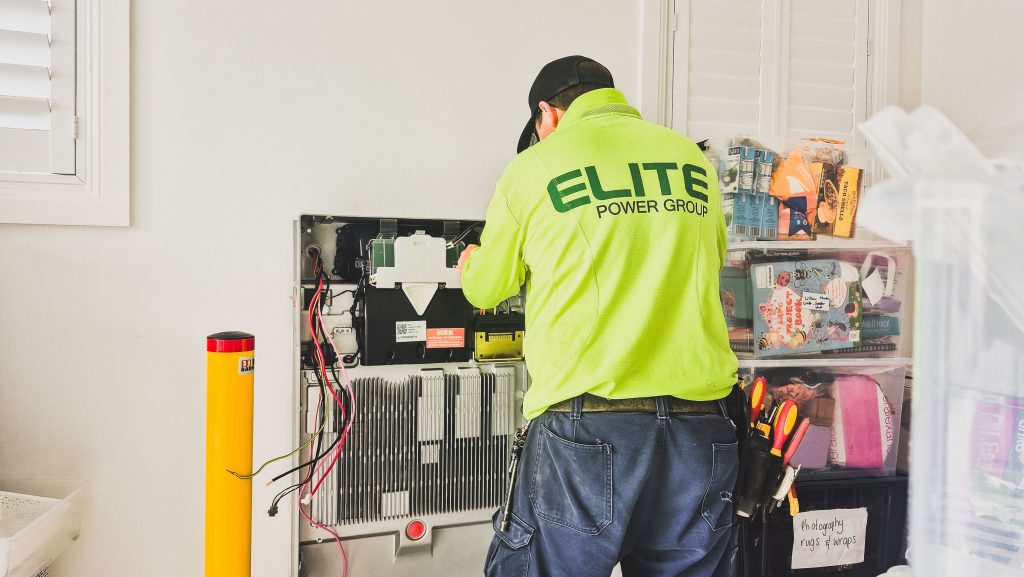
A safe installation may require sized cables, crimped lugs, fuses, breakers, disconnects, busbars, labels, a torque wrench, a multimeter, and protective gear.
This guide to essential solar panel installation and maintenance tools can help you organize the broader toolkit.
Keep high-current DC runs short, protect conductors from abrasion, and follow cable and torque specifications.
Grid-connected, hardwired, split-phase, and whole-home systems should be designed or reviewed by a qualified professional. Grounding, neutral bonding, permits, overcurrent protection, and utility requirements vary.
Safety and Maintenance Basics
A low-voltage battery bank may sound harmless, but it can deliver enormous current during a short circuit.
Before service, disconnect every source, verify voltage, cover exposed terminals, and follow the shutdown sequence. Use properly rated fuses or breakers.
Check regularly for loose connections, corrosion, damaged insulation, blocked vents, unusual heat, alarms, and changing fan behavior. Install supported safety updates.
Avoid mounting electronics directly above flooded batteries unless permitted. Corrosive gas and expensive power equipment make dreadful roommates.
Common Inverter Charger Mistakes
A common mistake is ignoring startup surge. Refrigerators, pumps, compressors, and tools can briefly draw several times their normal power.
Another error is pairing a large inverter with batteries or cables that cannot support its current demand.
Buyers also overlook cable size, charging settings, idle draw, transfer capacity, AC voltage, and maximum solar input on hybrid models.
Finally, “backup ready” does not mean every circuit stays powered. Confirm the protected loads and realistic battery runtime.
What Research Says About Inverter Chargers
System design affects how much solar energy you store and use. An NREL comparison of AC-coupled and DC-coupled solar battery systems found that DC-coupled designs may capture energy otherwise lost through inverter clipping. However, AC-coupled systems can be easier to add to an existing solar installation.
Reliability matters too. Sandia National Laboratories’ research into advanced inverter functions found only a very small estimated reduction in inverter lifespan from the smart grid-support functions studied.
The practical lesson is simple: choose equipment that fits your battery bank, system layout, expected loads, and installation environment.
Five Inverter Charger Products on Amazon US
Availability and specifications change, so check the current listing and manual before ordering.
Renogy 3000W Pure Sine Wave Inverter Charger
The Renogy 3000W Pure Sine Wave Inverter Charger combines 12V-to-120V conversion and charging.
Features: 3,000W continuous output, up to 9,000W surge, multiple battery profiles, and claimed efficiency above 90%.
Best for: RVs, cabins, and larger 12V backup systems requiring strong surge capacity.
AIMS Power 3000W 12V Pure Sine Inverter Charger
The AIMS Power 3000W 12V Pure Sine Inverter Charger is a low-frequency option for demanding loads.
Features: 3,000W continuous output, 9,000W surge for up to 20 seconds, automatic transfer, and a 100A charger.
Best for: Pumps, refrigerators, tools, RVs, and off-grid systems with motor-driven equipment.
Victron Energy MultiPlus-II 12/3000/120-50
The Victron Energy MultiPlus-II 12/3000/120-50 combines pure sine wave output, charging, and power management.
Features: 3,000VA-class output, 120A charging, 50A transfer capability, PowerAssist, and UL certification on the listed model.
Best for: Premium RV, marine, backup, and expandable systems where monitoring and integration matter.
SUNGOLDPOWER 3000W 24V All-in-One Solar Inverter
The SUNGOLDPOWER 3000W 24V All-in-One Solar Inverter combines inversion, solar charging, and AC charging.
Features: 3,000W output, an 80A MPPT controller, a 40A AC charger, and 120V pure sine wave output.
Best for: Cabins, workshops, and smaller 24V home systems suited to an all-in-one design.
Redodo 3000W Pure Sine Wave Inverter Charger
The Redodo 3000W Pure Sine Wave Inverter Charger targets 12V mobile, off-grid, and backup installations.
Features: 3,000W continuous output, up to 9,000W surge, remote control, and support for compatible lithium and other batteries.
Best for: RV owners, home backup users, and off-grid setups needing a straightforward 12V option.
Frequently Asked Questions About Inverter Chargers
Is it possible to use an inverter charger without solar panels?
Yes. It can run appliances from a battery and recharge it using utility, shore, or generator power. Solar panels are optional.
Does an inverter charger include an MPPT controller?
Not always. A standard unit usually contains an inverter and AC charger. A hybrid model may also include an MPPT solar charge controller.
What kind of inverter charger is required for a refrigerator?
Check running watts and startup surge. Then confirm the inverter, batteries, and cables can deliver the required current.
Can solar panels be directly connected to an inverter charger?
Only when it includes a compatible solar charge controller and the array stays within its voltage, current, and power limits. Otherwise, use a separate controller.
Is a 12V, 24V, or 48V inverter charger better?
A 12V system often suits smaller mobile setups. Higher-power systems may benefit from 24V or 48V because the higher voltage reduces DC current and can simplify cabling.
Choosing Your Inverter Charger With Confidence
A good inverter charger should fit your appliances, battery voltage, chemistry, charging sources, and future plans—not simply your maximum budget.
Begin with an honest load list, include startup demand, estimate battery runtime, and verify important specifications in the manuals.
When properly matched, the inverter charger becomes the quiet traffic controller of your solar system. It directs energy, keeps batteries ready, and helps your home, RV, boat, or cabin remain useful after sunset.
Careful planning now can prevent expensive upgrades, confusing faults, and disappointing battery performance during everyday use.
Take your time and seek qualified help for hardwired work. Thoughtful design makes a solar setup safer and more dependable.