How RV Solar Panels Work for Off-Grid Travel
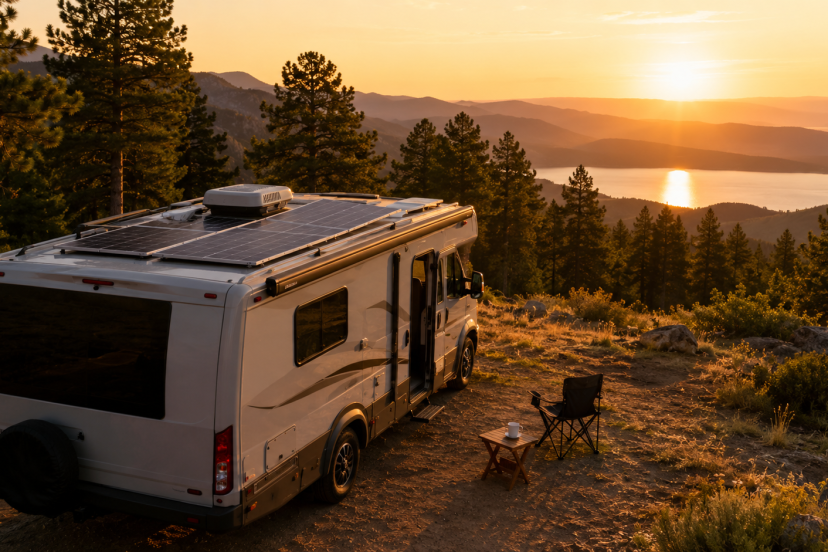
You know that uneasy moment when your RV battery starts dropping faster than you expected? Your phone is barely hanging on, the fridge is working hard, and suddenly that morning coffee feels like it depends on a small act of mercy. That is where an rv solar panel setup can make travel feel a lot less stressful.
Instead of relying only on campground hookups or a noisy generator, solar panels let your RV collect sunlight, store that power in batteries, and use it when you are parked away from the grid. It’s not magic. It is not flawless. But when it is sized and installed properly, it can give you more freedom, more quiet, and a better shot at enjoying the places you drove all that way to see.
In this guide, you will learn how RV solar panels work, what parts you need, how much solar power may be enough, what mistakes to avoid, and which Amazon products can help you build a practical setup.
What Is an RV Solar Panel?
An RV solar panel is a solar panel designed to collect sunlight and turn it into electricity for your camper, motorhome, travel trailer, van, or fifth wheel.
The simple idea is this: sunlight hits the panel, the panel creates electricity, and that electricity helps charge your RV batteries.
From there, your battery can power things like:
- Interior lights
- Phones and tablets
- Fans
- Small appliances
- Water pumps
- 12V refrigerators
- Laptops
- Other low-to-moderate power devices
Think of your RV solar panel system as a quiet helper on the roof. It does not ask for fuel. It does not rumble like a generator. It just sits there doing its job while you hike, cook, nap, or stare dramatically at a mountain like you are in a travel documentary.
How RV Solar Panels Turn Sunlight Into Power
RV solar panels use photovoltaic cells to turn sunlight into direct current electricity, also called DC power. Since RV batteries also store DC power, solar panels pair naturally with RV battery systems.
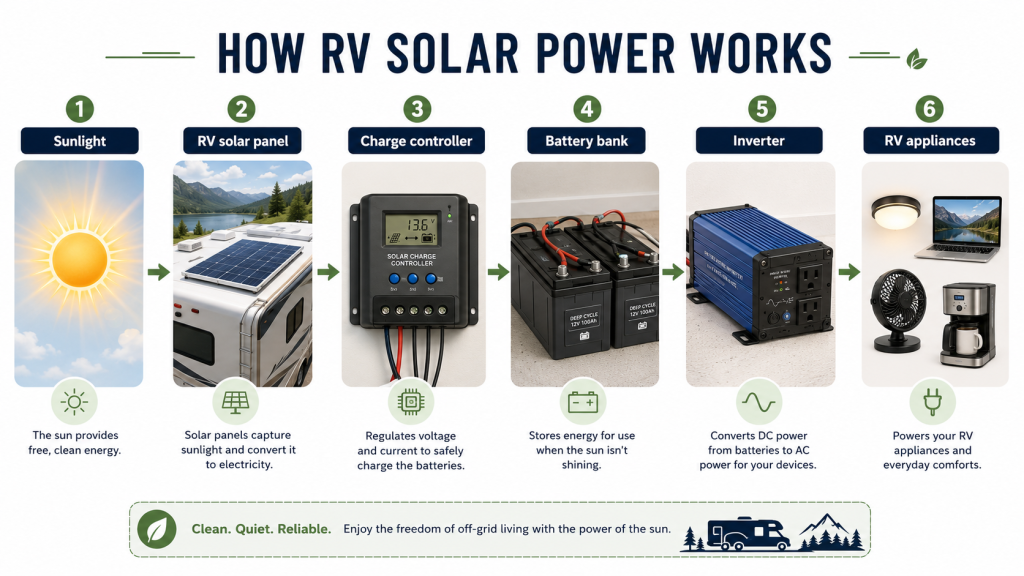
Here is the basic flow:
- Sunlight reaches the solar panel.
- The panel creates DC electricity.
- The battery’s power supply is controlled by the charge controller.
- The battery stores that energy.
- Your RV uses the stored power when needed.
That is the plain-English version. No engineering degree required.
Why the Solar Charge Controller Matters
A solar charge controller is one of the most important parts of your RV solar power system. It controls how much power flows from the panels into your battery.
Without it, your battery could receive too much power or charge unevenly. That can shorten battery life or damage your system.
There are two common types:
PWM Charge Controllers
PWM controllers are often found in budget-friendly RV solar kits. They work well for smaller, simple setups.
MPPT Charge Controllers
MPPT controllers usually cost more, but they are more efficient. They can be especially helpful in cooler weather, changing sunlight, or larger solar systems.
If your panels are the workers, the charge controller is the manager making sure nobody dumps a wheelbarrow of electricity in the wrong place.
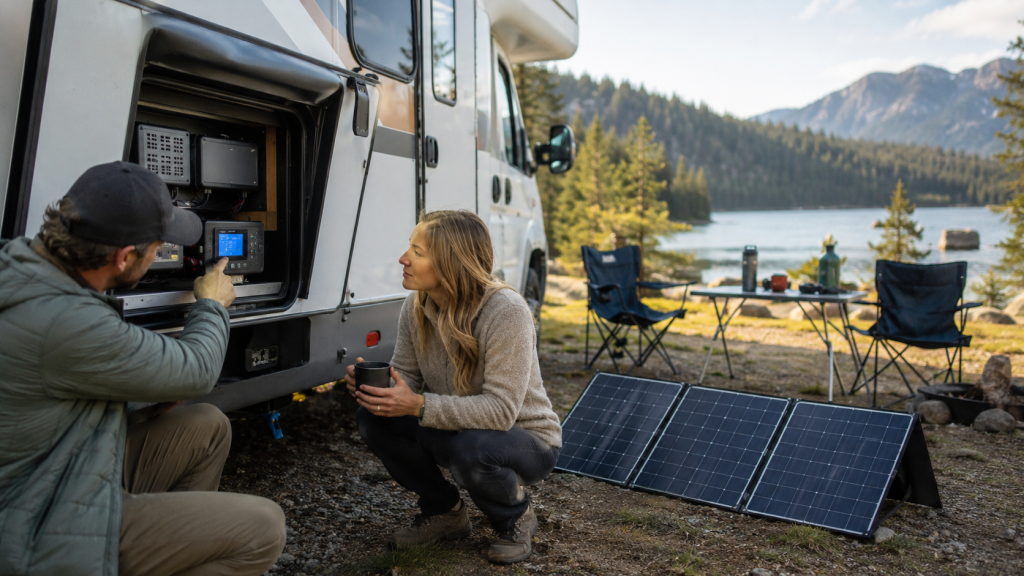
Main Parts of an RV Solar Power System
An off-grid solar system can sound complicated at first. But if you dissect it, it becomes lot simpler to comprehend.
A typical RV solar setup includes:
- Solar panels
- Charge controller
- Battery bank
- Inverter
- Wiring
- Fuses or breakers
- Mounting hardware
Each part has a job. When they work together, your RV can collect, store, and use solar energy more safely.
Batteries
Your battery bank stores the energy your panels collect. Without batteries, your solar panels would only be useful while the sun is shining.
The two most common battery types for RV solar systems are lead-acid and lithium.
Lead-Acid Batteries
Lead-acid batteries are less expensive initially. However, they are heavier and usually offer less usable capacity.
Lithium Batteries
Lithium batteries cost more at first, but they are lighter, charge faster, and often last longer. Many full-time RVers prefer lithium because it handles off-grid travel better.
A simple way to picture it: solar panels collect the groceries, but your batteries are the pantry. If the pantry is too small, you run out of food even if the store was open earlier.
Inverter
Your battery’s DC power is converted to AC power by an inverter. AC power is what many household-style devices use.
You may need an inverter for:
- Laptops
- Coffee makers
- Small kitchen appliances
- TVs
- Some chargers
- Household-style outlets
Not every device needs an inverter. Many RV items already run on DC power. Still, if you want a more home-like setup, an inverter becomes useful.
Wiring, Fuses, and Safety Gear
This is the part many beginners want to skip. Please do not.
Good wiring, proper fuses, breakers, and secure mounts protect your RV solar panel system from damage. They also help reduce safety risks.
Electrical work is not the place to “wing it and see what happens.” If you are not confident, bring in a qualified RV solar installer. There is no shame in keeping your camper from becoming a very expensive toaster.
RV Solar Panels: Fixed vs. Portable
There is a place for both stationary and mobile solar panels. The ideal option will depend on your mode of transportation.
Fixed RV Solar Panels
Fixed panels are installed on the roof of your RV. Once installed, they charge while you drive, park, or camp.
They are great if you want a setup that works without much daily effort.
Fixed panels are best for:
- Full-time RVers
- Frequent boondockers
- Larger battery banks
- Campers who want a low-maintenance setup
- People who do not want to set panels up every time they stop
The downside is that roof panels only work well when your RV is parked in good sunlight. If you park under trees, your solar output may drop.
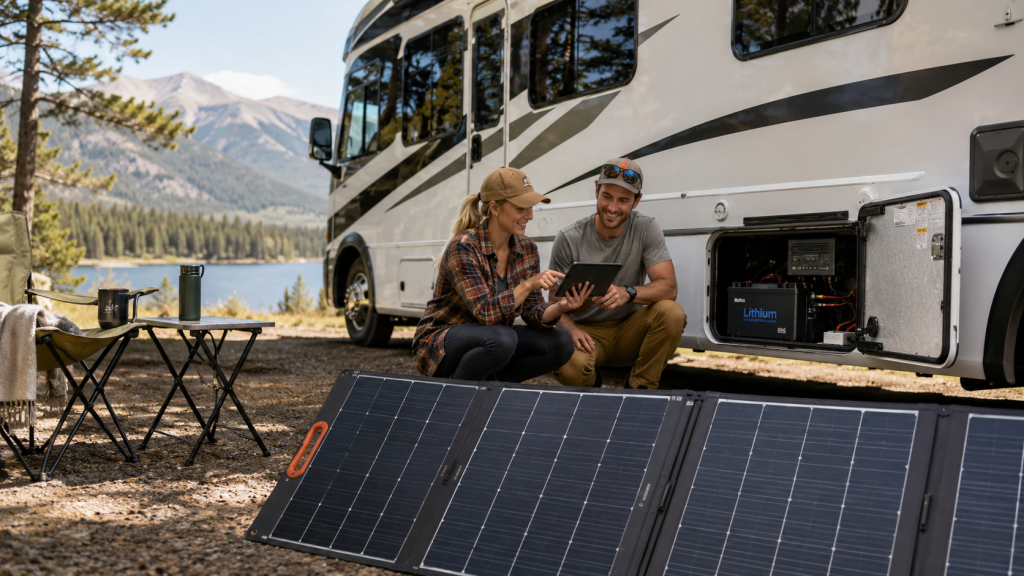
RV solar panels that are portable
Portable panels sit on the ground and can be moved throughout the day. This gives you more flexibility.
For example, you can park your RV in the shade while placing the panel in a sunny spot nearby. That is a huge win if you camp in warm places and do not want your RV baking in direct sun.
Portable panels are best for:
- Weekend campers
- Small trailers
- Van campers
- Beginners testing solar
- People who camp around trees
- Anyone who wants flexibility
The only catch is that you have to set them up, move them, and store them.
How to Choose the Right RV Solar Panel Setup
Do not start by buying the biggest kit you can find. Start with your actual camping habits.
If your dream trip is a quiet weekend with coffee, a book, and a few phone photos, you may not need a massive setup. But if your RV is also your office, kitchen, movie room, and weather shelter, you will need more power.
Look for:
- Enough wattage for your daily needs
- A compatible charge controller
- Battery compatibility
- Expansion options
- Strong mounting hardware
- Weather-resistant materials
- Clear installation instructions
- Good customer reviews
Also, measure your roof space before buying anything. Solar panels are not like throw pillows. You cannot just squeeze them in because they “look about right.”
Step-by-Step RV Solar Panel Installation Overview
Some RV solar kits are DIY-friendly, especially smaller systems. Still, electrical work deserves care.
Here is the basic installation process:
- Plan where the panels will go.
- Mount roof panels or prepare portable panels.
- Route the wiring safely.
- Connect the charging controller to the panels.
- Attach the battery to the charge controller.
- Add fuses or breakers.
- Test the system.
- Monitor charging performance.
Take your time with this part. A clean, safe install is always better than a rushed one.
Battery Storage: Where Your Solar Power Goes at Night
Solar panels collect energy during daylight. Batteries let you use that energy later.
That matters because many RV needs happen after sunset. You may need lights, fans, phone charging, a water pump, or a fridge running through the night.
Without enough battery storage, even a good solar panel setup can feel limited.
A strong battery bank gives your RV solar power system breathing room. It helps you handle cloudy weather, shady campsites, and nighttime use without constantly worrying about your battery percentage.
Smart Ways to Use Solar Energy While Camping
Solar power works best when your habits support your system.
Here are a few simple tips:
- Charge devices during peak sunlight.
- Use LED lights.
- Park with sunlight in mind.
- Clean dusty panels.
- Avoid running high-draw appliances too often.
- Use fans before relying on heavier cooling.
- Track your battery level daily.
Small habits can stretch your power farther. Even at home, simple solar upgrades can shift how you think about energy. For example, these solar walkway lights for outdoor spaces show how solar can add convenience, safety, and efficiency without making life complicated.
Recommended Amazon RV Solar Panel Products
Here are five Amazon products that fit different RV solar needs.
Renogy 200 Watts 12 Volts Monocrystalline RV Solar Panel Kit
This Renogy kit is a solid option for RV owners who want a roof-mounted starter system. It includes solar panels, a charge controller, and mounting hardware for RVs, campers, trailers, boats, and similar off-grid setups.
Features:
- 200W solar output
- Monocrystalline panels
- Charge controller included
- Mounting brackets included
- Designed for RV and off-grid use
Best for: RVers who want a reliable starter kit from a well-known solar brand.
ECO-WORTHY 200 Watts 12 Volt/24 Volt Solar Panel Kit
This ECO-WORTHY kit is a good pick for campers who want a budget-friendly off-grid solar setup. It supports 12V and 24V systems and works for RVs, caravans, campers, and small off-grid applications.
Features:
- 200W solar capacity
- Monocrystalline solar panels
- 30A PWM charge controller
- 12V and 24V compatibility
- Good for basic off-grid charging
Best for: Budget-minded RV owners who want a simple solar kit to get started.
Topsolar Solar Panel Kit 100 Watt 12 Volt Monocrystalline
This 100W Topsolar kit is better for smaller setups. It can help charge 12V batteries and includes useful starter parts like cables, mounting brackets, and a charge controller.
Features:
- 100W solar panel
- 12V battery charging
- Charge controller included
- Cables and Z brackets included
- Compact size
Best for: Beginners, weekend campers, and light power users.
Go Power Overlander Charging Kit 200W
The Go Power Overlander kit is built for RV owners who may want to expand later. It comes with a 30-amp Bluetooth PWM controller and a 200W solar module.
Features:
- 200W solar module
- Bluetooth PWM controller with 30 amps
- Expandable up to 600W
- Designed for RV solar charging
- Good upgrade path
Best for: RV owners who want a system they can grow over time.
HQST 100W 12V Monocrystalline Solar Panel
This HQST panel is a practical option for DIY campers. It works for RVs, boats, caravans, and other small off-grid battery charging setups.
Features:
- 100W output
- Monocrystalline design
- Compact panel size
- Good for 12V battery charging
- Works for DIY solar builds
Best for: Van campers and DIY RVers building a small or expandable solar setup.
Research-Backed Reasons Solar Energy Matters
Solar power is not just useful for quiet RV camping. It also has real environmental value. A 2024 Lawrence Berkeley National Laboratory report found that U.S. wind and solar generation delivered $249 billion in climate and air-quality health benefits from 2019 to 2022. It also helped prevent 1,200 to 1,600 premature deaths in 2022 by reducing pollution. Read more from the clean-energy research behind healthier air.
For RV owners, that makes an rv solar panel more than a convenience. It can reduce generator use, lower fuel dependence, and make off-grid travel cleaner and quieter.
The U.S. Department of Energy also highlights the public health benefits of solar and wind in its report on why clean electricity quietly saves lives.
Common RV Solar Panel Mistakes to Avoid
Solar is helpful, but it is not a cure-all. A few simple mistakes can make a good system underperform.
Avoid these common problems:
- Buying panels before calculating power needs
- Ignoring shade
- Using wires that are too small
- Skipping fuses or breakers
- Choosing the wrong charge controller
- Forgetting about battery capacity
- Mounting panels where roof vents cast shadows
- Expecting full rated wattage all day
A 200W panel will not produce 200 watts every minute from sunrise to sunset. Heat, clouds, shade, panel angle, dirt, and time of day all affect output.
That does not mean solar is unreliable. It just means your setup needs realistic expectations.
FAQs About RV Solar Panels
How many RV solar panels do I need for off-grid camping?
Most light campers can start with 100W to 200W of solar. Full-time RVers, remote workers, or campers using a fridge and multiple devices may need 400W to 800W or more.
Can an air conditioner be powered by an RV solar panel?
Typically, an air conditioner cannot be powered by a single RV solar panel. RV air conditioners use a lot of power. You would need a large solar array, a strong battery bank, and a capable inverter.
Is a portable solar panel better than a roof-mounted RV solar panel?
Portable panels are better for flexibility, especially if you camp in shaded areas. Roof-mounted panels are better for convenience because they charge without daily setup. Many RVers use both.
Do RV solar panels work on cloudy days?
Yes, RV solar panels can still work on cloudy days, but they produce less power. This is why battery storage is important for nighttime use and poor weather.
What size battery do I need for an RV solar kit?
It depends on your daily power use. A small weekend setup may only need one deep cycle battery, while larger off-grid systems often use multiple lithium batteries.