How To Install Solar Walkway Lights

You know that slightly awkward moment when guests arrive after sunset and your walkway looks like a mystery trail in a low-budget adventure movie? That is exactly where Solar Walkway Lights shine—literally and emotionally. They make your path safer, your yard warmer, and your home feel more welcoming without calling an electrician or digging trenches through your flower beds.
In this guide, you’ll learn how to choose, place, install, maintain, and troubleshoot solar path lights so your walkway glows beautifully at night. We’ll also look at Amazon product ideas and a little research-backed solar wisdom, because yes, those small lights are using real photovoltaic magic.
Why Solar Walkway Lights Make Your Home Feel More Welcoming
Solar Walkway Lights do more than brighten a path. They create a tiny “come on in” moment before anyone reaches your front door.
A dark walkway can feel cold, unsafe, or unfinished. Add a few outdoor solar lights, though, and suddenly your yard feels planned. Not fancy in a stiff way—just cared for.
They are especially helpful if you have:
- A front walkway
- Garden paths
- A driveway edge
- Patio steps
- Backyard seating areas
- Side-yard paths
- Rental-friendly landscaping needs
The beauty is that solar pathway lights do not need outdoor wiring. During the day, they charge, and at night, they turn on. So, instead of running extension cords like a backyard spiderweb, you simply stake them into the ground and let the sun do its quiet little job.
How Solar-Powered Walkway Lighting Works
Solar garden lights use a small solar panel, rechargeable battery, LED bulb, and light sensor. During the day, the panel collects sunlight and stores energy in the battery. At dusk, the sensor tells the light to turn on.
Think of each light as a tiny squirrel storing acorns for nighttime. Except the acorns are sunlight, and the squirrel has a weatherproof stake.
Most solar landscape lighting works best when the panel gets direct sunlight for several hours. Shade, cloudy weather, dirt on the panel, or poor placement can reduce brightness and runtime.
Before You Start: Check Sunlight, Shade, and Soil
Before installing anything, walk your path in the morning, afternoon, and early evening. Notice where the sun hits and where shadows linger.
Solar Walkway Lights need sunlight more than they need perfect symmetry. A perfectly spaced row under a giant shade tree may look nice at noon, then disappoint you at night.
Ask yourself:
- Does this area get 6–8 hours of sunlight?
- Will shrubs block the solar panel?
- Does rainwater collect here?
- Is the ground soft enough for stakes?
- Will the lights get bumped by lawn equipment?
If your walkway has mixed sun and shade, place the brightest lights in the darkest or busiest areas, such as steps, turns, and entry points.

Choose the Best Solar Path Lights for Your Yard
Not all LED walkway lights are designed for the same job. Some are decorative. Some are brighter. Some are smart lights with motion detection.
Here is a simple way to choose:
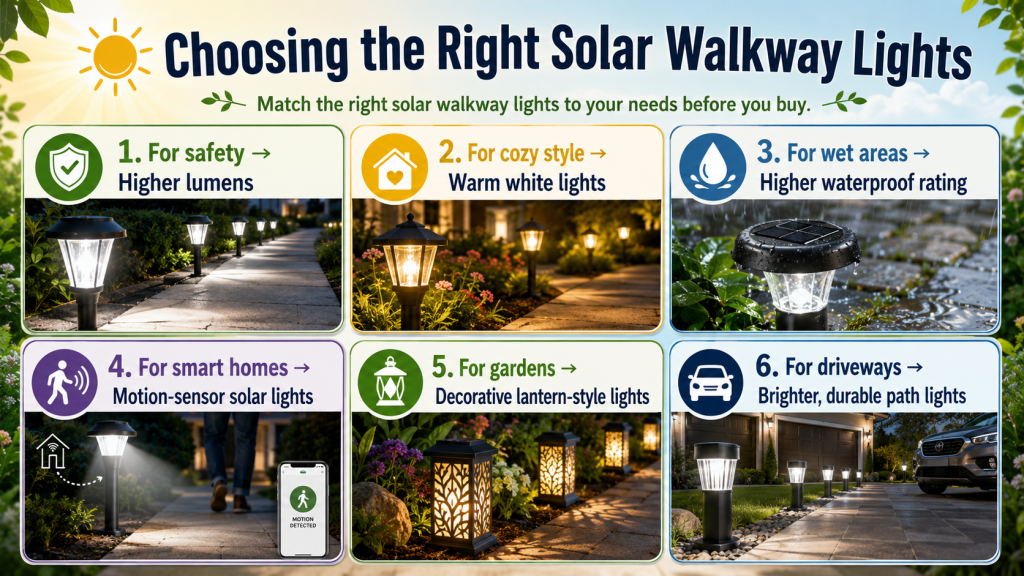
- For soft ambiance: choose warm white solar path lights.
- For safety: choose brighter solar pathway lights with higher lumens.
- For rainy climates: choose waterproof solar lights with higher IP ratings.
- For modern homes: choose black or stainless steel designs.
- For gardens: choose lantern-style or patterned garden path lights.
- For smart homes: choose app-controlled or motion-sensor lights.
Warm white usually feels cozy and welcoming. Cool white can look sharper and more modern, but it may feel harsh in a soft garden setting.
Tools and Supplies You’ll Need
The nice thing about Solar Walkway Lights is that installation is beginner-friendly. You probably will not need a toolbox that looks like it belongs to a contractor named Big Mike.
You may need:
- Solar walkway light set
- Tape measure
- Garden trowel
- Rubber mallet
- Small level
- Gloves
- Bucket of water for hard soil
- Soft cloth for cleaning panels
Avoid hammering directly on the light head or solar panel. If the ground is stubborn, loosen it first with a trowel or water.
Step-by-Step: How To Install Solar Walkway Lights
Installing solar yard lights is simple, but a little planning makes the final look much better.
1. Lay the lights out first
Place each light on the ground before staking it. Step back. Look from the sidewalk, driveway, and front door.
This “dry layout” helps you avoid the classic mistake of installing everything, then realizing the row looks like it had one too many cups of coffee.
2. Space them evenly
Most walkways look good with lights spaced about 6–8 feet apart. Use closer spacing for darker areas, curves, or steps.
3. Turn the lights on before installation
Many solar lights have a small switch under the cap. Turn it on before you stake it into the ground. Then cover the panel with your hand to test whether the light activates.
4. Push stakes gently into the soil
If the ground is soft, push the stake straight down. If it is hard, make a pilot hole with a trowel first.
5. Angle panels toward sunlight
Some designs allow slight adjustment. Make sure the solar panel is not hidden by mulch, plants, railings, or porch shadows.
6. Let them charge fully
Give the lights a full sunny day before judging brightness. Many new lights need a proper first charge before they perform well.

How far apart are solar walkway lights supposed to be?
For most homes, spacing Solar Walkway Lights 6–8 feet apart creates a balanced glow. If your lights are very bright, you can space them farther apart. If they are decorative and low-lumen, move them closer.
For curved paths, place lights along the outside edge of the curve. This helps guide the eye naturally and makes the path easier to follow.
A helpful rule: light the decision points first.
That means:
- Steps
- Turns
- Doorways
- Path intersections
- Uneven ground
- Driveway edges
Once those areas are covered, fill in the rest for style.
Best Places to Use Outdoor Solar Path Lights
Solar Walkway Lights are not just for front sidewalks. You can use them anywhere you want gentle guidance after dark.
Great spots include:
- Front entry paths
- Backyard garden trails
- Around raised beds
- Poolside walkways
- Patio edges
- Driveway borders
- Side gates
- Around a mailbox
- Along gravel paths
- Near outdoor seating areas
For a warm, lived-in feel, avoid making your yard look like an airport runway. A softer staggered layout often feels more natural than two perfectly rigid rows.
Common Installation Mistakes to Avoid
Even easy projects have sneaky little traps. Here are the ones to skip.
- Putting lights too close together: This can look cluttered and overly bright.
- Installing in shade: The lights may charge poorly.
- Ignoring water flow: Standing water can shorten product life.
- Forgetting the on/off switch: Yes, it happens. No shame.
- Using only decorative lights for safety: Pretty lights may not be bright enough for steps.
- Blocking panels with plants: Trim around the solar panel as greenery grows.
- Judging them after one cloudy day: Solar lighting changes with weather and season.
If your first layout looks off, adjust it. Landscape lighting is more like arranging furniture than doing math homework.
Best Solar Walkway Lights to Consider
1. GIGALUMI Solar Outdoor Lights, 12 Pack LED Solar Lights Outdoor Waterproof
Short description: A budget-friendly 12-pack for basic walkway, garden, patio, and driveway lighting.
Features:
- 12-pack LED solar lights
- Waterproof outdoor design
- Auto on/off operation
- Designed for garden, path, yard, patio, and driveway use
- Listed with up to 10 hours of lighting on Amazon
Use case: Best for homeowners who want affordable solar pathway lights for a longer walkway or larger yard.
2. BEAU JARDIN 8 Pack Solar Pathway Lights Outdoor Stainless Steel Waterproof Glass
Short description: A more decorative option with glass shades and stainless steel styling.
Features:
- 8-pack solar pathway lights
- Glass light shade
- Stainless steel look
- Auto sensor operation
- Designed for gardens, lawns, backyards, and walkways
Use case: Best for front paths, garden borders, and homes where curb appeal matters as much as function.
3. LETMY Solar Pathway Lights Outdoor, 8 Pack Bright Solar Lights Outdoor
Short description: A bright solar path light option for outdoor landscape and driveway use.
Features:
- 8-pack pathway lights
- IP66 waterproof listing
- Warm white lighting option
- Wireless outdoor design
- Suitable for walkway, driveway, and landscape lighting
Use case: Best for people who want brighter waterproof solar lights for everyday path visibility.
4. Ring Solar Pathlight — Outdoor Motion-Sensor Security Light
Short description: A smart solar-powered pathlight with motion activation.
Features:
- Solar-powered pathlight
- 80 lumens when motion is detected
- Works with Ring smart lighting
- Can sync with select Ring devices and Alexa-enabled devices
- Designed for walkways and outdoor areas
Use case: Best for smart-home users who want solar walkway lighting plus motion-based security near entrances, gates, or driveways.
5. MAGGIFT 12 Pack Solar Pathway Lights Outdoor Waterproof
Short description: A warm white solar path light set with simple stake installation.
Features:
- 12-pack solar pathway lights
- Warm white glow
- IP44 waterproof/weatherproof listing
- Auto on at night and off at dawn
- No wiring required
Use case: Best for cozy garden path lights, casual backyard paths, and homeowners who want simple decorative lighting.
Research-Backed Reasons Solar Lighting Is a Smart Upgrade
The U.S. Department of Energy explains that outdoor solar lighting uses solar cells to convert sunlight into electricity, stores that electricity in batteries, and can be easy to install and nearly maintenance-free. That makes solar path lights especially practical for walkways where grid wiring would be expensive or annoying to add. You can read more in the DOE’s guide to outdoor solar lighting.
Solar walkway lights rely on photovoltaic technology—the same basic idea behind larger solar panels. The U.S. Energy Information Administration explains that photovoltaic cells convert sunlight directly into electricity, while the Department of Energy notes that individual PV cells are usually small and often produce about 1 or 2 watts of power. For a deeper beginner-friendly explanation, this guide on how photovoltaic panels work is a helpful next read.
How To Maintain Solar Garden Lights
Solar Walkway Lights are low-maintenance, not no-maintenance. A little care keeps them brighter for longer.
Try this simple monthly routine:
- Wipe solar panels with a soft damp cloth.
- Clear mulch, leaves, and grass around each light.
- Check that the stake is straight.
- Replace rechargeable batteries when runtime drops.
- Move lights if seasonal shade changes.
- Remove snow or heavy debris after storms.
If you live near dust, pollen, salty air, or heavy tree cover, clean the panels more often. A dirty solar panel is like trying to charge your phone through a sweater.
Troubleshooting Dim or Flickering Solar Landscape Lights
If your solar landscape lighting looks weak, do not panic. Most problems are easy to fix.
The lights are dim
They may not be getting enough sun. Move them to a brighter spot and clean the panel.
The lights turn off too early
The rechargeable battery may be old or undercharged. Let the light charge for a full sunny day, then test again.
One light does not work
Check the switch, battery tab, battery position, and panel cover. New lights sometimes ship with protective tabs.
The lights flicker
Moisture, weak batteries, or loose connections may cause flickering. Dry the light, inspect the battery compartment, and replace the battery if needed.
The lights are uneven
That usually means different sunlight exposure. Swap dim lights with brighter-positioned lights to see whether the issue is the product or the placement.
FAQs About Solar Walkway Lights
How much time do solar walkway lights last at night?
Most Solar Walkway Lights last around 6–10 hours after a full day of charging. Runtime depends on sunlight, battery quality, weather, panel size, and brightness level.
Do solar pathway lights work in winter?
Yes, solar pathway lights can work in winter, but shorter days, snow, clouds, and lower sun angles may reduce charging. Keep panels clean and place them where they get maximum daylight.
How many lumens do I need for walkway lighting?
For soft decorative lighting, 5–20 lumens may be enough. For safer path visibility, look for brighter lights around 30–80 lumens, especially near steps or entryways.
Can Solar Walkway Lights stay outside in the rain?
Many outdoor solar lights are weather-resistant, but check the IP rating. Higher waterproof ratings usually handle rain better. Avoid placing lights where water pools.
Should solar walkway lights be warm white or cool white?
Warm white feels cozy and natural for gardens and front paths. Cool white looks brighter and more modern. For most homes, warm white creates a softer, more welcoming glow.