Top 10 RV solar panel kits
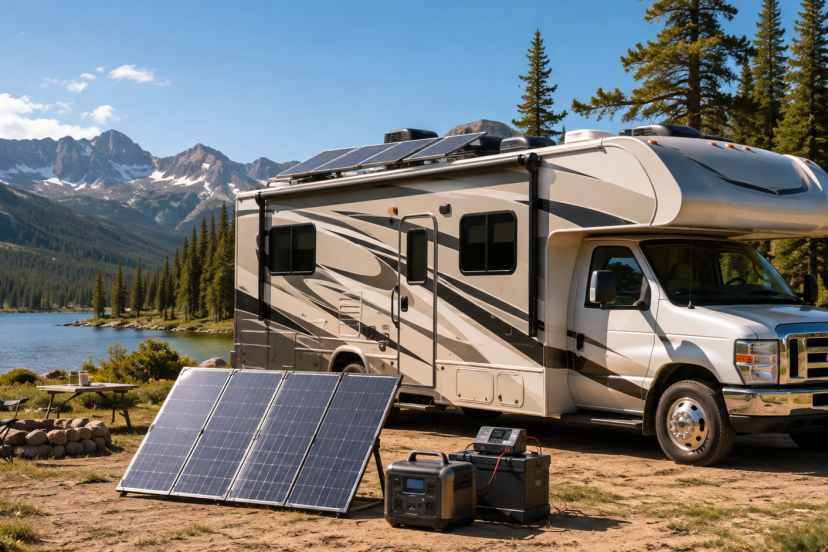
RV solar panel kits combine panels, a charge controller, wiring, and mounting hardware to recharge an RV battery bank from sunlight. They suit weekend campers, van travelers, boondockers, and full-time RV owners who want independent power for lights, fans, electronics, pumps, and efficient refrigerators. Choosing the right kit matters because roof space, battery chemistry and daily energy use vary. We compared verified components, installation, portability, expansion, compatibility, warranties, and value rather than relying only on ratings or headline wattage. Real-world fit mattered throughout our comparisons.
| Product | Best for | Key feature | Main limitation | Price category | Overall recommendation |
| Renogy 200W Starter Kit | Most owners | Balanced package | PWM controller | Mid-range | Best overall |
| ECO-WORTHY 200W Kit | Budgets | 12V/24V support | Basic controller | Budget | Strong value |
| Renogy 400W RV Kit | Large systems | 400W capacity | Needs roof space | Premium | Best premium |
| Topsolar 100W Kit | Beginners | Simple setup | Limited output | Budget | Easy first kit |
| Newpowa Portable Kit | Portable charging | MPPT controller | Needs storage | Mid-range | Best portable |
| Go Power Overlander | Prewired RVs | Bluetooth controller | Higher cost | Premium | Integrated choice |
| WindyNation 100W Kit | All-in-one buyers | Battery and inverter | Heavy bundle | Premium | Broad package |
| ACOPOWER Portable Kit | Battery flexibility | Waterproof controller | Bulky suitcase | Mid-range | Versatile pick |
| Newpowa Bifacial Kit | Reflective sites | Bifacial panels | Variable rear gain | Mid-range | Specialized kit |
| DOKIO 110W Kit | Small storage | Lightweight panel | Modest output | Budget | Compact backup |
1. Renogy 200 Watt 12 Volt Monocrystalline Starter Kit — Best for Overall RV Use
Overview: This fixed-roof starter kit pairs two 100W monocrystalline panels with a 30A Wanderer PWM controller, cables, branch connectors, and mounting brackets. It offers enough capacity for RV battery charging without needing a 400W array.
Key Features: 200W rated panel capacity; 30A PWM controller; support for common battery profiles; included mounting and connection hardware.
Pros: Balanced output, good documentation and straightforward expansion.
Cons: PWM captures less energy than a comparable MPPT controller, and Bluetooth monitoring requires an optional module.
Best For: Weekend campers and moderate users building their first permanent system.
Verdict: Its component mix, documentation, and upgrade path make it the strongest choice.

2. ECO-WORTHY 200W 12V/24V Solar Panel Kit — Best for Budget Buyers
Overview: ECO-WORTHY combines two 100W monocrystalline panels, a 30A PWM controller, Z brackets, solar cables, tray cable, and branch connectors. The panels can be arranged for 12V or 24V battery systems, giving budget-minded owners useful flexibility.
Key Features: 200W total capacity; 12V or 24V wiring options; predrilled frames; included 30A controller and mounting hardware.
Pros: Competitive bundle, off-grid compatibility, and included wiring for installation.
Cons: The PWM controller is simple, and buyers should inspect packages immediately for shipping damage.
Best For: Occasional RVers who want affordable fixed solar without sourcing every small component separately.
Verdict: It earns the budget award by covering the essentials with room for later upgrades.

3. Renogy 400 Watts 12 Volts Monocrystalline Solar RV Kit — Best for Premium Fixed Systems
Overview: This four-panel RV package supplies 400W of rated solar capacity and uses a flush-mount Adventurer 30A PWM controller. It is designed for owners with more roof room and higher charging needs than a smaller system supports.
Key Features: Four 100W monocrystalline panels; 30A negative-ground controller; LCD monitoring; cables, brackets, connectors, and cable entry.
Pros: Substantial rooftop capacity, clean controller installation, and a complete hardware package.
Cons: Four panels require roof planning, and a premium MPPT controller would extract more from changing conditions.
Best For: Longer boondocking trips, larger battery banks, and RVs running several moderate DC loads.
Verdict: It provides the strongest fixed-array capacity here without moving into a complicated residential-scale system.

4. Topsolar 100 Watt 12 Volt Monocrystalline Kit — Best for Beginners
Overview: Topsolar’s compact kit includes one 100W monocrystalline panel, a 30A 12V/24V PWM controller, solar cable, and Z brackets. Its smaller scale makes the wiring easier to understand and the roof placement less intimidating for a first installation.
Key Features: 100W panel; LCD PWM controller; mounting brackets; long connection cable; compatibility with basic off-grid battery charging.
Pros: Low entry cost, manageable panel size, and few components.
Cons: One panel offers limited recovery after cloudy weather or heavy overnight use, so expansion may become necessary.
Best For: Weekend trailers, battery maintenance, lights, phone charging, and owners learning solar fundamentals.
Verdict: This is the most approachable permanent kit for light loads when expectations remain realistic.

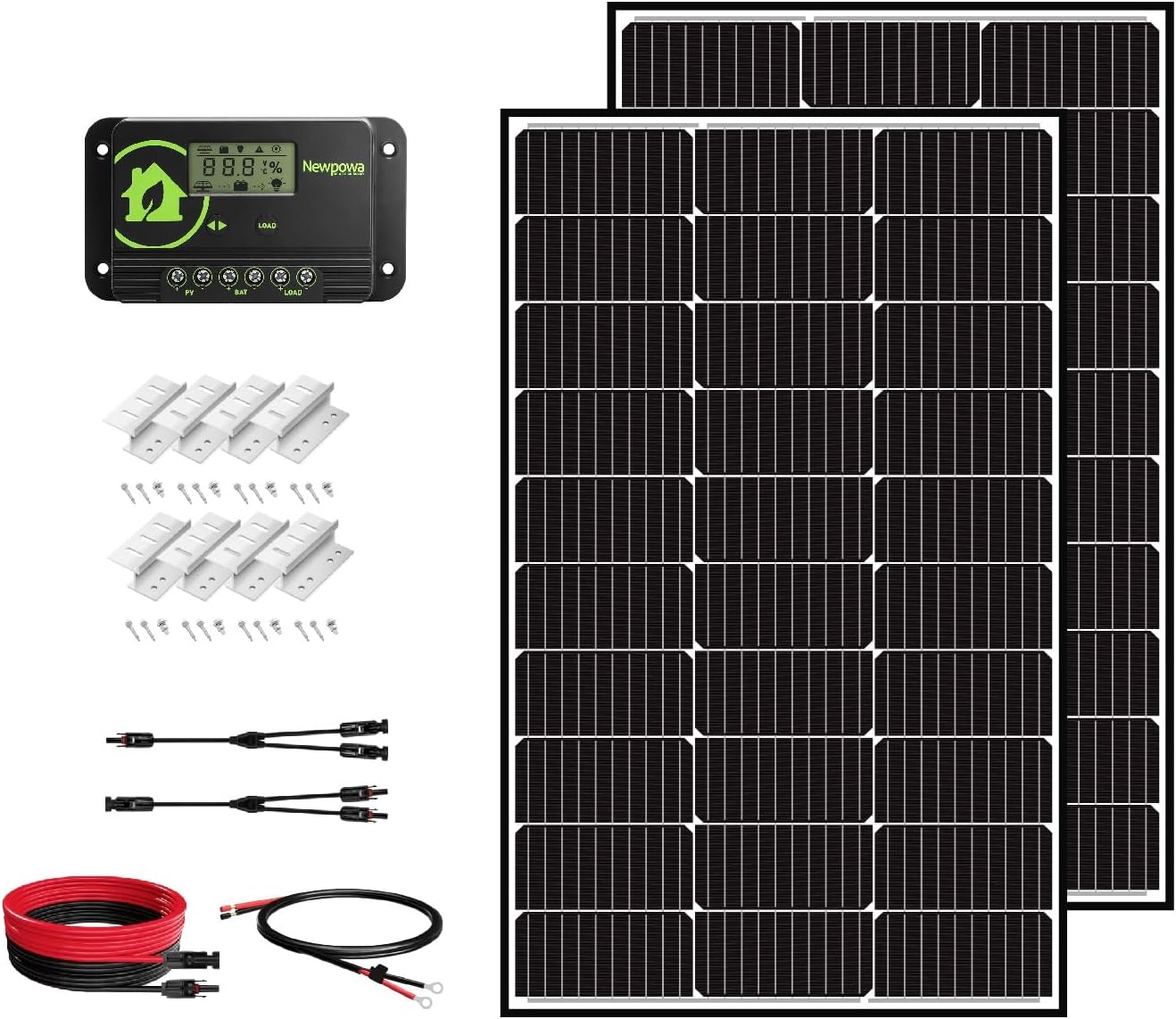
5. Newpowa 200W Portable Solar Panel Kit — Best for Portable Charging
Overview: Newpowa’s folding 200W kit uses two hinged 100W panels and includes a 20A MPPT controller, a long extension cable, ring terminals, and battery clamps. You can park the RV in shade while positioning the panels in sunlight.
Key Features: 200W folding array; Bluetooth-capable MPPT controller; adjustable placement; battery-clamp and ring-terminal options.
Pros: Better solar positioning than roof-only panels, efficient MPPT charging, and no permanent roof penetration.
Cons: The folded unit still needs protected storage, and it must be deployed and stored.
Best For: Renters, shaded campsites, seasonal travelers, and owners unwilling to drill the roof.
Verdict: Strong output, flexible placement, and MPPT control make it the best portable battery-charging kit in this roundup.

6. Go Power! Overlander 200W Solar Kit — Best for Prewired RV Integration
Overview: The Overlander is a purpose-built RV charging package with one 200W monocrystalline module, a flush-mount 30A Bluetooth PWM controller, cables and mounting hardware. It is appealing when an RV already uses Go Power’s Wired for Solar infrastructure.
Key Features: 200W single-panel design; 30A digital controller; Bluetooth monitoring; expansion support; RV-focused cabling and mounting.
Pros: Clean installation, app monitoring, one roof module, and RV-focused documentation.
Cons: It costs more than many generic 200W kits, and the long panel may not fit around crowded roof equipment.
Best For: Newer prewired RVs and owners prioritizing integration over price.
Verdict: Its polished hardware and RV-specific layout justify the premium for compatible vehicles.

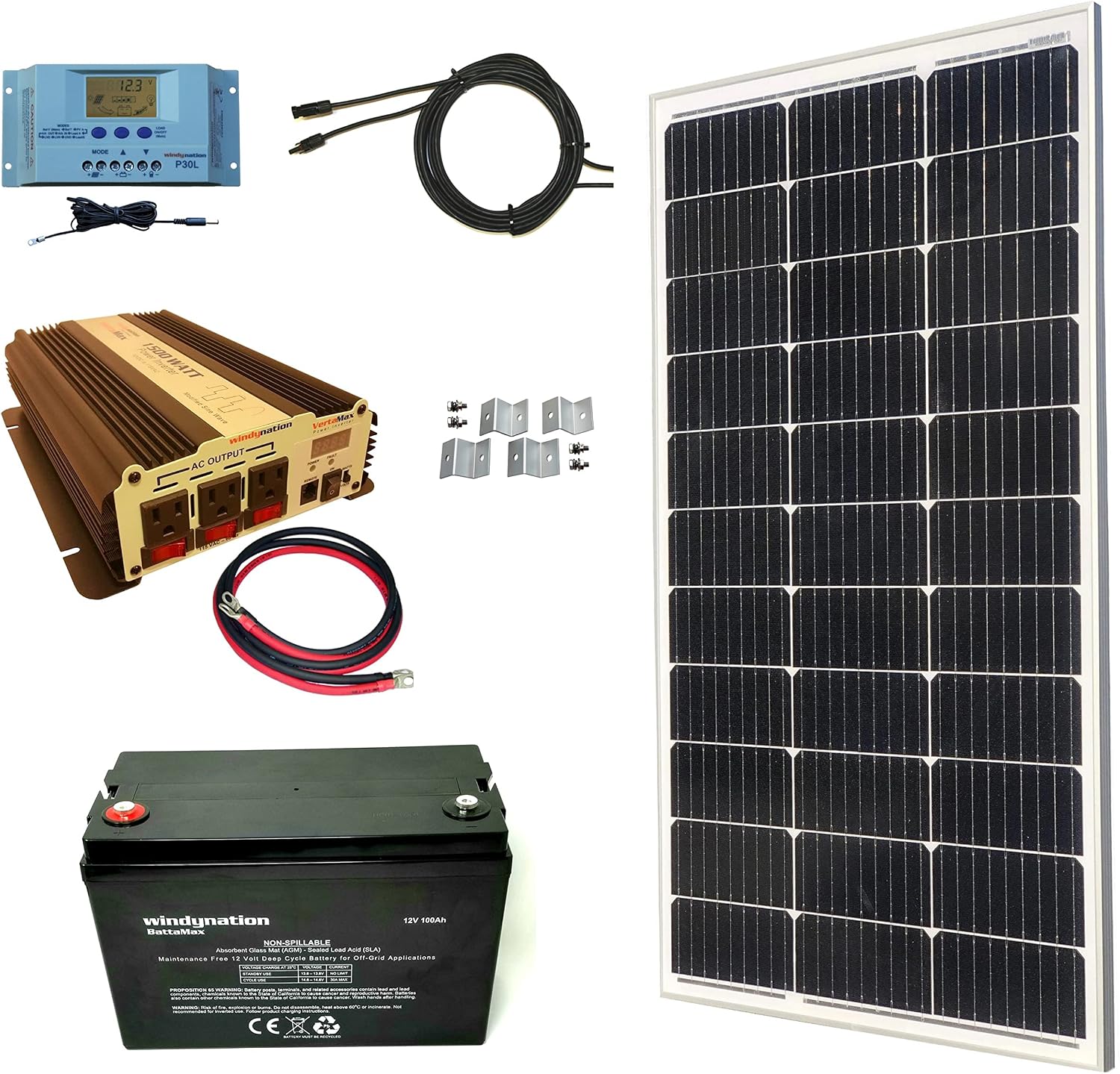
7. WindyNation 100W Kit with Inverter and 100Ah AGM Battery — Best for an All-in-One Package
Overview: This WindyNation configuration adds a 1500W inverter and 100Ah AGM battery to its 100W monocrystalline panel, 30A controller, cable, and hardware. Unlike panel-and-controller kits, it supplies storage and AC conversion components in one purchase.
Key Features: 100W panel; P30L LCD controller with temperature sensor; 100Ah AGM battery; 1500W inverter; extensive solar cable.
Pros: Reduces component shopping, provides AC capability, and gives beginners a matched starting package.
Cons: The AGM battery and inverter add weight, while 100W solar recharges slowly after heavy AC use.
Best For: Buyers starting without a battery, inverter, or existing solar equipment.
Verdict: It is the broadest bundle here, but users must keep appliance expectations aligned with its modest panel capacity.
8. ACOPOWER 200W Portable Solar Panel Kit — Best for Battery-Type Flexibility
Overview: ACOPOWER’s suitcase-style kit combines four 50W monocrystalline sections, a 20A waterproof controller, stands, connectors, clips, and a protective carrying design. Its controller supports several battery profiles for owners who may change chemistry.
Key Features: 200W folding array; waterproof controller; adjustable stands; quick battery connection; rugged aluminum case hardware.
Pros: Broad battery compatibility, quick field setup, and no roof drilling.
Cons: The suitcase is heavier and bulkier than fabric-backed foldable panels, and repeated setup requires accessible storage.
Best For: Multi-vehicle households, boats and RVs sharing one kit, or travelers testing solar before installation.
Verdict: Its battery flexibility and durable portable construction make it a specialist choice despite the storage penalty.

9. Newpowa 200W Bifacial Monocrystalline Starter Kit — Best for Reflective Campsites
Overview: This fixed kit uses two 100W bifacial panels, a 20A PWM controller, cable, branch connectors, and Z brackets. Bifacial cells can collect some light from the rear when mounted above a bright or reflective surface with adequate clearance.
Key Features: 200W front-rated capacity; bifacial panel design; parallel wiring accessories; 20A controller; complete mounting basics.
Pros: Potential rear-side contribution, rigid-panel durability, and a beginner-friendly parts package.
Cons: Rear-side gains depend heavily on mounting height, surface reflectivity, and shading; flush roof mounting limits the benefit.
Best For: Raised racks, light roofs, snow, and clearance-friendly DIY installations.
Verdict: It offers a meaningful design difference for owners who can create the spacing needed to use bifacial construction effectively.
10. DOKIO 110W 18V Foldable Solar Panel Kit — Best for Compact Storage
Overview: The DOKIO folds into a thin, lightweight package and includes a controller, cables, adapters, clips, USB outputs, and a storage bag. It can charge compatible 12V batteries or connect to supported portable power stations, making it useful as backup power.
Key Features: 110W monocrystalline panel; foldable fabric-backed format; multiple connector options; controller with USB outputs; low carrying weight.
Pros: Easy to store, quick to deploy, and inexpensive compared with heavier framed suitcases.
Cons: Limited wattage and less rigid protection demand especially careful handling.
Best For: Small trailers, emergency charging, tent campers, and RVers with almost no spare storage.
Verdict: It is the most space-conscious option, although serious boondockers will want more generation capacity.

How to Choose the Best RV Solar Panel Kits
Estimate daily watt-hours, then choose enough panel capacity to replace them under realistic sunlight. A 100W kit can maintain batteries and cover light electronics, while 200W suits moderate DC use. Larger 400W arrays better support longer stays, bigger batteries, and cloudy recovery, but they require more roof area.
Before choosing wattage, review how RV solar panels work for off-grid travel so you can match the kit to your battery bank and daily loads.
Check controller type and capacity. PWM controllers are affordable and work well in straightforward systems. MPPT controllers generally make better use of available panel voltage, especially in cool weather, partial sun, or long cable runs. Confirm the controller supports your battery chemistry and has enough current headroom for planned expansion.
Measure usable roof space around vents, antennas, air conditioners, and walking areas. Portable panels avoid roof drilling and can chase sunlight, but they consume storage space and require setup. Fixed panels charge whenever sunlight is available and are harder to steal, yet roof sealing and cable routing must be done carefully.
Review every included component. Many kits omit batteries, inverters, fuses, disconnects, sealant, or specialty adapters. Use correctly sized wire and overcurrent protection, follow connection order, and secure panels for highway vibration and wind. Finally, compare warranty terms and support, because coverage can differ among panels, controllers, and accessories.
Frequently Asked Questions About RV Solar Panel Kits
How many watts do I need for an RV?
Light weekend use may need 100W to 200W, while longer off-grid stays often benefit from 300W to 600W or more. Calculate daily watt-hours and battery capacity instead of choosing by RV length alone.
Will an RV solar kit run an air conditioner?
Panels do not directly run most RV air conditioners reliably. You need a large battery bank, strong inverter, substantial array, and careful planning. Many standard kits are intended mainly for battery charging and smaller loads.
Can I connect a kit to lithium batteries?
Only when the charge controller includes the correct lithium charging profile and voltage settings. Confirm compatibility with both the controller and battery manufacturer before connecting anything.
Are portable or roof-mounted panels better?
Roof panels are convenient and always available. Portable panels can be aimed toward the sun and moved away from shade. The better choice depends on storage, security, roof space, and camping habits.
Do RV solar panel kits include everything?
Usually not. Many exclude the battery, inverter, fuses, disconnects, sealant, roof-entry parts, or adapters. Check package contents and the manual before ordering hardware.
Final Verdict
The Renogy 200W Starter Kit is the best overall choice because it balances output, hardware, documentation, and expansion. ECO-WORTHY’s 200W kit is the best budget option, with core parts and 12V/24V flexibility. The Renogy 400W RV Kit is the premium winner for owners with enough roof space and larger charging needs. Topsolar’s 100W kit is best for beginners managing light loads, while the Newpowa 200W Portable Kit is the best specialized choice for shaded campsites and no-drill installation.
Compare controller type, panel dimensions, roof layout, battery compatibility, and safety hardware before deciding. Confirm current warranty details, package contents, seller information, and product availability on Amazon.com before purchasing.