Flexible Solar Panels: A Practical Guide to Choosing and Using Them
A curved RV roof, boat deck, lightweight shed, or portable off-grid setup can make a framed panel feel like the wrong tool. That is where flexible solar panels earn their place. They replace heavy glass and aluminum framing with a lighter construction that can follow gentle curves and fit spaces rigid panels cannot.
Still, “flexible” does not automatically mean durable, efficient, or suitable for every surface. This guide explains how these panels work, where they make sense, what shortens their life, how to size a system, and which models suit different users. By the end, you should know whether a flexible panel solves your problem or whether a rigid panel would be the wiser investment.
Affiliate disclosure: This article may contain product recommendations that could earn the website owner a commission, at no extra cost to you.
What Flexible Solar Panels Actually Are
Flexible solar panels are thin photovoltaic modules that follow a gentle curve. Most use monocrystalline silicon cells laminated onto polymer or fiberglass instead of glass and an aluminum frame.
Many are really semi-flexible. They can arc but should not be folded, creased, repeatedly rolled, or forced around sharp corners. Follow the manufacturer’s bend limit.
They produce direct-current electricity, so an off-grid system still needs wiring, a charge controller, a battery, and sometimes an inverter.
How They Differ From Rigid Solar Panels
Rigid panels offer strong protection, cooling airflow, and a long record on permanent roofs. Flexible panels remove much of that weight and bulk, helping where roof loading, aerodynamics, or curvature matters.
The compromise is durability. Thin laminates are more vulnerable to impact, repeated flexing, trapped heat, and installation errors.
For a spacious house roof, rigid modules usually offer better long-term value. For a van, boat, trailer, or curved canopy, flexible construction may solve a problem a framed panel cannot.
Where Flexible Solar Panels Make Sense
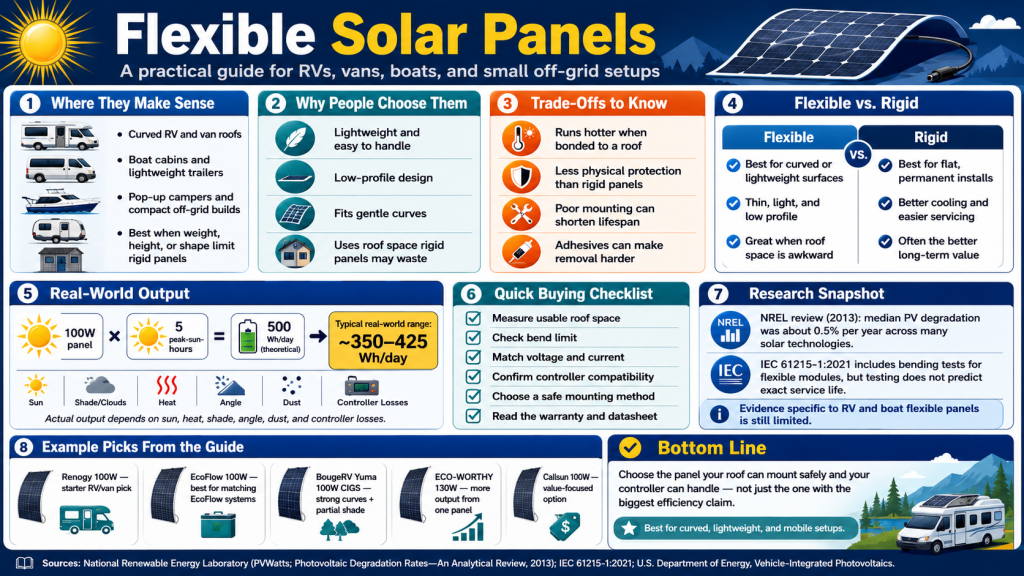
Common uses include RVs, vans, boats, golf-cart roofs, cabins, trailers, curved sheds, and temporary off-grid systems. They also suit structures that cannot comfortably carry framed panels and rails.
A low-profile module can reduce wind resistance and use narrow roof areas. However, fabric roofs, deeply corrugated metal, moving surfaces, and walkways can stress cells and wiring. The substrate must remain stable, clean, and compatible with the mounting method.
The Benefits That Matter Most
Low weight makes flexible solar panels easier to lift, position, and remove while preserving vehicle payload.
Their slim profile catches less wind than a framed module. Pre-punched eyelets can support removable mounting, while some models allow approved adhesives.
Most importantly, they can occupy curved or awkward spaces, adding capacity for lights, electronics, fans, pumps, or a compact refrigerator.
Heat and Durability Limitations
Solar output generally falls as cell temperature rises, and a roof-bonded panel may have little cooling airflow.
Repeated bending is another risk. A module may tolerate one careful curve yet suffer if a vehicle or boat deck keeps flexing. Sharp bends can stress cells and connections.
Thin surfaces may scratch, cloud, or delaminate after harsh cleaning or poor mounting. Ventilation, cable control, and a stable substrate matter as much as wattage.
Cell Technology and Surface Materials
Most flexible solar panels use monocrystalline silicon because it produces useful power from limited space. Manufacturers use smaller cell sections, multiple busbars, and laminated backings to manage silicon’s brittleness.
CIGS—copper indium gallium selenide—is a thin-film alternative that bends more freely and tolerates uneven illumination better. However, it may cost more per watt and need more area.
ETFE is a common weather-resistant top layer. With cheaper PET-covered models, examine warranties, temperature limits, and exposure guidance carefully.
How Much Solar Power You Need
List each device, its wattage, and daily running time. A 40-watt appliance running eight hours uses about 320 watt-hours before losses.
A 100-watt panel does not deliver 100 watts all day. Shade, heat, clouds, angle, wiring, and charging losses reduce usable energy.
Use this planning formula:
Daily solar energy = panel watts × peak-sun hours × system-efficiency factor
At 100 watts, five peak-sun hours, and a 0.75 factor, expect about 375 watt-hours. Add margin for clouds, seasons, and future loads.
Installation, Airflow, and Roof Protection
Read the panel manual and roof guidance before mounting. An adhesive suited to fiberglass may damage rubber membrane, paint, or composite material; drilling can create leaks.
When approved, preserve ventilation rather than sealing the entire rear surface to the roof. Avoid materials that soften in heat or hold water.
Keep cables away from sharp edges, secure them against wind, and use a proper cable gland at entry points. Plan for removal, because permanent bonding can make replacement difficult.
Positioning Flexible Solar Panels for Better Output
A flexible module follows normal photovoltaic rules: direct sunlight and minimal shade improve output.
Even a lightweight module needs thoughtful positioning, so start by finding the best solar panel angle for maximum sunlight and then adjust for curvature, roof space, and unavoidable shade.
Flat vehicle mounting may be the only practical option. Prioritize an unshaded location and expect seasonal variation. A removable setup can sit in the sun while the vehicle stays shaded.
Electrical Compatibility and System Components
Check open-circuit voltage, operating voltage, current, connector type, and fuse rating—not only wattage. These values must suit the controller and series or parallel arrangement.
Use a controller designed for the battery chemistry and voltage. MPPT models help when panel voltage is well above battery voltage or sunlight varies; a correctly sized PWM controller can suit a simple 12-volt system.
Portable power stations also have strict input limits. An adapter changes the plug, not the electrical characteristics, so stay within published voltage and current ranges.
Recommended Flexible Solar Panels for Different Needs
These flexible solar panels cover different priorities rather than repeating one basic design.
| Product | Power | Standout feature | Best suited to |
| Renogy Flexible | 100W | Five-year product/output warranty | Balanced all-round use |
| BougeRV Yuma CIGS | 200W | Highly flexible thin-film design | Curved, shade-prone roofs |
| EcoFlow Flexible | 100W | 23% stated efficiency, IP68 | Power-station systems |
| ECO-WORTHY Flexible | 130W | More output than common 100W units | Value-focused RV builds |
| Newpowa Black Flexible | 100W | 3.8-pound black module | Lightweight, discreet installs |
Renogy 100 Watt 12 Volt Flexible Monocrystalline Solar Panel
Best for: Buyers wanting a balanced, established all-rounder
Renogy rates this panel at 100 watts, with a 43-by-22.9-inch footprint, 5.3-pound weight, IP67 rating, and five-year material, workmanship, and output warranty. It suits RV, van, cabin, and marine projects where moderate flexibility and standard solar connectors matter. Its 15.7% stated module efficiency is lower than some newer premium designs.
BougeRV Yuma 200W CIGS Thin-Film Flexible Solar Panel With Pre-Punched Holes
Best for: Deep curves, long narrow spaces, and partial shade
This 200-watt CIGS panel measures about 82.8 by 27.1 inches and weighs roughly 6.4 pounds. Its thin-film construction bends more freely than typical crystalline panels and handles uneven illumination well. Pre-punched holes support mechanical mounting. Its long footprint and higher purchase cost, however, will not suit every roof or budget.
EcoFlow 100W Flexible Solar Panel
Best for: Users building around portable power stations or Power Kits
EcoFlow’s 100-watt panel weighs about 5.1 pounds, uses monocrystalline cells with a stated 23% efficiency, includes pre-cut eyelets, and carries an IP68 rating under controlled testing. Standard solar connectors support broader use, although some power-station setups require a separately purchased charging cable or adapter.
ECO-WORTHY 130W 12V Flexible Monocrystalline Solar Panel
Best for: Shoppers wanting more than 100 watts in a compact class
This 130-watt panel uses monocrystalline cells and a thin 37.8-by-27.2-inch body weighing about 4.4 pounds. The extra output can help on space-limited RV or boat roofs, while standard solar connectors simplify system integration. Its appeal is value and power density, though buyers should compare warranty and installation support with premium alternatives.
Newpowa NPA100S-12SFM-BLK 100W Flexible Solar Panel
Best for: Lightweight installations where a black finish matters
Newpowa’s black 100-watt panel weighs about 3.8 pounds, has six pre-drilled mounting holes, and carries an IP68 rating. Its low weight makes positioning easier on small vans, boats, or lightweight roofs, while the dark surface blends into some builds. The published one-year warranty is modest beside longer-covered competitors.
Research-Backed Facts Before You Buy
A 2018 National Renewable Energy Laboratory analysis identified portable charging and ground transportation as promising markets for lightweight, flexible photovoltaics. The practical point is not that every flexible panel outlasts a rigid one; it is that lower mass can justify a premium when transportation or structural loading matters.
The IEC 61215-1:2021 standard added a bending test for flexible modules. However, IEC states that qualification results do not provide a numerical prediction of service life. Certification therefore shows structured testing, not a guaranteed lifespan in every installation.
For production planning, use NREL’s PVWatts Calculator. It uses long-term weather data and models tilt, direction, losses, and thermal behavior, yet NREL warns that results contain assumptions and uncertainty. Treat its output as a range, then allow for shade, roof heat, dirt, and battery-system losses.
Maintenance and Troubleshooting
Inspect the panel every few months and after severe weather. Look for lifted edges, loose eyelets, cable abrasion, cloudy laminate, bubbles, cracks, corrosion, or unexplained input drops.
Clean with water and a soft cloth or sponge according to the manufacturer’s instructions. Avoid pressure washers, abrasive pads, strong solvents, and walking on the module unless specifically allowed.
If output falls, remove shade, inspect connectors and fuses, verify controller settings, and compare panel voltage with specifications. Test panels individually when possible, and contact the manufacturer or a qualified technician for suspected cell or laminate damage.
Frequently Asked Questions About Flexible Solar Panels
How long do flexible solar panels last?
Service life varies with construction, heat, mounting, weather, and handling. Premium models may provide useful output for years, but thin modules generally have less physical protection than framed panels. Compare product and power warranties, bend limits, temperature ratings, and installation instructions rather than relying on one broad lifespan estimate.
Can flexible solar panels be glued to an RV roof?
Some can, but only when the panel maker permits adhesive mounting and the adhesive suits the roof. Full-surface bonding may trap heat and complicate removal. Check roof warranties, follow ventilation instructions, prepare the surface correctly, and secure cables so wind cannot lift or fatigue the installation.
Are flexible panels waterproof?
Many outdoor models carry IP67 or IP68 ratings, but those ratings apply under defined tests. They do not guarantee that damaged laminate, a loose connector, an unsealed cable entry, or an incorrect roof penetration will remain watertight. Protect the complete installation, not only the panel face.
Can I walk on flexible solar panels?
Do not assume so. A panel may curve around a roof while still containing brittle cells that crack under concentrated pressure. Walkability must be explicitly stated by the manufacturer. Even then, follow its footwear, support, and load guidance, and plan normal movement around the module.
Are flexible solar panels worth the extra cost?
They are worthwhile when low weight, curvature, limited mounting height, or portability solves a real problem. They are less compelling when a rigid panel fits easily and long-term cost per watt is the priority. The best value comes from matching construction to the surface, not paying for flexibility you do not need.
Final Recommendation: Are Flexible Solar Panels Worth It?
Flexible solar panels work best when weight, curvature, aerodynamics, or awkward roof space rules out a conventional framed module. Choose by usable wattage, dimensions, bend limit, surface material, ingress rating, electrical specifications, warranty, and mounting guidance—not merely the largest wattage claim.
For a balanced 100-watt choice, Renogy offers familiar system compatibility and stronger warranty coverage. For a deeply curved or shade-prone installation, the BougeRV Yuma CIGS uses different technology, provided its long shape and higher cost fit your project.
Above all, protect the panel from trapped heat, sharp bends, moving cables, and foot traffic. When flexibility solves a genuine constraint, buy the best-supported model you can afford and install it with future removal in mind.