Sustainable Energy Solutions: A Practical Guide to Smarter Solar Power

Choosing cleaner energy can feel more complicated than it should. Solar panels get most of the attention, but a useful setup may also involve efficiency upgrades, batteries, an inverter, monitoring, or portable power. The right combination depends on your electricity use, property, outage concerns, budget, and future plans. Sustainable energy solutions work best when they solve a defined problem rather than simply add equipment. This guide explains the main options, how solar fits with storage and efficiency, what current research says, and which products suit several real-world situations. By the end, you should have a practical way to compare choices and decide what belongs in your energy plan.
What Sustainable Energy Solutions Actually Include
Sustainable energy solutions can include energy-efficiency improvements, solar photovoltaic panels, battery storage, efficient electrification, smart controls, and portable solar equipment. For a household, the better question is not “Which technology sounds greenest?” but “Which combination reduces waste and supplies the energy I actually need?”
A well-sized solar system on an efficient home can make more sense than installing extra generation simply to cover avoidable electricity use.
Start With the Energy You Already Use
Review about 12 months of electricity bills. Note annual use, seasonal peaks, and large loads such as cooling, water heating, or pumps. Then consider future additions such as an electric vehicle or heat pump.
This makes sustainable energy solutions easier to size and may reveal efficiency improvements that reduce the solar or battery capacity you need. U.S. Department of Energy guidance likewise recommends reviewing historical electricity use and considering future demand before sizing residential solar.
Solar Power Is Usually the Core Building Block
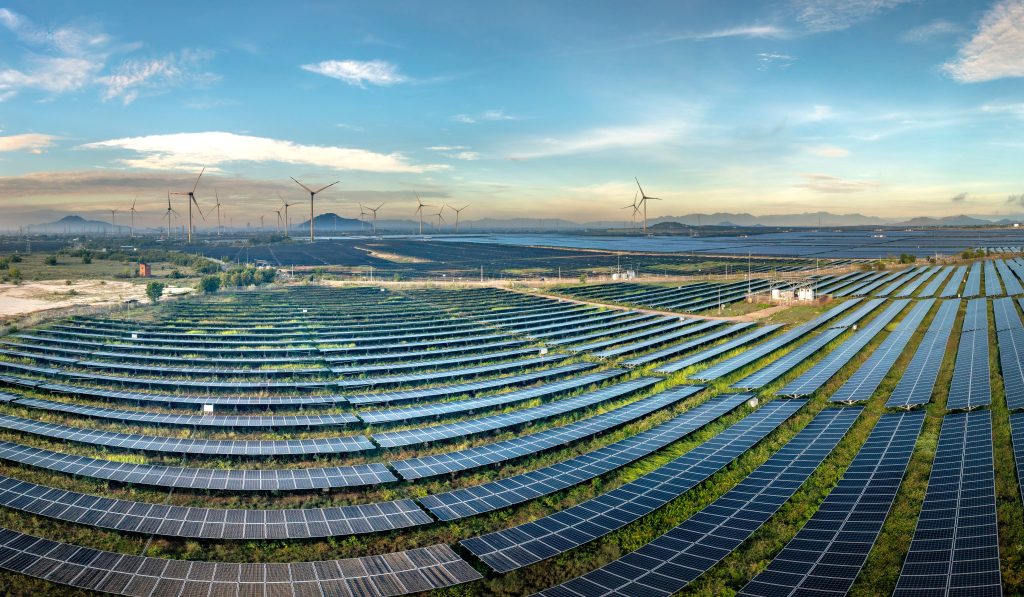
Solar PV is a practical way to generate renewable electricity on-site. Panels produce direct-current electricity, while an inverter converts it into alternating current used by most household equipment.
Annual output depends on more than panel wattage. Shade, orientation, tilt, weather, module temperature, system losses, and inverter design all matter. Compare proposals by expected annual kilowatt-hours, not system size alone. The Department of Energy also identifies location, roof position, shade, and system design as important factors in rooftop solar potential.
Rooftop, Ground-Mount, or Portable Solar?
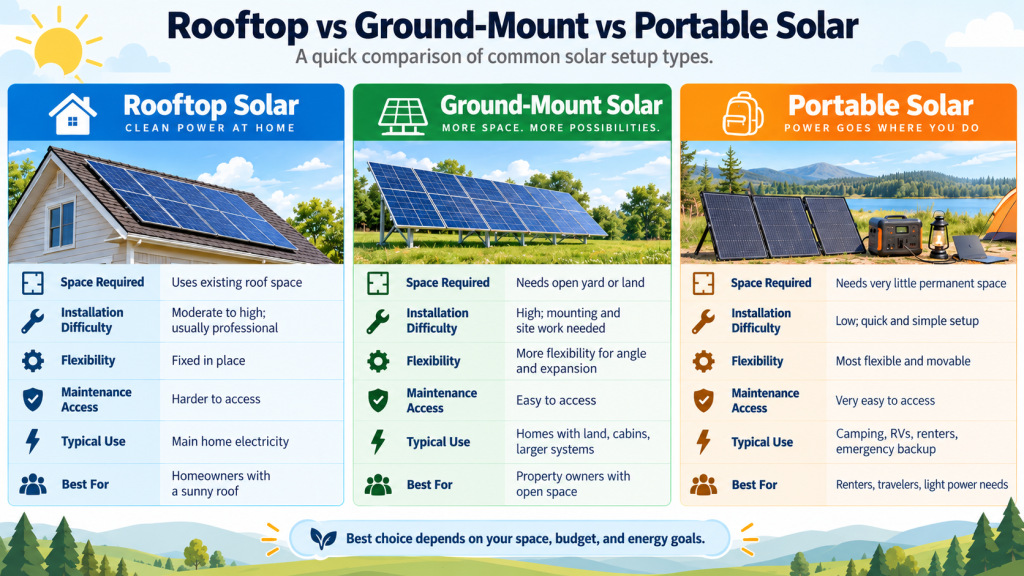
Rooftop solar preserves yard space and works well when the roof is sound and sunny. Ground mounts allow more control over orientation, access, and expansion, but foundations, trenching, and land use add complexity.
Before you compare equipment, use SolarFlez’s guide to solar panel placement to weigh roof orientation, shade, structural limits, and ground-mount tradeoffs.
Portable panels suit camping, RVs, emergency charging, and renters, but they are not substitutes for a whole-home array.
Pair Efficiency With Solar for Better Results
A sensible sequence is to reduce avoidable demand before sizing generation. Air sealing, insulation, efficient lighting, smart scheduling, and efficient appliances can lower consumption.
Think of it as fixing a leaky bucket before increasing the flow into it. Sustainable energy solutions become easier to size when each generated kilowatt-hour does more useful work.
This does not mean renovating everything before considering solar. Instead, identify realistic efficiency upgrades and factor their expected savings into your system design.
When Battery Storage Is Worth Adding
A battery can store daytime solar for evening use and support selected loads during outages when properly designed. However, storage is not automatically necessary.
Its value depends on electricity rates, export rules, time-of-use pricing, outage frequency, and backup needs. DOE guidance specifically highlights outages, non-one-to-one metering, and time-of-use or demand-charge rates as situations where storage may deserve consideration.
Identify what must stay powered and for how long. Sustainable energy solutions should size storage around those needs rather than an arbitrary battery capacity.
Inverters, Controllers, and Monitoring Matter Too
Power electronics determine how a system behaves. Grid-tied inverters synchronize solar with utility power; hybrid inverters can coordinate solar, storage, and the grid; charge controllers regulate battery charging in many smaller systems.
Monitoring shows production, consumption, and battery status. It will not rescue a poor design, but it can help reveal unusual consumption, shading, or performance changes earlier.
When comparing systems, look beyond panel efficiency and battery capacity. Controls, usable outputs, monitoring access, and expansion options affect how convenient the equipment will be day to day.

Grid-Tied, Hybrid, and Off-Grid Systems Compared
Grid-tied solar is usually the simplest option for a connected home, with the grid covering shortfalls. Standard grid-dependent residential solar generally switches off during a grid outage for safety unless suitable backup equipment is installed.
Hybrid systems add storage and controls for greater flexibility. Off-grid systems must cover loads without routine utility support, so they require more careful seasonal generation and battery planning.
More independence usually means more equipment, so avoid assuming an off-grid design is automatically the most sustainable or economical choice.
Sustainable Energy Solutions for Renters and Small Spaces
Renters can still reduce demand with efficient lighting, smart plugs, permitted weather sealing, and careful appliance use. Portable power stations and foldable panels can provide limited backup or outdoor power without permanent construction.
For cabins, sheds, boats, and RVs, compact 12-volt systems may combine panels, a charge controller, battery, and inverter. These sustainable energy solutions work best when loads are known and modest.
Start by listing the devices you actually intend to run rather than buying the largest battery or panel kit that fits the space.
How to Compare Cost, Payback, and Resilience
Compare total installed cost, including racking, electrical work, permitting, site work, storage, and monitoring. Then compare expected annual generation with your rate structure and export compensation.
Payback is only one factor. Backup power, lower grid dependence, and expandability may matter too. Because rates, incentives, financing, and rules vary by location, ask competing installers to use the same consumption data and explain their assumptions.
That approach makes different sustainable energy solutions easier to compare without letting an unusually optimistic production estimate distort the decision.
Research-Backed Guidance on Sustainable Energy Solutions
The International Energy Agency’s 2026 Global Energy Review electricity-supply analysis reports that renewables supplied 34% of global electricity generation in 2025, up from 32% in 2024. Solar PV generation rose by about 600 TWh, its largest annual increase on record. These global figures show rapid renewable growth, but they do not predict one household’s savings.
IRENA’s 2025 Renewable Power Generation Costs in 2024 report found that 91% of newly commissioned utility-scale renewable capacity in 2024 produced electricity at a lower levelized cost than the cheapest new fossil-fuel alternative. Its global weighted-average LCOE for new utility-scale solar PV was $0.043/kWh. These are utility-scale averages, not residential installation prices.
IRENA also reported a 93% decline in utility-scale battery-storage project costs from 2010 to 2024, from $2,571/kWh to $192/kWh. Meanwhile, U.S. Department of Energy solar consumer guidance recommends reviewing past electricity use, roof condition, shade, and future loads before sizing solar, while DOE battery-storage guidance explains situations where storage can add practical value. Together, the evidence supports a “measure first, size second” approach to sustainable energy solutions.
Recommended Sustainable Energy Solutions for Different Needs
The products below solve different problems rather than competing for one identical job. Portable stations simplify backup, a standalone battery suits a designed 12-volt system, and a panel kit offers an entry point for small off-grid generation.
| Product | Best for | Core feature |
| EF ECOFLOW DELTA Pro | Higher-capacity portable backup | 3600Wh, 3600W AC |
| Anker SOLIX F2000 | RV and flexible backup | 2400W, LiFePO4 |
| Jackery Explorer 2000 v2 | Simple emergency power | 2042Wh, 2200W |
| Litime 12V 200Ah Mini | DIY 12V storage | 2560Wh, 200A BMS |
| Renogy 200W Kit | Small off-grid beginners | Two 100W panels |
EF ECOFLOW Portable Power Station 3600Wh DELTA Pro, 120V 3600W AC Output | 2.7H Fast Charge Power Station, Expandable up to 25kWh, Solar Generator for Home Use, Power Outage, Camping, RV, Emergencies
Best for: Higher-capacity portable backup and expandable setups
The DELTA Pro combines 3600Wh of storage with 3600W AC output and supports expansion up to 25kWh according to its current product specification. That makes it useful for readers who need more than occasional device charging. The tradeoff is size: this is substantial portable equipment, and solar panels require separate planning.
Anker SOLIX F2000 Portable Power Station, PowerHouse 767, 2400W Solar Generator, GaNPrime Battery Generators for Home Use, LiFePO4 Power Station for Outdoor Camping, and RVs (Solar Panel Optional)
Best for: RV users and households wanting flexible backup
The SOLIX F2000 provides 2400W output and uses a LiFePO4 battery, with solar charging available through compatible panels. Its all-in-one format reduces the component matching required by a DIY battery bank, which is convenient for travel or backup. Still, buyers should calculate essential loads before choosing capacity.
Jackery Explorer 2000 v2 Portable Power Station, 2042Wh, 2200W AC Output | LiFePO4 Battery, USB-C PD 100W Fast Charging, Solar Generator for Emergencies, Power Outages, Camping (Solar Panel Optional)
Best for: Straightforward emergency power with useful portability
The Explorer 2000 v2 combines 2042Wh of storage, 2200W AC output, a LiFePO4 battery, and 100W USB-C PD charging. It suits readers who want one portable unit for essential electronics, outages, or camping. Solar panels are optional, so renewable charging capacity must be selected separately.
Litime 12V 200Ah Mini Lithium LiFePO4 Bluetooth Battery for RV Solar Marine | Group 31+, Max. 20000 Cycles at 60% DOD, 200A BMS, 2560Wh, Low Temp Protection, IP65, for Camper, Home Backup, Power Outages
Best for: DIY 12V solar, RV, and marine battery systems
This 12V 200Ah LiFePO4 battery lists 2560Wh, a 200A battery-management system, Bluetooth monitoring, low-temperature protection, and IP65 protection. It gives experienced DIY users a flexible storage component rather than a closed power station. However, it still requires compatible charging, inverter, cabling, overcurrent protection, and system design.
Renogy 200W 12V Monocrystalline Solar Panel Kit + 30A PWM Charge Controller | 200W 12V Monocrystalline Solar Starter Kit with 2Pcs 100W Panels & 30A PWM Controller for RV, Boats, Camper, Off-Grid System
Best for: Beginners building a small 12V off-grid setup
This kit combines two 100W monocrystalline panels with a 30A PWM charge controller, giving beginners a simpler starting point for modest RV, boat, camper, or cabin loads. The bundled controller removes one component choice. Still, 200W is modest generation capacity, so calculate daily energy needs before expecting it to run demanding appliances.
Common Mistakes That Make Solar Projects Disappointing
Avoid buying before defining the problem. Common missteps include oversizing before improving efficiency, adding a battery without identifying backup loads, ignoring shade or roof age, and comparing quotes built on different production assumptions.
For DIY sustainable energy solutions, component compatibility and electrical protection matter as much as headline capacity. Permanent wiring, structural work, and utility interconnection should follow local codes and use appropriately qualified professionals where required.
Also leave room for realistic losses and seasonal changes rather than building a plan around perfect laboratory conditions.
Sustainable Energy Solutions FAQs
What are the most practical sustainable energy solutions for a home?
For many homes, start with efficiency, then consider solar PV, and add battery storage only when backup needs or local electricity economics justify it. Smart controls and efficient electric equipment can complement that plan. The right mix depends on climate, utility rates, building condition, energy use, available sunlight, and how much you value resilience.
Is a battery necessary when installing solar panels?
No. Many grid-tied solar systems operate without batteries. Storage becomes more attractive when you want outage backup, face time-of-use rates, receive limited value for exported solar, or want to use more of your own generation after sunset. Confirm that any proposed backup design can actually power the loads you consider essential.
How many solar panels are typically needed to power an average home?
There is no useful universal number. Panel count depends on annual electricity consumption, module rating, unshaded area, local solar resource, orientation, system losses, and your target for reducing grid use. Start with a year of bills and a site-specific production estimate. A credible proposal should explain expected annual kilowatt-hours, not just panel count.
Are portable power stations a replacement for rooftop solar?
Usually not. Portable power stations work well for camping, short outages, renters, and selected devices, but their storage and output are far below what many homes use over a full day. They can be part of sustainable energy solutions, especially with portable panels, while whole-home supply requires a much more carefully sized system.
How do I know whether sustainable energy solutions are worth the cost?
Compare full installed cost with expected generation, electricity prices, export rules, incentives, financing, maintenance, and equipment life. Then include priorities such as backup power or lower grid dependence. Use conservative assumptions and comparable proposals. A system can make sense for one household but not a neighbor with different shade, rates, or consumption.
Final Recommendation: Build Sustainable Energy Solutions Around Real Needs
Start with your loads, not a shopping list. Reduce obvious waste, review annual electricity use, assess sunlight and site constraints, and decide whether your main goal is lower bills, backup power, portability, or future flexibility. A grid-connected home may only need well-sized solar, while an outage-conscious household may add storage. Renters and travelers may get more value from portable equipment such as the Jackery Explorer 2000 v2 or Anker SOLIX F2000, while the Renogy 200W kit suits smaller DIY needs. Sustainable energy solutions work best when every component has a clear job. Compare assumptions across proposals and choose the simplest system that reliably meets your actual needs.