How To Setup RV Solar Power
You know that feeling when you finally park somewhere gorgeous… and then the generator noise starts up (yours or your neighbor’s)? Or when you’re doing the “phone flashlight + headlamp + mild panic” combo because the lights dipped again?
That’s exactly why RV Solar Power feels so magical. It’s quiet. It’s steady. And it lets you camp where you actually want to camp—without rationing every watt like it’s the last cookie on Earth.
In this guide, I’ll walk you through a friendly, realistic setup—from sizing your system to choosing panels, batteries, and wiring—so you can build something that fits your travel style (weekend warrior, full-time boondocker, “I just want coffee and Netflix,” etc.).
Affiliate note: This article includes Amazon product links—if you buy through them, I may earn a small commission at no extra cost to you.
What RV Solar Power Really Solves (and what it doesn’t)
RV Solar Power is amazing at covering your daily “normal life” electricity: lights, fridge control board, fans, device charging, water pump, laptops, and yes—coffee rituals.
But it’s not a magical cheat code for unlimited energy. Solar works best when you match it to a plan:
- Make power during the day
- Store it in batteries
- Use it wisely at night
If you’ve ever cooked a big meal and then tried to stretch leftovers for two days, it’s kinda like that. Solar is the cooking. Batteries are the fridge. Your habits decide how long it lasts.
The biggest win most RVers feel
Not “infinite power”—it’s freedom from stress. You stop constantly asking, “Can I run that?” and start thinking, “Where are we camping next?”
Quick Reality Check: Your Daily Power Budget
Before you buy anything, do one simple thing: estimate your daily watt-hours (Wh).
Here’s the easy method:
- List your devices
- Note watts (or amps)
- Multiply by hours used per day
A “real-life” mini example
- Phone charging: 10W × 2h = 20Wh
- Laptop: 60W × 2h = 120Wh
- Fan: 25W × 6h = 150Wh
- Lights: 20W × 4h = 80Wh
Total: ~370Wh/day
Now add a “life happens” cushion (because it always does): +20–30%.
Meet the Parts: Panels, Controller, Battery, Inverter, Wiring
An RV solar system is basically a team:
- Solar panels: make electricity from sunlight
- Charge controller: safely feeds solar into your batteries
- Battery bank: stores energy for later
- Inverter: converts battery power to household AC power (120V)
- Wiring + fuses: keeps it safe and reliable
The simplest rule
If you’re unsure where to spend more: spend on the controller, wiring safety, and batteries. Panels matter, but a weak controller or sketchy wiring can ruin your whole vibe.

Solar Panels for an RV: Rigid, Flexible, or Portable
Three main options—each with a personality:
Rigid panels (the dependable friend)
- Best efficiency and lifespan
- Great for roof mounting
- Usually the best value per watt
Flexible panels (the “looks sleek” choice)
- Lighter, lower profile
- Can run hotter (often means less efficiency)
- Lifespan varies—install matters a lot
Portable panels (the shade-lover’s bestie)
- Park the RV in shade, put panels in sun
- Great for rules-heavy campgrounds
- More setup/tear-down each time
If you move often and chase sun, roof panels feel effortless. If you camp in trees a lot, portable panels can save you from constantly losing output.
How Many Watts of Solar Do You Need?
Let’s keep this practical:
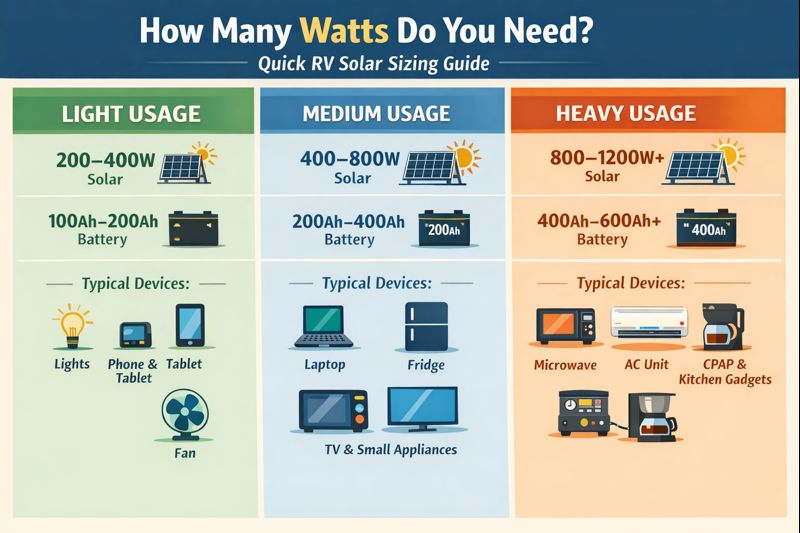
- Light use (300–800Wh/day): ~200–400W solar
- Medium use (800–1500Wh/day): ~400–800W solar
- Heavier use (1500–3000Wh/day): ~800–1200W+ solar
Then factor in:
- Season (winter sun is stingy)
- Shade (even small shade can hurt a lot)
- Your patience level (do you want to think about power daily?)
A quick shortcut many RVers like
Aim for solar watts that can produce 2–3× your daily battery “refill” needs on a good sun day. That way cloudy days don’t immediately wreck your plan.
Charge Controllers: MPPT vs PWM (in plain English)
Your charge controller is the “traffic cop” between panels and batteries.
PWM (budget-friendly, basic)
- Cheaper
- Works fine for small systems
- Less efficient when panel voltage is much higher than battery voltage
MPPT (smarter, usually worth it)
- Better efficiency and flexibility
- Handles higher panel voltage nicely (great for wiring runs)
- Often performs better in colder temps and mixed conditions
If you’re building anything beyond a tiny weekend setup, MPPT is usually the “buy once, cry once” move.
Batteries: Lithium vs AGM for RV Life
Batteries decide how your nights feel. Cozy and easy… or like you’re babysitting a fragile power egg.
AGM / Lead-acid (the traditional choice)
- Lower upfront cost
- Heavier
- You usually can’t use the full capacity without shortening life
LiFePO4 Lithium (the modern favorite)
- Lighter for the usable capacity
- Handles deeper discharge better
- Faster charging (which pairs beautifully with solar)
If you full-time or boondock often, lithium tends to feel like upgrading from a flip phone to a smartphone. More expensive, yes—but the day-to-day experience is smoother.
Inverters: Pure Sine Wave Matters More Than You Think
If you want to run AC devices—microwave, blender, CPAP, laptop chargers—you’ll use an inverter.
Modified sine wave (cheap, but picky)
Some devices hate it. Others run hotter. Some make noises. Some just… don’t work.
Pure sine wave (clean power)
- Safer for sensitive electronics
- Usually quieter
- More “shore power-like”
If you’ve ever heard a charger buzz like an angry insect, you’ve met modified sine wave problems.
Wiring & Safety: Fuses, Breakers, and Wire Gauge
Okay, this part isn’t glamorous. But it’s the part that prevents melted wires and terrifying smells.
You want:
- Correct wire gauge for the current and distance
- Proper fusing near the battery (seriously—near the battery)
- Clean, tight connections (loose = heat)
Quick safety checklist
- Fuse the positive line close to the battery
- Use a proper shunt if you’re monitoring
- Protect wire runs from sharp edges
- Keep moisture out of roof entries
When in doubt, overbuild safety. Your RV is literally your home.
Roof Mounting Done Right (No-Leak, Low-Drama)
Roof installs can feel intimidating, but you can make them pretty painless.
What helps most
- Plan your panel layout first (vents, AC unit, skylights matter)
- Use sturdy mounts
- Seal properly and neatly
The mindset shift
Don’t rush. Roof work punishes rushing. If you treat it like a careful DIY weekend project (not a sprint), you’ll feel way more confident.
Portable & Hybrid Options (Solar Suitcases + Solar Generators)
Not everyone wants a roof install. Totally fair.
Portable solar works great if:
- You camp in shade
- You want a removable setup
- You have a smaller power goal
Solar generators (battery + inverter + controller in one box) work great if:
- You want plug-and-play
- You don’t want to mess with wiring
- You want something you can use outside the RV too
A lot of RVers end up hybrid:
- Roof solar for “always-on basics”
- Portable panel or generator as a flexible backup
A Simple Step-by-Step Install Plan
Here’s a clean, beginner-friendly order:
Step 1: Decide your “must-have” loads
Pick 5–10 core items you want powered daily.
Step 2: Choose your battery capacity first
Because solar’s job is to refill the battery—not the other way around.
Step 3: Pick panels to reliably recharge
Match solar watts to your daily energy use + weather reality.
Step 4: Add the right controller and inverter
- MPPT controller sized for panel voltage/current
- Pure sine inverter sized for your AC needs
Step 5: Wire it safely
Battery fuse, correct cable thickness, clean terminations.
Step 6: Test in stages
Test panel → controller → battery charging first. Then inverter.
That staged approach prevents the “why isn’t anything working” spiral.
Monitoring, Maintenance, and Troubleshooting
If RV Solar Power is the engine, monitoring is the dashboard.
What you want to track
- Battery state of charge (SOC)
- Solar input (W)
- Battery voltage and current
- Daily usage trends
Maintenance that actually matters
- Keep panels reasonably clean (dust and pollen add up)
- Check roof seals periodically
- Tighten electrical connections during routine checks
The most common “mystery problem”
Shade. Tiny shade. Like one branch. Solar panels can be dramatic about shade.
Product Picks: 5 Amazon Finds That Fit RV Solar Power
Below are five popular, high-rated options with strong review histories across Amazon listings (ratings can shift over time, so always double-check before buying).
1) Renogy 200W 12V Monocrystalline Solar Starter Kit (Wanderer)
Features
- 200W panel capacity (often two 100W panels)
- Starter-friendly components
- Good “first real system” foundation
Best for
- Weekend boondocking
- Running basics: lights, fans, charging, fridge electronics
2) Victron Energy SmartSolar MPPT 100V 30A (Bluetooth)
Features
- MPPT efficiency + smart charging profile options
- Built-in Bluetooth monitoring
- Works with 12V/24V systems
Best for
- Medium systems (400–800W solar)
- RVers who want reliable charging + app visibility
3) LiTime 12V 100Ah LiFePO4 Lithium Battery
Features
- LiFePO4 chemistry (stable, RV-friendly)
- Strong usable capacity vs lead-acid
- Great for pairing with solar charging
Best for
- Boondockers who want less battery babysitting
- Anyone tired of “half-capacity” lead-acid reality
4) GIANDEL 2200W Pure Sine Wave Power Inverter
Features
- Pure sine output for sensitive electronics
- Strong wattage for common RV loads
- Solid fit for many mid-range setups
Best for
- CPAP users, laptop-heavy travelers
- Running a microwave occasionally (depending on model + surge)
5) Renogy 500A Battery Monitor (Shunt-Based)
Features
- Shunt monitoring (more accurate SOC tracking)
- Real-time amps in/out
- Helps you spot trends before problems hit
Best for
- Anyone who wants confidence, not surprises
- Lithium setups where accurate SOC matters
Research-Backed Notes: Why RV Solar Power Is a “Long-Game” Upgrade
If you’re investing in RV Solar Power, you’re not just buying gear—you’re buying predictability. And the research backs up why a well-built setup can stay useful for years.
Solar panels tend to age slowly (so your system doesn’t “fall off a cliff”)
A well-known NREL paper, Photovoltaic Degradation Rates—An Analytical Review (2012) compiled nearly 2,000 real-world degradation rates and found a median degradation rate around 0.5% per year—meaning most panels lose output gradually, not suddenly.
What that means for you: if you build your system with a little extra capacity (and avoid shade + sloppy wiring), you’re setting yourself up for stable performance over time—not a constant “why is this weaker already?” headache.
LiFePO4 batteries can handle a lot of cycling (great for daily off-grid use)
A 2024 paper in the journal Batteries looked at aging performance in retired LiFePO4 cells and reported examples reaching 10,000 cycles while still retaining a meaningful amount of capacity (one example showed ~33.9% capacity loss after 10,000 cycles).
Here’s the study: Second-Life Assessment of Commercial LiFePO4 Batteries (2024).
FAQ
How much does RV solar power cost to set up?
A basic DIY setup often lands in the “few hundred to a couple thousand” range depending on battery type. Lithium increases upfront cost, but it usually improves daily comfort and usable capacity.
Can RV solar power run an air conditioner?
Sometimes—but it’s the hardest common RV load. You typically need a large solar array, a big lithium bank, and a soft-start (plus realistic expectations). Many RVers use solar for everything else and run AC briefly or with generator help.
How long will my RV batteries last on solar?
Solar doesn’t “make batteries last”—it refills them. Your runtime depends on usable battery capacity, your daily loads, and your solar recharge window. Monitoring makes this predictable instead of stressful.
Is it better to use a solar generator or a hardwired system?
If you want plug-and-play and portability, solar generators feel easy. If you want scale, roof integration, and better long-term value, hardwired systems usually win.
Do I need to tilt my RV solar panels?
Tilting can help in winter or when you’re parked for a while, but many RVers skip it for simplicity. If you move often and chase sun, flat roof panels still work well.
Conclusion
RV Solar Power isn’t just about watts and wiring—it’s about how you want RV life to feel. Quiet mornings. Confident nights. Less “can we?” and more “let’s go.”
Start small if you need to. Size honestly. Build safely. Then enjoy the moment when you realize you’ve been camped for days… and you haven’t thought about electricity once. That’s the real flex.