Top 10 MPPT Solar Charge Controllers
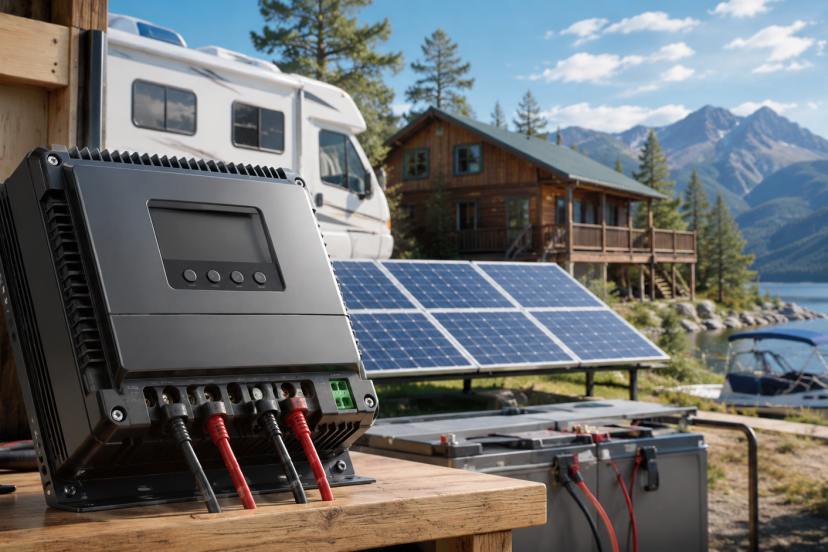
MPPT solar charge controllers sit between your solar array and battery bank, turning changing panel output into controlled charging. They suit RVs, boats, cabins, backup systems, workshops, and off-grid installations where wasted energy or incorrect charging can become expensive. Choosing the right controller matters because its voltage ceiling, current rating, battery settings, wiring terminals, and thermal limits must match the system. We compared Amazon.com availability, manufacturer specifications, monitoring options, installation demands, battery compatibility, limitations, and value rather than ratings or marketing claims for dependable long-term operation.
Comparison Table
| Product | Best for | Key feature | Main limitation | Price category | Overall recommendation |
| Victron SmartSolar 100/30 | Connected systems | Built-in Bluetooth | No front display | Premium | Best overall |
| Renogy Rover 40A | RV solar | Adjustable profiles | Bluetooth may cost extra | Mid-range | Versatile choice |
| EPEVER Tracer 4210AN | Detailed monitoring | Meter bundle | More wiring | Mid-range | Strong technical value |
| LiTime 60A | Larger arrays | 12V–48V support | Large enclosure | Mid-range | Expansion-friendly |
| BougeRV Sunflow 40A | Cold-weather lithium | Low-temperature cutoff | 12V/24V only | Mid-range | RV-friendly |
| ECO-WORTHY 40A | Budget builds | OLED display | Basic interface | Budget | Affordable MPPT |
| PowMr MPPT-60A | High-voltage arrays | 160V PV ceiling | Steeper setup | Budget | Capable for DIY users |
| MakeSkyBlue V123 60A | Custom systems | Broad voltage support | Limited ecosystem | Budget | Flexible alternative |
| RICH SOLAR 40A | Simple cabin systems | Negative grounding | Bulky design | Mid-range | Straightforward choice |
| Morningstar TriStar MPPT 45 | Professional installations | Robust diagnostics | Expensive, no standard display | Premium | Best heavy-duty option |
1. Victron Energy SmartSolar MPPT 100/30 — Best for Overall System Monitoring
Overview: The SmartSolar 100/30 is a compact 30A controller for 12V or 24V battery banks and arrays with open-circuit voltage below 100V. Built-in Bluetooth lets you configure charging, review history, and diagnose errors through VictronConnect.
Key Features: 100V maximum PV voltage; 30A charging output; automatic 12V/24V detection; Bluetooth and VE.Direct communications; configurable multistage charging.
Pros: Excellent app; compact enclosure; extensive settings; established accessory ecosystem.
Cons: No front LCD; premium price; terminals need careful cable preparation.
Best For: Owners who value reliable monitoring, flexible battery profiles, and future integration with other Victron equipment.
Verdict: It combines usability, documentation, and system visibility unusually well.

2. Renogy Rover Li 40A MPPT Solar Charge Controller — Best for RV Solar
Overview: Renogy’s Rover Li 40A targets 12V and 24V mobile or small off-grid systems. It includes an LCD for checking operating data without a phone. Adjustable charging parameters support common lead-acid and lithium configurations.
Key Features: 40A rated current; 100V maximum solar input; up to 520W at 12V or 1,040W at 24V; LCD interface; remote temperature sensor.
Pros: Familiar controls; broad battery compatibility; useful capacity for medium RV arrays; strong documentation.
Cons: Wireless monitoring may require a compatible module; menu navigation takes practice.
Best For: RV, van, boat, or cabin owners wanting a recognizable platform with room beyond a starter array.
Verdict: The Rover earns its place through practical sizing and accessible controls for mobile installations.

3. EPEVER Tracer 4210AN MPPT Controller Kit — Best for Detailed Local Monitoring
Overview: The Tracer 4210AN is a 40A common-negative controller often sold on Amazon with an MT50 remote meter, temperature sensor, and communications cable. It suits users who prefer a dedicated display and deeper settings.
Key Features: 40A charging; automatic 12V/24V operation; 100V PV input limit; programmable battery settings; remote display and RS485 communications in selected bundles.
Pros: Informative meter; mature controller platform; replaceable monitoring accessories; good value for technical users.
Cons: Bundle contents vary; extra cables create installation clutter; software setup can feel dated.
Best For: Cabins, workshops, and DIY systems where local data access and adjustable charging matter.
Verdict: It offers rich monitoring, provided you confirm the exact Amazon bundle.

4. LiTime 60A MPPT Solar Charge Controller — Best for Expandable 48V Systems
Overview: LiTime’s 60A controller supports 12V, 24V, 36V, and 48V battery banks, making it expansion-friendly. Its 150V maximum solar input permits longer series strings, reducing array-side current in larger installations.
Key Features: 60A charge rating; 150V maximum PV input; multi-voltage battery support; LCD and status indicators; lithium and lead-acid profiles.
Pros: High current capacity; flexible system voltage; generous array limits; suitable for larger battery banks.
Cons: Physically larger; installation requires substantial wiring and protection; versions may differ regarding Bluetooth.
Best For: Growing cabin, home-backup, or workshop systems moving beyond basic 12V architecture.
Verdict: Its voltage range and 60A output suit planned expansion.

5. Victron Energy SmartSolar MPPT 75/15 — Best for Compact Solar Systems
Overview: The SmartSolar 75/15 is a 15A controller for 12V or 24V battery banks and solar arrays below its 75V input ceiling. Built-in Bluetooth helps you configure charging and review performance without adding a separate display.
Key Features: 75V maximum PV voltage; 15A charging output; automatic 12V/24V recognition; Bluetooth monitoring; VE.Direct communications.
Pros: Compact enclosure; polished app; configurable charging profiles; strong technical documentation.
Cons: Limited to smaller arrays; no front LCD; premium pricing for its current rating.
Best For: Vans, boats, sheds, and compact off-grid systems where space, monitoring, and dependable configuration matter more than high output.
Verdict: It is a compact choice for buyers who want monitoring and proven system integration.

6. ECO-WORTHY 40A MPPT Solar Charge Controller — Best Budget Option
Overview: This 40A model gives budget-minded buyers true MPPT functionality, an OLED screen, temperature sensing, and common-negative wiring for 12V or 24V systems. It suits cabins, sheds, RVs, and learning projects.
Key Features: 40A output; automatic 12V/24V operation; up to 560W at 12V or 1,120W at 24V; OLED data display; lithium and lead-acid settings.
Pros: Competitive price; readable local information; useful array capacity; straightforward negative grounding.
Cons: Documentation and interface are basic; advanced remote integration is limited.
Best For: Buyers building an affordable system who can verify settings and install proper fuses, breakers, and cable sizes.
Verdict: It is a sensible entry point into configurable MPPT charging.

7. PowMr MPPT-60A Solar Charge Controller — Best for High-Voltage Budget Arrays
Overview: PowMr’s 60A controller supports 12V through 48V battery banks and a maximum PV input around 160V, depending on revision. It suits experienced DIY users seeking higher string voltage on a budget.
Key Features: 60A charging; automatic multi-voltage recognition; high PV voltage ceiling; LCD interface; selectable lead-acid and lithium parameters.
Pros: Strong specifications for the cost; supports series-connected arrays; useful for larger off-grid projects.
Cons: Product revisions can differ; menus and manuals require careful reading; support is less comprehensive than premium brands.
Best For: Confident installers building cost-conscious 24V or 48V systems with higher-voltage panel strings.
Verdict: It offers substantial capacity, but verify the exact model and limits.

8. HQST 80A MPPT Solar Charge Controller — Best for Parallel High-Current Systems
Overview: HQST’s 80A controller supports 12V, 24V, 36V, and 48V battery banks with a 150V solar-input ceiling. It combines an LCD, Bluetooth, active cooling, and parallel charging for installations.
Key Features: 80A charging output; 150V maximum PV input; multi-voltage battery support; low-temperature LiFePO4 cutoff; parallel operation with compatible units.
Pros: High charging capacity; broad compatibility; local and app monitoring; expandable architecture.
Cons: Large enclosure; cabling is substantial; parallel cables are sold separately.
Best For: Cabins, workshops, and backup systems needing high current now or charging capacity later.
Verdict: It provides an expansion path for users whose arrays and battery banks exceed 40A-controller territory.

9. RICH SOLAR 40A MPPT Solar Charge Controller — Best for Simple Cabin Systems
Overview: RICH SOLAR’s 40A controller is a conventional 12V/24V common-negative unit with an onboard display and adjustable charging. It works standalone or with the brand’s cabin and RV kits.
Key Features: 40A rated current; automatic 12V/24V recognition; LCD monitoring; temperature compensation; support for common lead-acid and lithium batteries.
Pros: Simple local controls; sturdy enclosure; familiar wiring layout; appropriate for medium arrays.
Cons: Bulky compared with compact competitors; remote monitoring is limited; current Amazon stock should be confirmed.
Best For: Straightforward cabin, trailer, and workshop installations where an LCD is preferred over app-only monitoring.
Verdict: It is straightforward and appropriately sized for many medium systems.

10. Morningstar TriStar MPPT 45 — Best for Professional Off-Grid Installations
Overview: The TriStar MPPT 45 is a professional 45A controller designed for demanding 12V, 24V, or 48V systems. It prioritizes thermal performance, diagnostics, communications, and serviceability.
Key Features: 45A output; 150V-class PV input; 12V/24V/48V support; network and data capabilities; extensive programmable charging and protections.
Pros: Robust engineering; strong technical documentation; suitable for continuous-duty systems; advanced diagnostics.
Cons: Expensive; standard version lacks a display; configuration is better suited to experienced installers.
Best For: Remote cabins, telecom, industrial, and critical off-grid systems where reliability and diagnostics justify the investment.
Verdict: It is the premium pick for professional controls and diagnostics.

How to Choose the Best MPPT Solar Charge Controllers
Start with electrical compatibility, not brand popularity. Calculate the array’s cold-weather open-circuit voltage and keep it safely below the controller’s maximum PV limit. Then divide expected charging power by battery charging voltage to estimate output current, adding headroom without exceeding battery limits.
Controller sizing also changes with climate. Solar-panel open-circuit voltage rises as cell temperature falls, so use the panel manufacturer’s temperature coefficient and your location’s minimum temperature when checking the PV ceiling. Do not size from nominal panel voltage alone. On the battery side, remember that a controller’s amp rating describes maximum charging output, not the current arriving from the array. Higher battery voltage allows the same controller current to manage more charging power. Leaving ventilation space matters too: high output can trigger thermal derating, especially inside RV cabinets, engine compartments, or sun-heated boxes. Follow the mounting orientation and clearance instructions in the manual.
Match the controller to your bank voltage and chemistry. Compare absorption, float, equalization, temperature-compensation, and low-temperature rules with the battery manufacturer’s instructions. Never equalize lithium batteries unless specifically directed.
Consider monitoring and installation. Bluetooth is convenient, but a local display remains useful where phones are unreliable. Check terminal size, ventilation clearances, grounding method, enclosure protection, included sensors, and whether communications accessories cost extra. For a broader system-planning overview, see SolarFlez’s solar panels for off-grid living buyer’s guide, which explains how controllers work with panels, batteries, and inverters.
Finally, plan protection correctly. Use manufacturer-approved cable sizes, appropriately rated fuses or breakers, disconnects, strain relief, and safe connection order. Controllers cannot fix undersized wiring, excessive PV voltage, reversed polarity, loose terminals, or installation in a sealed hot compartment.
Frequently Asked Questions About MPPT Solar Charge Controllers
Are MPPT controllers worth the extra cost over PWM?
Yes, particularly when panel voltage is substantially above battery voltage, array size is moderate or large, wiring runs are long, or sunlight changes frequently. Very small matched-voltage systems may see less financial benefit.
How many watts can a 40A MPPT controller handle?
It depends on battery voltage and the manufacturer’s published limit. Typical 40A models handle roughly twice as much array power on 24V banks as on 12V banks. Always follow the exact manual.
Can one controller charge lithium and lead-acid batteries?
Many can, but only one correctly configured bank at a time. Confirm that adjustable voltages and temperature behavior match the battery manufacturer’s requirements before connecting the system.
Should the battery or solar panels be connected first?
Most manufacturers instruct installers to connect the battery first so the controller can establish system voltage, then connect solar input. Follow the specific manual and use safe disconnect procedures.
Can an MPPT controller be oversized?
A higher current rating is generally acceptable if charging current can be limited appropriately, but excessive PV voltage is never acceptable. Battery charging limits, controller input-current rules, and array power allowances still apply.
Final Verdict
Victron SmartSolar 100/30 is best overall for monitoring and configuration. ECO-WORTHY’s 40A model is the best budget option for straightforward 12V or 24V builds. Morningstar’s TriStar MPPT 45 is the best premium controller for professional, continuous-duty installations. The Renogy Rover 40A is the best beginner-friendly option because its LCD, documentation, and practical RV sizing reduce setup friction. LiTime’s 60A controller is the best specialized choice for expandable 36V or 48V systems and higher-voltage arrays. Before buying, confirm compatibility, dimensions, terminals, warranty terms, and current Amazon.com information.