Best Portable Generator for Camping: 5 Options Compared
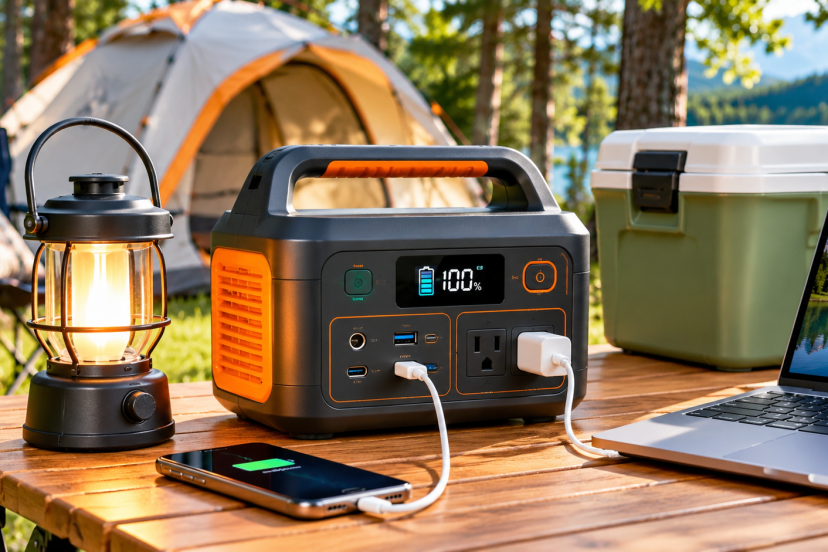
A camping trip gets complicated when your fridge needs power, your phone is nearly empty, and the nearest outlet is miles away. Choosing the best portable generator for camping means matching the equipment you bring to how long you stay, rather than buying the biggest machine available.
Some campers need a quiet battery station for lights and laptops. Others need an engine-driven generator to handle demanding appliances over several days.
This guide compares five distinct models, explains the numbers that matter, and shows how to estimate your actual electricity needs. You’ll also learn when solar charging helps, which connections to check, and how to avoid common safety mistakes before heading outdoors.
Best Portable Generator for Camping: Battery or Fuel?
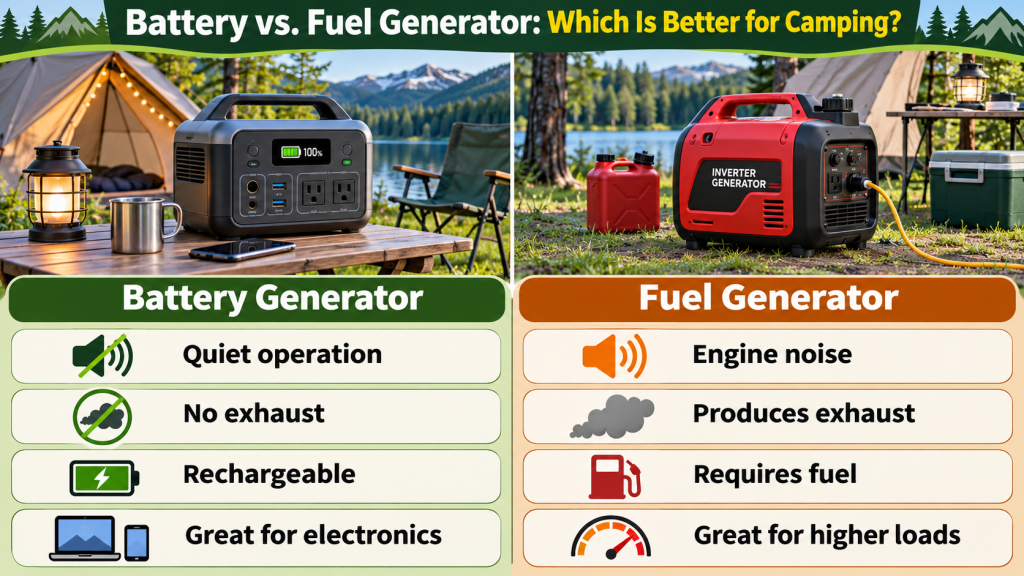
Portable battery stations store electricity and deliver it through USB, DC, or standard AC outlets. They make no combustion exhaust while operating and are generally better suited to quiet, low-power campsites. However, once the stored energy runs out, you must recharge them.
Fuel-powered inverter generators make electricity while their engines run. They can support larger continuous loads if you carry enough fuel, but require outdoor placement, periodic maintenance, and permission to operate at your campground.
Calculate Your Campsite’s Daily Energy Needs
Start with everything you intend to power, then estimate its running watts and daily operating hours. Multiply watts by hours to find watt-hours (Wh), the amount of energy each device consumes.
For example, a hypothetical 15W fan running six hours uses 90Wh. Add a 50W light for two hours and that’s another 100Wh. Together, those loads require 190Wh before accounting for conversion losses or other devices.
For a fridge, use its measured daily energy consumption rather than multiplying its rated compressor wattage by 24 hours.
Understand Running Watts and Startup Power
Running watts tell you how much electricity a generator can supply continuously. Starting or surge watts describe the brief extra output available when certain motors start.
Check the power label on your largest appliance and consider what might run simultaneously. A generator rated for 600W continuous output cannot reliably operate a conventional 1,000W kettle, even if its marketing mentions a higher temporary power mode.
Refrigerators and pumps may require an initial surge.
Choose the Right Battery Capacity for Your Trip
Battery capacity is listed in watt-hours. Do not assume every advertised watt-hour reaches your devices. Inverters, electronics, temperature, and standby operation all consume some energy. Keep some battery capacity in reserve instead of planning to use it all.
For a one-night electronics-focused trip, a small station may be enough. For a continuously operating cooler, several people, or multiple nights, consider a larger battery or a dependable recharging plan.
Compare Noise, Fumes, and Convenience
Battery power stations are appealing at shared campgrounds because they do not have running combustion engines. Internal fans may still operate, particularly during heavy loads or charging, so they are not completely silent.
Gasoline and propane generators create exhaust, engine noise, and a need to store fuel securely.
Think about the hours you need electricity. Check quiet hours before relying on an engine.
Plan Solar Charging Around Real Conditions
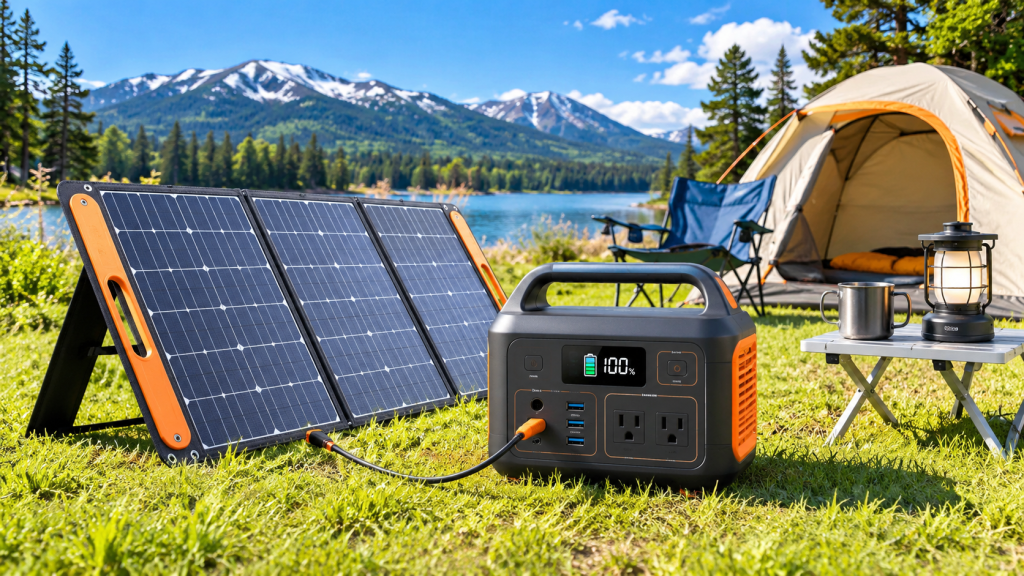
A solar-ready station is useful only if you have compatible panels and enough sunlight. Check its allowed input voltage, connector type, maximum charging watts, and whether the required cable is included.
A panel’s wattage is a peak laboratory rating, not a promise of constant output. Trees, cloud cover, low sun angles, and heat can all slow charging.
For panel positioning and connector choices, see SolarFlez’s solar panels for camping guide. Plan an alternate charging method if rain is forecast throughout your trip.
Check Outlets, USB-C, and Other Connections
Look at your devices before comparing outlet counts. A laptop that supports USB-C Power Delivery might charge directly, saving the energy that would otherwise be lost through an AC inverter. A 12V camping fridge may work through a suitable automotive-style socket.
Not every power station has an AC outlet. The Anker SOLIX C300 DC, for example, is designed for DC and USB-powered equipment; it cannot directly run a household plug-in appliance.
Look Beyond Advertised Weight and Size
A generator called portable may still be awkward to carry over gravel or up a trail. Add the weight of solar panels, protective cases, fuel cans, and cables when judging your complete setup.
For walk-in campsites, prioritize light weight and a secure handle.
Leave room around cooling vents, protect equipment from rain, and never enclose a running fuel generator in a tent or vehicle.
Recommended Portable Generators for Camping
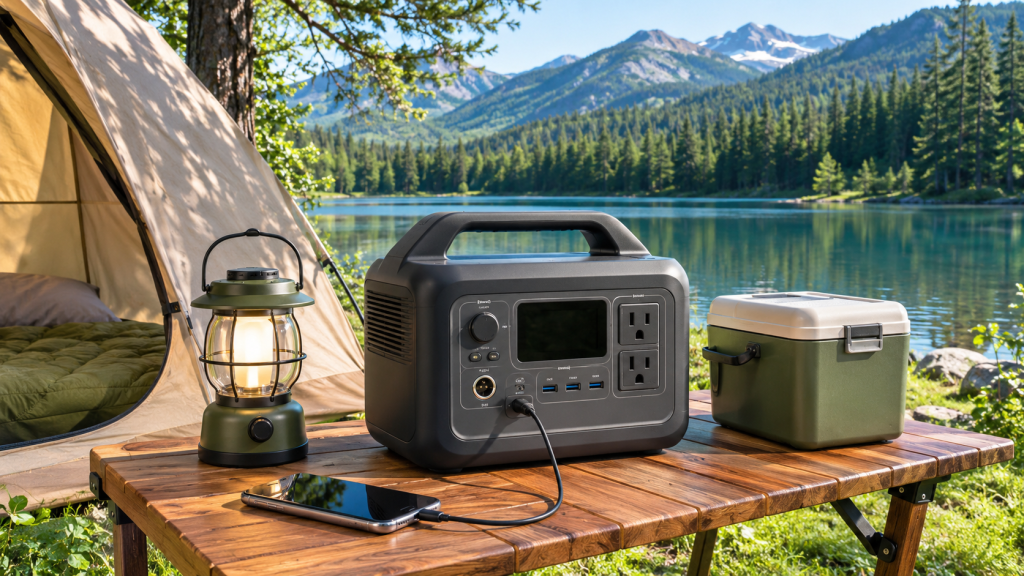
These five choices cover different camping priorities. Four store electricity in batteries; one burns fuel to produce it. Compare capacity and continuous output separately, since they answer different questions.
Jackery Explorer 1000 v2 Portable Power Station
Best for: Overall car camping and families needing generous battery capacity.
The Explorer 1000 v2 combines a 1,070Wh lithium iron phosphate battery with 1,500W continuous AC output and three AC outlets. Its maximum solar input is 400W, making it practical for longer stays with suitable panels. At roughly 23.8 pounds, it offers useful flexibility but is heavier than compact alternatives and cannot replenish itself without a charging source.
EcoFlow RIVER 2 Pro Portable Power Station
Best for: Campers balancing cooler runtime with manageable weight.
The RIVER 2 Pro offers 768Wh of battery storage, 800W continuous AC output, and solar input up to 220W. It also supports USB-C and 12V connections, making it versatile for mixed camping equipment. Its approximately 18.2-pound weight is reasonable for car trips, although its smaller inverter cannot continuously power high-wattage cooking appliances.
BLUETTI Elite 30 V2 Portable Power Station
Best for: Compact setups that still require standard AC outlets.
The Elite 30 V2 stores 288Wh and provides 600W total continuous AC output, plus high-power USB-C connections. It weighs about 9.5 pounds and accepts up to 200W of compatible solar input. That combination suits laptops, lights, and brief appliance use. The limited battery capacity, however, makes long overnight refrigeration loads harder to support without recharging.
Anker SOLIX C300 DC Portable Power Station
Best for: Lightweight USB-C and 12V camping equipment.
At around 6.2 pounds, the C300 DC carries a 288Wh battery, two 140W USB-C ports, and an automotive-style DC outlet. It can accept up to 100W of solar charging with suitable equipment. This is a smart alternative to carrying an AC inverter you never use, but its lack of household AC outlets rules out conventional plug-in appliances.
Champion Power Equipment 201323 2500-Watt Dual Fuel Inverter Generator with CO Shield
Best for: Remote permitted campsites with sustained higher electrical demands.
The Champion 201323 runs on gasoline or propane and supplies 1,850 running watts on gasoline or 1,665 on propane. It includes a carbon-monoxide shutoff system and weighs around 43 pounds. Fuel flexibility is helpful on extended trips, but the engine produces exhaust and noise, needs maintenance, and must always operate outdoors away from occupied spaces.
Estimate Runtime for Fridges, Fans, and Laptops
A simple first estimate is battery watt-hours divided by a device’s average watts. For instance, a 288Wh station powering a hypothetical 30W average load has a theoretical runtime of 9.6 hours.
Actual runtime will be shorter when you account for inverter losses, standby consumption, temperature, and usable capacity.
For a compressor fridge, use its documented daily watt-hours or measure consumption with a suitable meter over a representative day. If it uses 300Wh daily, a 288Wh battery is unlikely to provide a full day without charging, even though the fridge’s running watts may look modest.
Match Your Generator to Campsite Rules
Before purchasing an engine generator, check whether your usual campground permits them, where they may be used, and whether operation is limited to designated hours. Rules can differ between public parks, private sites, and dispersed camping areas.
Some places prohibit engines entirely, making battery storage the practical choice.
Keep any permitted generator away from paths and neighbors. If site rules are uncertain, ask the operator before travel.
Avoid These Common Buying Mistakes
The most expensive mistake is choosing by peak watts alone. A generator with impressive surge output may still lack the steady power or stored energy your appliances require.
Another is assuming a solar-compatible battery includes a solar panel. Bundles vary, and charging cables, adapters, and protective accessories may be separate purchases.
Finally, avoid overlooking weather protection, cold-weather charging limits, and servicing needs. Most portable battery stations are not designed to sit uncovered in rain.
What Federal Guidance Says About Safety and Solar Output
The CDC’s carbon monoxide safety guidance says fuel-powered generators must operate outdoors, more than 20 feet from windows, doors, and vents. Never use one in a tent, camper, garage, or other enclosed shelter, even with openings uncovered. An automatic carbon-monoxide shutoff is an added safeguard, not permission to ignore placement.
For solar charging, the U.S. Department of Energy’s explanation of photovoltaic performance describes module ratings measured at 1,000 watts per square meter of sunlight and a 25°C cell temperature. Real camping conditions often differ, so actual panel output can be lower.
These sources explain two practical buying decisions: prioritize safe generator placement, and size solar charging with extra margin instead of relying on ideal-condition numbers.
Frequently Asked Questions About Camping Generators
What size generator is enough for a weekend camping trip?
A 250–300Wh battery may cover basic phone charging, LED lighting, and short fan use, depending on your equipment. A fridge, several laptops, or longer stays can push energy needs into the 700–1,000Wh range or beyond. Add up your actual daily watt-hours first, then choose enough capacity with a reasonable buffer and a way to recharge.
Can a portable battery generator be safely used inside a tent?
A battery power station does not produce combustion exhaust during operation, unlike gasoline or propane generators. Still, follow its instructions for ventilation, moisture protection, temperature, and clearance around cooling vents. Avoid placing it where bedding blocks airflow or condensation can collect. Never operate any fuel-burning generator inside a tent, even briefly.
Will a 100W solar panel fully recharge a camping power station?
It may recharge a small battery, but the time depends on remaining capacity, sunlight, panel alignment, charging limits, and losses. A 1,000Wh battery cannot reasonably be expected to recharge quickly from a single 100W panel. Verify input compatibility and plan for several hours of effective sunlight, potentially across multiple days for larger batteries.
Is a solar generator better than a gasoline generator for camping?
A battery-based solar generator is often a better fit where quiet operation, modest power demands, and easy setup matter most. A gasoline or propane inverter generator may suit remote sites with sustained higher loads and authorized engine use. Solar panels are optional charging accessories on many battery models, so the term solar generator does not always mean a panel is included.
Can a camping generator run a coffee maker or electric heater?
Only if its continuous output meets the appliance’s power requirement and its available energy or fuel is sufficient. Heating appliances commonly draw substantial power, so they can exhaust small batteries quickly or exceed compact inverter limits. Check the appliance label, account for any other running loads, and never use a generator inside an enclosed cooking or sleeping area.
Conclusion: Which Camping Generator Should You Choose?
The best portable generator for camping is the one that powers your actual equipment without adding unnecessary weight, noise, or complexity. Start with daily energy consumption, check the highest continuous and startup loads, then decide how you will recharge during the trip.
For flexible family car camping, the Jackery Explorer 1000 v2 offers substantial storage and AC output. The EcoFlow RIVER 2 Pro is a middle-ground option, while the Anker SOLIX C300 DC suits campers relying on USB-C and 12V devices. Choose the Champion dual-fuel inverter generator only where engine operation is permitted and safe outdoor placement is possible.
If you mainly need lights, phones, and a fan for a weekend, begin with a compact battery station rather than paying for power you are unlikely to use.