Are Portable Solar Panels Right For You?
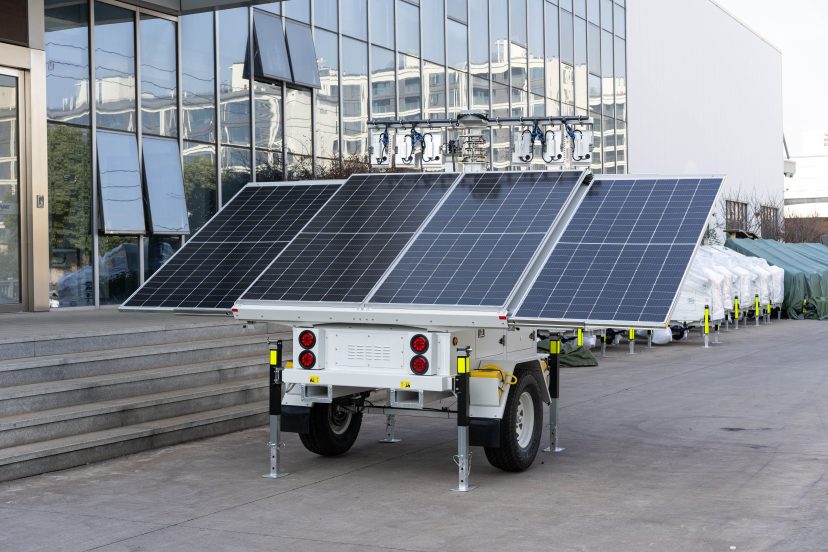
A camping trip, an unexpected power outage, or a weekend in your RV can quickly reveal how dependent you are on electrical outlets. Portable Solar Panels offer a way to collect electricity from sunlight without installing equipment on your roof. But buying a panel does not automatically mean you can run appliances, charge a battery safely, or keep essential devices working through several cloudy days.
The right choice depends on what you need to power, how often you travel, and whether you already own a compatible battery or power station. This guide explains what portable panels can realistically do, where they fall short, how to choose the right size, and which designs suit different situations.
How Portable Solar Panels Work
Portable solar panels capture sunlight and turn it into direct-current (DC) electricity. Some have USB ports for charging small electronics, while others send electricity to a power station or charge controller.
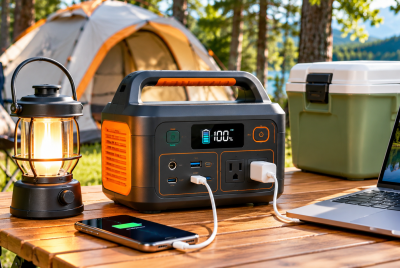
Generation is not storage. A panel generates electricity when light is available; it usually cannot save that electricity for later. To run lights after sunset, you will normally need a battery or portable power station. To use ordinary household AC outlets, you also need an inverter, often built into the station.
Who Benefits Most From a Portable Setup?
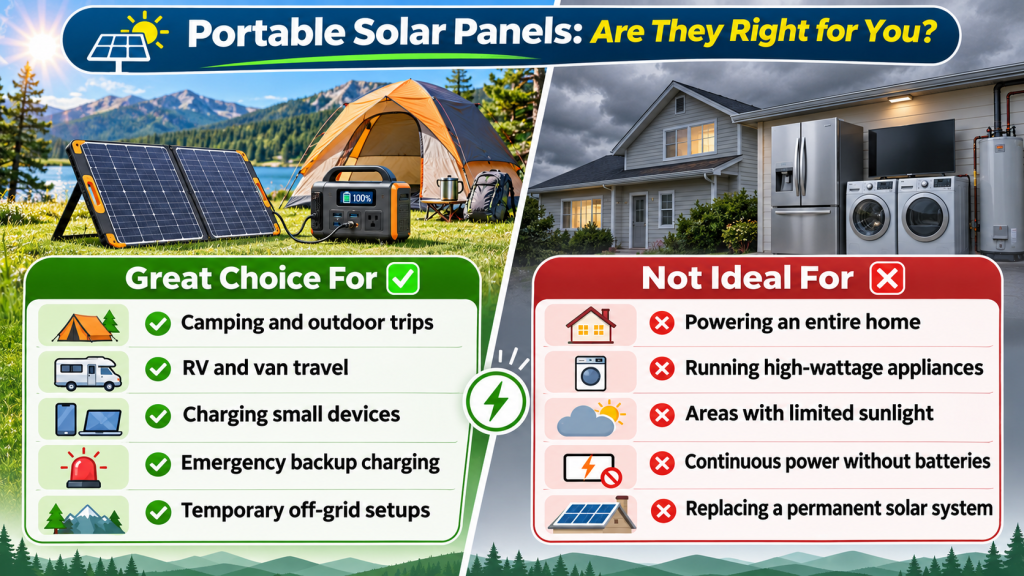
Portable panels suit people whose electricity needs move with them. RV owners can position panels in the sun while parking their vehicles in the shade. Renters may appreciate a system that requires no permanent roof changes, provided their outdoor placement is permitted.
They also offer a charging option during extended outages, although production depends on daylight and weather. If camping is your main reason for buying, the solar panels for camping guide explains campsite-specific setup choices in greater detail.
When Portable Solar Panels Are Not the Best Choice
A small portable kit is unlikely to replace household electricity. Air conditioners, electric kettles, and space heaters can demand far more power than a typical folding panel produces. Even with a large battery, sustained operation may require substantial solar capacity.
Portable gear is also less convenient when you need uninterrupted charging: you must unpack it, find clear ground, manage cables, and sometimes adjust its angle. If your goal is regularly reducing a home’s electric bill, a properly designed fixed solar system deserves consideration instead.
Portable Panels vs. Rooftop Solar and Fuel Generators
Portable panels prioritize flexibility, roof-mounted systems prioritize regular production, and fuel generators provide electricity without waiting for sunshine, provided fuel and safe outdoor operating space are available.
| Option | Main advantage | Main trade-off |
| Portable panels | Movable and removable | Weather-dependent, limited scale |
| Rooftop solar | Consistent installed capacity | Installation cost and fixed location |
| Fuel generator | Can run after dark | Fuel, noise, maintenance, exhaust |
Fuel generators must operate safely outdoors, away from openings, because exhaust contains carbon monoxide. No single solution suits every type of outage.
Foldable Panels, Solar Suitcases, and USB Chargers
Foldable fabric-backed panels pack into relatively slim cases and are popular with portable power stations. Keep cables and folding seams protected during transport.
Rigid solar suitcases use framed sections and hinged supports. They generally take more storage space and can be heavier, but some include a controller and battery clamps for an RV or 12-volt battery system.
Compact USB solar chargers trade total wattage for low bulk. They can be practical for phones and power banks, but are not substitutes for larger battery-charging panels.
How Much Electricity Can You Realistically Collect?
A panel’s rated wattage reflects its output under standard test conditions rather than guaranteed power at all times. Actual production changes with cloud cover, temperature, shadows, panel direction, and the receiving device’s charging limits.
A useful planning example: a 100-watt panel operating at an average delivered 60 watts for four productive hours would supply about 240 watt-hours (Wh) before any additional battery-storage losses. This is an illustration, not a forecast for your location.
Check the charging display over several hours, not just at noon. Plan for lower-output days.
How to Choose the Right Wattage for Your Devices
Start by listing the equipment you want to use and multiplying each item’s watts by its daily operating hours. A hypothetical 10-watt light used for five hours consumes 50 Wh; a 40-watt device running three hours consumes 120 Wh. Together, that is 170 Wh before conversion losses.
Around 100 watts suits modest daytime battery top-ups. Panels rated 200 watts or more offer greater charging potential for larger power stations, but also require more space and a compatible input. Allow a margin for clouds.
Batteries, Charge Controllers, and Connectors Explained
A portable power station normally includes its own battery-management and solar-charging electronics. Check its solar input voltage range, maximum input current, allowable wattage, connector, and polarity against the panel specifications. A plug fitting into the connection does not necessarily mean the devices are compatible.
For a separate 12-volt battery, use a charge controller specified for the battery chemistry and electrical setup. Never connect an unregulated panel directly to a battery merely because the cable fits. PWM controllers can be straightforward; MPPT controllers can improve energy harvesting in suitable conditions, although their benefits depend on system design.
Before combining panels, check combined voltage and current.
Where to Position Panels for Better Charging
Place panels where sunlight reaches the entire active surface, not merely the top edge. Trees, awnings, roof racks, and even a thin shadow can reduce output. Adjustable stands help you face the panel toward the sun and change its angle during the day.
Prioritize unobstructed sunlight during charging hours. Avoid leaving panels loose in gusty conditions. Secure stands and cables; keep batteries where their instructions permit.
What to Check Before Buying a Portable Solar Panel
Look beyond headline wattage. Compare its folded size, carried weight, available stand angles, cable length, and actual connector arrangement.
Also examine the manufacturer’s weather-resistance claims carefully. A panel’s stated ingress-protection rating does not necessarily cover open USB ports, adapters, controllers, or a connected power station. Check what accessories are included, whether replacements are available, and which components have separate warranties.
Safe Use, Maintenance, and Long-Term Value
Solar panels can produce voltage whenever exposed to light, even when you are not actively charging. Inspect insulation and connectors, follow connection instructions, and never improvise wiring into a household outlet. Protect cables from crushing and disconnect equipment before packing it away.
Clean dirt using the maker’s recommended method, allow equipment to dry before storage, and avoid sharp objects against the solar surface.
A panel may be affordable on its own, but a battery, controller, extension lead, and suitable storage case can change the buying decision.
Recommended Portable Solar Panels for Different Needs
Before ordering, confirm the exact configuration and compatibility with your equipment.
BigBlue 28W Solar Panel Charger with Dual USB-C and USB-A
Best for: Backpackers and day-trippers charging USB devices.
This compact folding charger provides USB outputs for phones and power banks without requiring a large power station. Its small format is easier to pack than a full-size camping array. However, it does not store electricity, and its modest output makes it unsuitable for running appliances or recharging large batteries quickly.
Jackery SolarSaga 100W Portable Solar Panel
Best for: Owners of compatible Jackery power stations.
The SolarSaga 100W folds for transport and uses integrated stands for positioning outdoors. Its available USB outputs add flexibility for small electronics, while the solar connection supports specified Jackery Explorer models. Check the exact panel revision and power-station connector before buying; compatibility varies across generations, and a 100-watt rating is not constant real-world output.
Anker SOLIX PS100 Portable Solar Panel
Best for: Campers prioritizing adjustable setup and weather resistance.
The PS100 is a foldable 100-watt panel with an adjustable stand and an IP67-rated panel design. It is well suited to topping up a compatible portable power station during camping or occasional outages. Confirm the supplied charging cable and your station’s input limits; the panel needs separate energy storage for nighttime use.
Renogy 200W 12V Monocrystalline Foldable Solar Suitcase with Voyager 20A Controller
Best for: RV owners charging an appropriate 12-volt battery.
Renogy combines a rigid folding 200-watt suitcase with a preinstalled Voyager 20A PWM charge controller and battery-clamp leads. That makes it a more complete choice for supported battery systems than a panel-only package. Its framed construction is comparatively bulky, and users must still select the correct battery profile and follow the manual’s connection sequence.
EF ECOFLOW 220W Bifacial Portable Solar Panel
Best for: Larger compatible power stations and sunny campsites.
This folding panel has a 220-watt rated front side plus a rear surface that can collect reflected sunlight. That extra contribution depends heavily on the ground and placement, so it should not be treated as guaranteed output. The larger deployed footprint suits car-based trips better than lightweight hiking, and electrical compatibility still needs checking.
What Solar Performance Research Actually Shows
The U.S. Department of Energy’s photovoltaic performance guidance explains that cell efficiency measures how effectively sunlight becomes electricity. It does not mean a portable panel will deliver its advertised peak output throughout the day.
The department’s research on photovoltaic energy yield identifies partial shading, surface dirt, module temperature, and power-conversion losses as factors affecting production. These findings apply to solar technology generally; they do not establish a specific daily yield for every portable model.
DOE guidance on photovoltaic system design also explains the role of battery storage when solar generation is unavailable. Prioritize clear sunlight, compatible storage, and realistic daily energy needs over impressive wattage claims.
Frequently Asked Questions About Portable Solar Panels
Can portable solar panels power a refrigerator?
Yes, with a correctly sized battery system; the panel alone cannot reliably power a refrigerator overnight. Check the appliance’s actual daily energy consumption, starting surge, and the power station’s inverter rating. Measure daily consumption because refrigerators cycle on and off.
Do portable solar panels work through a window?
They can sometimes generate electricity behind glass, but outdoor placement is generally more effective. Window glass, tinting, shadows, and the angle of incoming sunlight reduce the light reaching the cells. For apartments, check building rules and use a securely positioned outdoor location when allowed.
Is it safe to leave a portable solar panel outside overnight?
It depends on the product’s weather rating and the conditions. Some panels tolerate rain, but their attached cables, plugs, and charging equipment may have different protection levels. Overnight exposure adds risks from wind, moisture, theft, and accidental damage without meaningful solar charging. Packing it away after daylight is usually simpler.
Is a 100W or 200W portable solar panel better?
A 100-watt model is easier to transport and can be enough for small batteries or occasional charging. A 200-watt model offers more generation potential, but only if there is adequate sunlight and the connected device accepts the input. Compare daily energy needs and storage space first.
Are portable solar panels worth buying for emergencies?
They can be worthwhile when outages last beyond the energy stored in your power station and you have access to a safe, sunny setup area. Their limitations are equally important: storms may produce little electricity, and solar charging typically happens during daylight. Charge essential equipment beforehand; keep a backup plan.
Final Verdict: Are Portable Solar Panels Right For You?
Portable Solar Panels make the most sense when you need flexible, occasional electricity rather than a permanent household supply. A compact BigBlue charger can serve basic USB needs, while Jackery’s SolarSaga 100W is better suited to a compatible small power station. For an RV battery, Renogy’s suitcase kit offers a controller-equipped alternative.
Before choosing, calculate how many watt-hours you use each day, check the receiving battery’s electrical limits, and picture where the panel will sit in full sunlight. Remember that panels generate electricity; batteries make it available later.
If your priorities are camping, off-grid travel, or charging during prolonged outages, a thoughtfully matched portable system is worth considering. If you need continuous high-power use or substantial household savings, investigate a larger fixed system instead.