Solar Power Inverter for Home: How to Choose the Right Model in 2026
Buying a solar power inverter for home use can get confusing fast. Two units may both say “5,000 watts,” yet one works with a 48V battery bank, another is intended for grid interaction, and a third cannot directly serve your home’s 240V loads. The right choice depends on what you want to power, whether you use batteries, your solar-array voltage, and local electrical requirements.
This guide explains those decisions in plain language, compares five inverter options for different households, and highlights the specifications worth checking before you buy. The goal is not to chase the largest number on the label. It is to match the inverter to your home, solar equipment, backup goals, and installation plan.
What a Solar Power Inverter for Home Actually Does
Solar panels produce direct-current electricity, while most household circuits use alternating current. The inverter changes DC electricity into AC power that your home can use. The U.S. Department of Energy also notes that modern inverters may provide monitoring and grid-support functions, depending on their design.
Some products are simple battery inverters. Others combine an inverter, AC charger, transfer function, and MPPT solar-charge controller. Know which jobs your system needs before comparing wattage.
Start With Your System Type: Grid-Tied, Off-Grid, or Hybrid
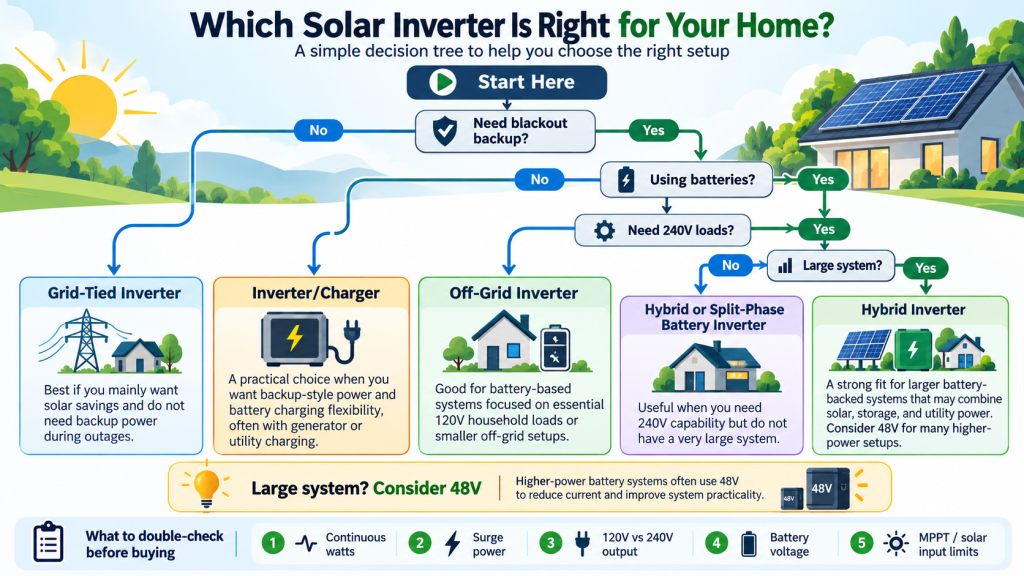
A grid-tied system works with the utility. An off-grid system must serve loads without it. A hybrid system may combine solar, batteries, and grid or generator input, but features vary by model.
Grid-connected solar does not automatically power your house during an outage. Backup requires compatible equipment plus correct isolation or transfer hardware.
If you also need AC charging from utility power or a generator, SolarFlez’s inverter charger guide explains how that function differs from an inverter and solar charge controller.
How to Size a Solar Power Inverter for Home
Start with the loads you expect to run at the same time, not every appliance you own. Add their continuous wattage, then account for startup demands from motors and compressors. Leave reasonable operating headroom instead of planning to run the inverter at its limit.
For a battery-based solar power inverter for home, the battery bank must also supply the required current. A large inverter paired with an undersized battery, cables, or protection devices is not a balanced system.
Continuous Watts, Surge Watts, and 120/240V Output
Continuous output is what the inverter can sustain; surge output covers brief startup demand. Appliances such as refrigerators, pumps, and certain air conditioners can require a brief surge of additional power when their motors start.
Many North American homes use both 120V and 240V circuits. A 120V-only solar power inverter for home can suit a critical-load subpanel, but it cannot directly serve normal 240V loads. Verify split-phase capability before planning whole-home backup.
Battery Voltage and Why 48V Often Makes Sense
For larger battery-backed systems, 48V architecture is common because higher DC voltage means lower current for the same power. That can make conductors easier to manage, although cables, busbars, fuses, breakers, and disconnects still need correct sizing.
A 12V solar power inverter for home can suit an existing 12V bank or smaller system. At high power, though, 12V creates very high DC current, so choose voltage as part of the full system design.
MPPT Solar Input: The Specification Buyers Miss
An all-in-one inverter’s MPPT controller has voltage and current limits. Your panel string must stay within that window, including in cold conditions when open-circuit voltage can rise.
Check maximum PV voltage, MPPT range, input-current limits, and tracker count. Multiple MPPT inputs help when roof sections face different directions. If your solar power inverter for home lacks MPPT, budget for a separate solar charge controller.
Pure Sine Wave, Efficiency, and Power Quality
For household use, pure sine wave is the practical default for typical electronics, motors, and variable-speed equipment.
Efficiency matters too, but one headline percentage tells only part of the story. Conversion efficiency changes with load and operating conditions, while standby consumption matters in off-grid systems left on overnight. Compare verified specifications rather than vague “high efficiency” claims.
Safety, Listings, and Grid-Interconnection Requirements
Electrical compatibility should never be inferred from marketing language. In the United States, IEEE 1547-2018 covers interconnection and interoperability requirements for distributed energy resources, while UL Solutions identifies UL 1741 among standards used for inverter and interconnection-equipment certification.
Still, a listing does not guarantee acceptance by every utility. For a grid-connected solar power inverter for home, confirm the exact model, required certifications, utility rules, disconnects, and local electrical-code requirements before purchase.
Recommended Solar Power Inverter for Home Options
These five models suit different buyers rather than repeating one design. Some integrate solar charging; others fit modular systems with separate controllers.
| Product | Best fit | Battery | AC output | Solar controller |
| LiTime 3500W | Compact all-in-one backup | 48V | 120V | 80A MPPT |
| PowMr 5000W | Flexible expansion | 48V | 120V / configurable split-phase | 100A MPPT |
| SUNGOLDPOWER 10000W | Larger household loads | 48V | 120/240V | Dual MPPT |
| Victron MultiPlus 3000VA | Modular systems | 48V | 120V | Separate |
| Renogy P2 3000W | Existing 12V banks | 12V | 120V | Separate |
LiTime 3500W Solar Inverter Charger, All-in-One 48V DC-120V AC, 80A MPPT | With UPS & RS485 Communication, Surge 7000W, Max 40A Charge Current, Hardwire Terminal for Home Backup, Off-Grid
Best for: Compact 48V backup and off-grid systems
This 3,500W all-in-one combines a 48V inverter, 80A MPPT solar charging, AC charging, and communication functions. It suits a modest backup build. Its main limitation is 120V output, so buyers planning native 240V household loads need a different architecture.
PowMr 5000W Hybrid Solar Inverter 48V DC to 110V/120V/208V/240V AC, Single & Split & Three Phase Pure Sine Wave Power with 100A MPPT Controller, Support Parallel, for LiFePO4/Li/GEL/AGM Battery
Best for: DIY users who want flexible expansion
PowMr’s 5,000W platform uses a 48V battery system, MPPT solar charging, and parallel configurations. Manufacturer documentation for the SP5K lists 120V single-phase or 208/240V split-phase backup configurations. That flexibility is useful, but correct configuration, wiring, and approval remain important.
SUNGOLDPOWER 10000W 48V Solar Inverter, Split Phase Built-in 2 MPPTs, Max 200A Battery Charging, AC Input/Output 120V/240V(settable), Pure Sine Wave Inverter(BMS COMM) UL1741 SPH10048P
Best for: Larger homes needing 120/240V backup capability
This 10,000W 48V model targets heavier household loads with split-phase 120/240V output and dual MPPT inputs. That can simplify a larger battery-backed design. However, higher capacity increases demands on batteries, PV input, conductors, and overcurrent protection, so it should follow a proper load calculation.
Victron Energy MultiPlus Inverter/Charger 120VAC 3000VA 48V 35A | Pure Sine Wave Inverter Charger for 35 amp Battery
Best for: Premium modular systems
The 48V MultiPlus combines pure-sine-wave inverter and battery-charger functions with Victron’s PowerAssist and expandable architecture. It fits buyers who prefer modular equipment and separate solar charging. This is not an all-in-one MPPT solar inverter, so PV charging requires additional compatible hardware.
Renogy Inverter P2 3000W Pure Sine Wave Inverter 12V DC to 120V AC Converter for Home, RV, Truck, Camping, Trailer, with Wired Remote Controller, Support Li, AGM, SLD, Gel, FLD Batteries
Best for: Existing 12V battery systems and smaller off-grid loads
Renogy’s P2 delivers 3,000W of continuous 120V pure sine wave power from a 12V battery bank, supports surges up to 6,000W, and includes a wired remote. It suits existing 12V systems. It has no integrated solar controller, and full-power operation requires substantial DC current, cabling, and protection.
When a Smaller Inverter Is Smarter Than a Bigger One
Oversizing can increase costs around the inverter, including batteries, conductors, and protection equipment.
Decide whether you need whole-home backup or only critical loads. Refrigeration, lights, internet, selected outlets, and a pump may need far less capacity than electric heating or cooking. For many households, the best solar power inverter for home is the smallest unit that comfortably handles planned loads and startup surges.
Research-Backed Guidance Before You Buy
The U.S. Department of Energy’s explains that inverters convert solar DC into AC and that advanced units can provide monitoring and grid functions. Choose by system role, not wattage alone.
For grid-connected equipment, defines interconnection and interoperability requirements. UL Solutions’ identifies standards including UL 1741. Together, they show why verified listings and local approval matter.
A 2023 peer-reviewed IET Renewable Power Generation study identifies the inverter subsystem as reliability-critical in grid-connected PV systems, reinforcing the value of monitoring, thermal management, installation quality, and serviceability.
Installation, Ventilation, and Monitoring Considerations
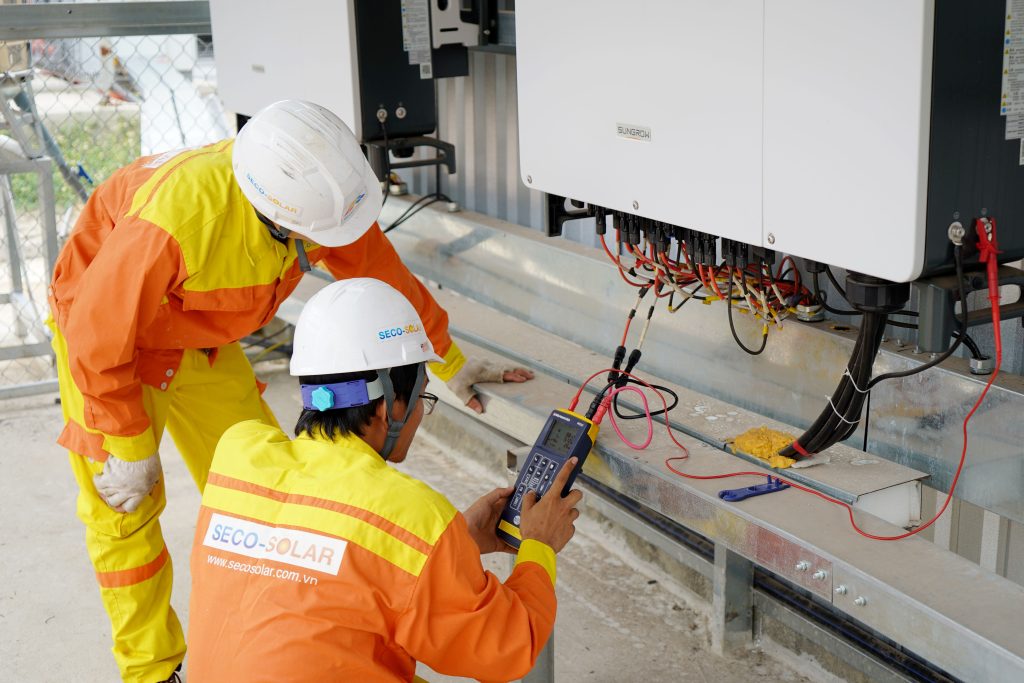
Inverters create heat, so follow the manufacturer’s mounting, clearance, temperature, and environmental requirements. An accessible location also makes service easier.
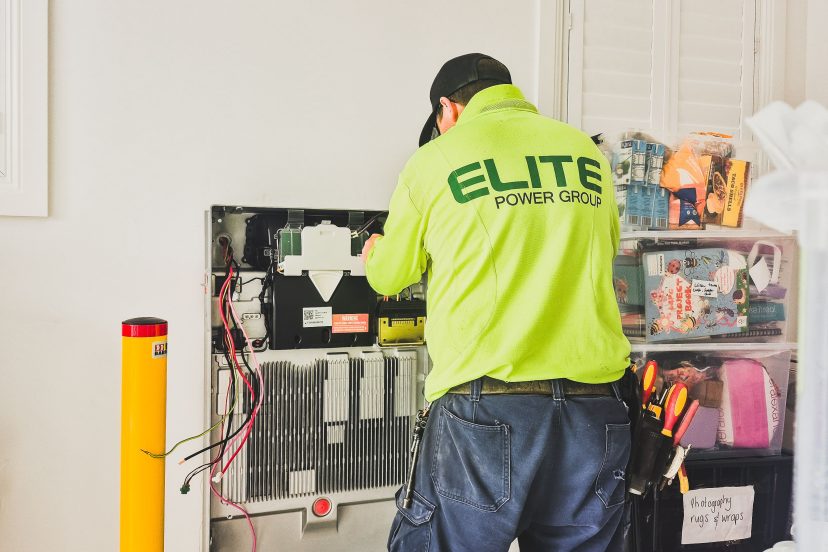
Monitoring can show PV input, battery condition, AC loads, faults, and operating mode. For a hardwired solar power inverter for home, professional installation is often sensible because grounding, DC fault current, transfer equipment, and service-panel work involve serious electrical risks.
Common Buying Mistakes to Avoid
Do not shop by wattage alone or assume “hybrid” means the same thing across brands. Verify battery charging, MPPT, generator input, backup transfer, grid export, and battery-free operation individually.
Also check voltage. A 120V unit cannot become a normal 120/240V whole-home inverter simply because its wattage is high. Review battery compatibility, PV limits, monitoring, documentation, support, and required certifications. A solar power inverter for home is one part of a complete system.
Frequently Asked Questions About a Solar Power Inverter for Home
What size solar power inverter for home do I need?
Add the wattage of loads you expect to run simultaneously, then account for motor or compressor startup surge and leave sensible headroom. A critical-load system may need only a few kilowatts, while a home with major 240V loads can require much more. Size the battery bank, cabling, and protective devices alongside the inverter rather than treating the inverter rating alone as the answer.
Can a solar inverter run my home during a blackout?
Only if the system is designed for backup operation. Many grid-tied systems shut down when utility power fails to prevent unintended energization of utility lines. Backup requires compatible inverter or storage equipment plus approved isolation or transfer hardware. Confirm the product’s documented backup mode and your installation design instead of assuming rooftop panels automatically provide outage power.
How does a 48V inverter compare with a 12V inverter?
Not universally, but 48V is generally more practical as power levels rise because it uses lower DC current for the same wattage. A 12V unit can still be appropriate for smaller systems or an existing 12V battery bank. Choose the voltage that fits your batteries, charging equipment, conductor sizing, expected loads, and future expansion.
Do I need a hybrid inverter if I already have batteries?
Not necessarily. Batteries can work with a separate inverter/charger and solar charge controller or with an integrated hybrid unit, depending on system design. A hybrid model can reduce component count, while a modular setup lets you select or replace functions separately. Compatibility with the battery management system, charging sources, and desired backup behavior matters more than the word “hybrid.”
What is the typical lifespan of a home solar inverter?
There is no single dependable lifespan for every model. Service life depends on design, loading, heat, ventilation, environment, installation quality, and maintenance. Compare warranty terms, operating-temperature limits, monitoring, service support, and replacement options instead of relying on a broad lifespan claim. Reliability research also supports treating the inverter as a component worth monitoring closely.
Conclusion: Choosing the Right Solar Power Inverter for Home
The best solar power inverter for home is the one that fits your electrical design, not simply the highest wattage. Start with simultaneous loads, startup surge, 120V versus 120/240V requirements, battery voltage, and PV input limits. Then verify listings, utility rules, monitoring, and installation needs.
For a compact 48V all-in-one build, the LiTime 3500W is a practical starting point. Larger homes that genuinely need split-phase backup may be better matched to the SUNGOLDPOWER 10000W architecture, while modular-system buyers may prefer Victron. Finalize the load calculation and system design first, then choose the inverter that matches that plan and your household priorities.