Top 10 Solar attic fans
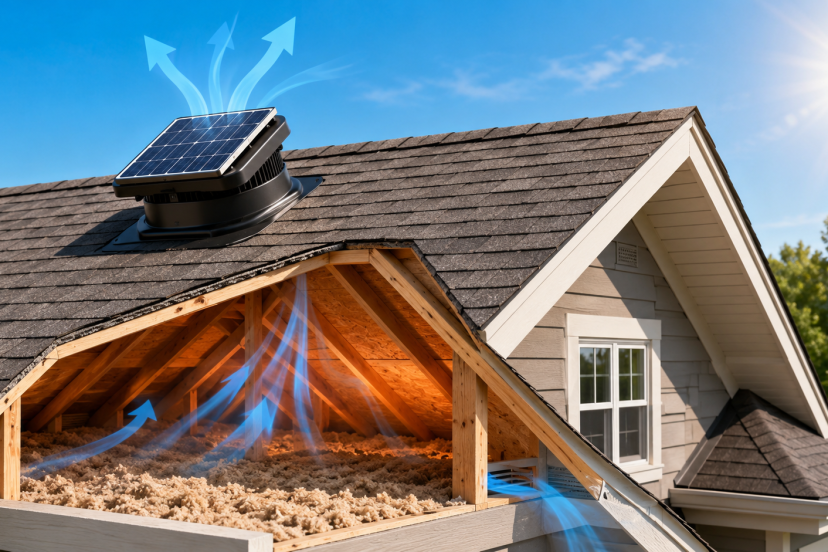
Solar attic fans use photovoltaic panels to power exhaust fans that remove hot, humid air from vented attics. They suit homeowners with sunny roofs, adequate soffit intake, and an attic properly separated from conditioned rooms. The right model supports airflow without adding daytime electricity use, but poor sizing may pull cooled household air through ceiling leaks. We compared mounting style, solar wattage, controls, claimed airflow, weather resistance, installation, accessories, warranty information, and value. Confirm roof compatibility and local codes before cutting an opening into your existing roof deck.
Solar attic fans comparison table
| Product | Best for | Key feature | Main limitation | Price category | Overall recommendation |
| iLIVING 40W Hybrid | Overall versatility | Solar and AC operation | Complex roof installation | Premium | Best all-rounder |
| Remington SF30-BLK | Moisture control | Thermostat and humidistat | Adapter costs extra | Premium | Strong sensors |
| Remington Builder 40W | Night operation | Included 110V adapter | Expensive | Premium | Best hybrid |
| Natural Light SAF48B | Large attics | Claimed 1,881 CFM | Large footprint | Premium | High capacity |
| 4SEASONS 12W | Small attics | Compact 400-CFM design | Limited coverage | Mid-range | Best compact |
| Amtrak SPF-12 | Custom systems | Fan-only format | Panel not included | Budget | Best value |
| VEVOR JBSF-320 | Gable mounting | Adjustable thermostat | Needs suitable gable | Mid-range | Beginner-friendly |
| Bsteciar SRFSZ-11-36 | Remote control | Dual-power compatibility | Newer brand | Mid-range | Convenient |
| DuskSnug KR-1210100001 | Simple automation | Controller-free operation | Claims need rechecking | Mid-range | Straightforward |
| LANGY LG-SAF-55 | High-watt use | 55W panel and thermostat | Limited track record | Mid-range | Specialized |
1. iLIVING ILG8SF301A 40W Hybrid Solar Roof Attic Fan — Best for Overall Versatility
Overview: This roof-mounted unit combines daytime solar ventilation with an included AC/DC adapter, targeting medium and larger attics.
Key features: 40W adjustable panel; claimed 1,150 CFM; thermostat adjustable from 50°F to 122°F; IP68 brushless motor.
Pros: Hybrid operation; adjustable panel; established manufacturer support.
Cons: Requires roof cutting; premium cost.
Best for: Homeowners wanting one adaptable system.
Verdict: Practical controls and hybrid capability make it the strongest overall package.

2. Remington Solar SF30-BLK 30W Roof Mount Attic Fan — Best for Humidity Control
Overview: Remington combines solar ventilation with automatic heat and moisture sensing, suiting humid climates and hands-off operation.
Key features: 30W tilted panel; thermostat and humidistat; brushless 24V DC motor; powder-coated steel; optional hybrid adapter.
Pros: Moisture-responsive operation; sturdy construction; aimable panel.
Cons: Nighttime power costs extra; relatively expensive.
Best for: Humid regions and moisture-prone attics.
Verdict: Integrated sensors distinguish it from simpler sun-only fans.

3. Remington Solar Builder Series 40W Attic Fan — Best for Night Operation
Overview: This Builder Series model includes a 110V adapter, supporting automatic operation when solar input drops.
Key features: 40W panel; hybrid adapter; thermostat and humidistat; brushless motor; oversized steel flashing.
Pros: Night operation included; automatic controls; substantial flashing.
Cons: Premium price; adapter needs surge protection under stated warranty terms.
Best for: Hot, humid attics needing extended operation.
Verdict: It includes hybrid hardware that many competitors sell separately.

4. Natural Light SAF48B 48W Solar Attic Fan — Best for Large Attics
Overview: The SAF48B is a high-output roof model marketed for broad coverage and demanding sunny climates.
Key features: 48W panel; claimed airflow up to 1,881 CFM; claimed coverage to 2,825 square feet; adjustable panel; large flashing.
Pros: Strong claimed capacity; aimable collector; established design.
Cons: Large footprint; Amazon may show third-party buying options only.
Best for: Large vented attics with strong sunlight.
Verdict: Few models pair this panel size with comparable claimed coverage.

5. 4SEASONS 12W Solar Attic Vent Fan — Best for Small Attics
Overview: This compact roof vent avoids oversizing garages, sheds, additions, and modest residential attics.
Key features: 12W monocrystalline panel; claimed 400 CFM; coverage to 500 square feet; polycarbonate housing; CSA A93 certification stated on Amazon.
Pros: Compact footprint; simpler sizing; weather-resistant housing.
Cons: Unsuitable for large attics; buying options vary.
Best for: Small roofs and limited ventilation zones.
Verdict: Its modest capacity fills a niche that oversized fans miss.

6. Amtrak Solar SPF-12 12-Inch Attic Exhaust Fan — Best Budget Option
Overview: The SPF-12 suits buyers who own a compatible panel or want a custom gable-mounted system.
Key features: 12-inch frame; 12V DC motor; claimed compatibility with 40W–100W panels; plug-and-play connectors; mounting tabs.
Pros: Flexible panel choice; shallow profile; budget positioning.
Cons: Panel and thermostat sold separately; Amazon airflow claims conflict.
Best for: Experienced DIY users building tailored ventilation.
Verdict: Useful hardware comes without forcing replacement of existing solar components.

7. VEVOR JBSF-320 12-Inch Solar Gable Mount Fan — Best for Beginners
Overview: This complete gable model avoids cutting roof decking when a suitable vent already exists.
Key features: Claimed 1,300 CFM; adjustable thermostat; protective mesh; 12-inch fan; claimed 1,850-square-foot coverage.
Pros: Accessible installation; thermostat included; screened opening.
Cons: Needs adequate gable and intake vents; output follows sunlight.
Best for: First-time installers with accessible gables.
Verdict: Familiar mounting and included controls reduce setup friction.
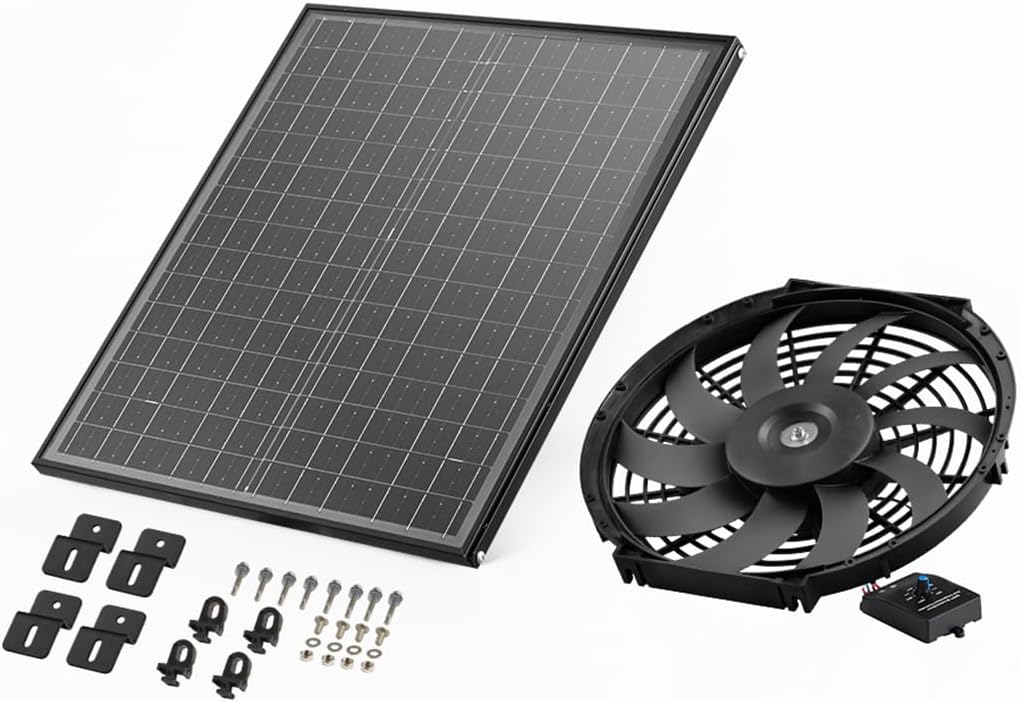
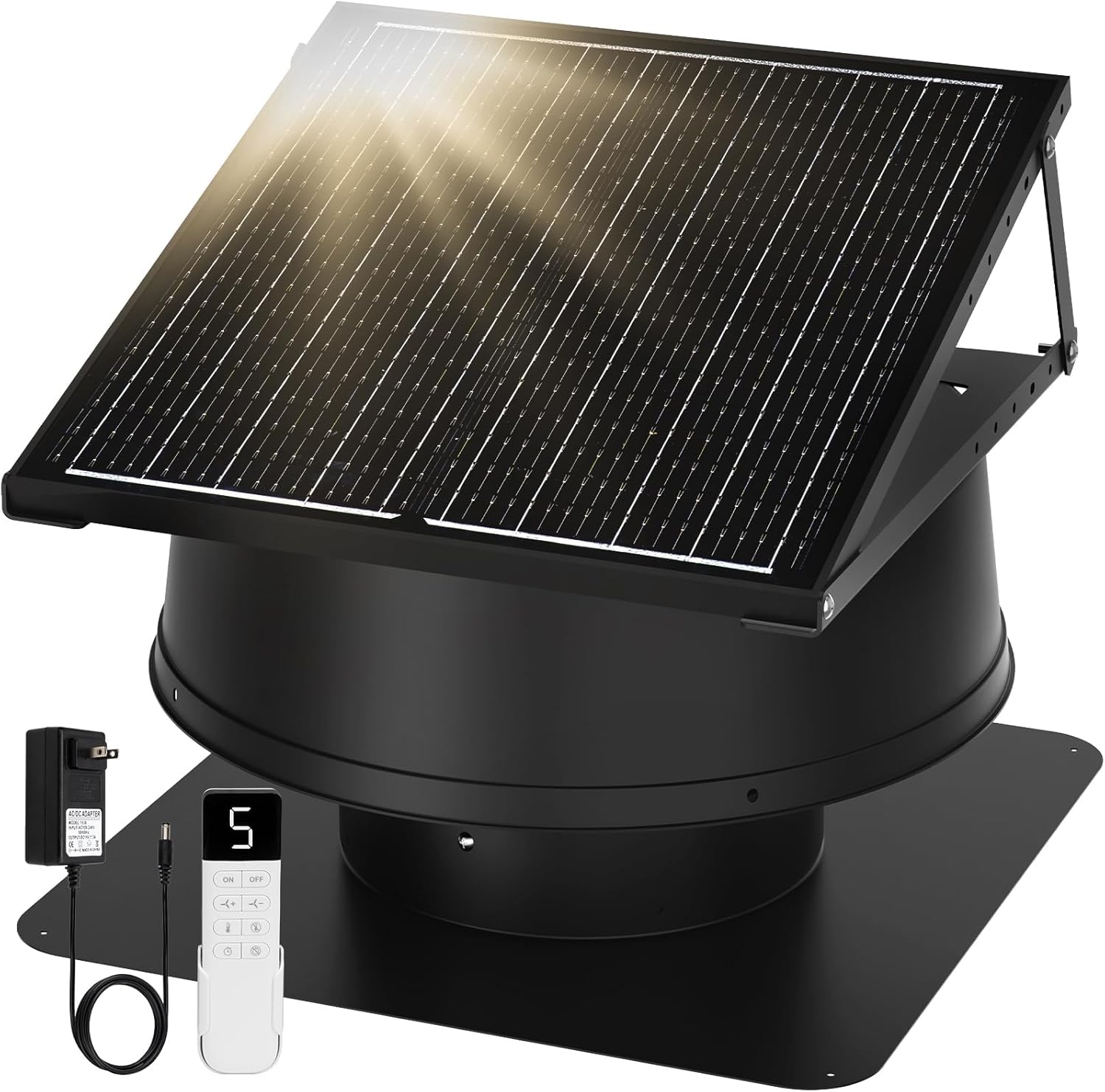
8. Bsteciar SRFSZ-11-36 42W Solar Attic Fan — Best for Remote Control
Overview: Bsteciar combines roof ventilation, remote operation, and dual-power compatibility for direct and automatic control.
Key features: 42W panel; claimed 2,100 CFM; thermostat; remote; smart power adapter; 22-inch footprint.
Pros: Remote convenience; solar/DC operation; complete accessories.
Cons: Limited brand history; verify controller range and warranty.
Best for: Users wanting adjustments without entering the attic.
Verdict: The remote and adapter make it more controllable than basic models.

9. DuskSnug KR-1210100001 40W Solar Attic Fan — Best for Simple Automation
Overview: DuskSnug offers controller-free automatic ventilation in a weather-resistant roof package.
Key features: 40W monocrystalline panel; 12-inch fan; claimed 1,800–2,000 CFM; metal housing; copper motor construction claimed by the seller.
Pros: Clean installation concept; substantial claimed airflow; integrated panel.
Cons: Limited history; performance figures are manufacturer claims.
Best for: Sunny sheds, garages, and uncomplicated attic projects.
Verdict: It appeals when simplicity matters more than remote control.

10. LANGY LG-SAF-55 Hybrid Solar Attic Fan — Best for High-Watt Specialized Use
Overview: LANGY combines a 55W panel, thermostat, and hybrid capability for stronger solar collection.
Key features: 55W panel; claimed 1,400 CFM; claimed 1,800-square-foot coverage; five aluminum-alloy blades; 16.4-foot cord.
Pros: Large panel; thermostat included; flexible cable routing.
Cons: Small review history; verify adapter and warranty details.
Best for: Attics, garages, RV structures, or greenhouses with good exposure.
Verdict: Its large panel offers a distinct alternative to conventional 30W systems.
How to Choose the Best Solar attic fans
Start with attic volume, not floor area alone. Coverage figures assume specific venting and sunlight, so compare CFM cautiously. A compact attic may need a smaller fan, while high airflow requires sufficient intake area to prevent excessive negative pressure.
Choose roof mounting when sun exposure and roof condition are suitable. Gable models are easier to service and may avoid roof penetrations, but need correctly sized openings. Confirm roof pitch, flashing dimensions, cutout size, cable length, and roofing-warranty implications.
Solar wattage influences daytime power, yet direction and shade matter equally. For stronger output, give the panel unobstructed sun and check the recommended solar panel angle for your location.
Controls determine behavior. Thermostats limit cool-weather operation; humidistats respond to moisture; hybrid adapters support cloudy or nighttime use. Verify included parts because similarly named models may omit adapters, remotes, or sensors.
Also compare motor type, screen access, and replacement-part availability. Brushless motors generally reduce wear, but published durability still depends on sealing, bearings, heat, and installation quality. A long warranty is useful only when registration, labor coverage, shipping, and adapter exclusions are clear. Save the receipt, model number, manual, and installer photographs for future claims.
Inspect soffit vents and air-seal the attic floor first. ENERGY STAR warns that powered attic fans can draw conditioned air from the house when intake vents are blocked or ceilings leak. Ask a roofer, HVAC professional, or energy auditor to check combustion-appliance backdraft risk, codes, and ventilation balance.
Frequently Asked Questions About Solar attic fans
Do solar attic fans work on cloudy days?
They usually slow as solar input falls. Hybrid models can use household power when their adapter and controls permit it.
How many CFM does my attic need?
No universal number applies. Attic volume, intake area, climate, roof design, and air sealing influence appropriate airflow.
Are roof-mounted or gable-mounted fans better?
Roof models may capture sun efficiently; gable models are often easier to install and service. Choose according to roof condition and vent layout.
Can a solar attic fan replace insulation?
No. Ventilation, air sealing, and insulation do different jobs. Correct insulation and sealed ceiling leaks remain essential.
Do these fans require maintenance?
Inspect the panel, flashing, screen, wiring, and fan annually. Remove debris safely, keep intake vents open, and follow manufacturer instructions.
Final Verdict
The iLIVING ILG8SF301A is best overall for adjustable solar collection, temperature control, and included hybrid power. The Amtrak SPF-12 is the best budget option for buyers with compatible hardware. Remington’s Builder Series 40W is the premium winner for extended operation, while the VEVOR JBSF-320 is the easiest starting point for an accessible gable installation. For specialized high-watt use, LANGY’s LG-SAF-55 stands out.
Compare specifications, confirm cutout and flashing dimensions, verify intake ventilation, review current warranty terms, and check the latest U.S. product information on Amazon.com before purchasing.