12 Solar Installation Mistakes to Avoid
You know that feeling when a solar quote lands in your inbox and suddenly everything sounds both exciting and weirdly complicated? One company says your roof is perfect. Another says you need optimizers. A third throws around words like interconnection, offset, and kilowatt-hour like you were apparently born knowing them.
That is exactly where a lot of people make avoidable Solar Installation mistakes.
The good news is that most of the big, expensive mistakes happen before the first panel ever touches the roof. So if you slow down, ask better questions, and plan with your real life in mind, you can make a smart move instead of a stressful one.
In this guide, you’ll learn the most common Solar Installation mistakes to avoid, how to spot red flags early, and what actually matters when you want a system that performs well for years.
Disclosure: This article includes affiliate product suggestions, which means I may earn a commission if you buy through those links at no extra cost to you.
Why solar installation goes wrong so often
Solar sounds simple from a distance: put panels on roof, catch sunlight, save money. But real life is messier.
Your roof age matters. Shade matters. Utility rules matter. Financing terms matter. Even the way your household might change over the next five years matters. The U.S. Department of Energy recommends looking at efficiency first, assessing solar potential, reviewing past electricity use, and getting bids plus site assessments before moving ahead.
That’s why good Solar Installation is less like buying a blender and more like tailoring a suit. Close enough is not good enough.
Mistake #1: Starting with a tired roof
If your roof is nearing the end of its life, installing solar first can be a wallet-punch later.
What to check first
Ask yourself:
- How old is the roof?
- Has it had leaks or patchwork repairs?
- Will it likely need replacement within the panel lifespan?
DOE guidance says roof condition should be assessed before installation, and it can save money to do solar at the same time as a roof replacement if that work is already coming.
A shiny new solar array on a worn-out roof is like putting expensive tires on a car with a failing transmission. It looks productive right up until it isn’t.
Mistake #2: Skipping a real shade analysis
A little shade is not always a deal breaker, but pretending it does not exist definitely is.
Trees, chimneys, nearby buildings, and even seasonal sun angles can drag performance down. In an NREL study of 542 PV systems, average power loss from partial shading was 8.3%, and the researchers estimated losses would have been 13% without panel-level optimizers.
Why this matters
Two homes on the same street can have wildly different solar results just because one roof gets clean morning sun and the other has a stubborn oak tree throwing elbows by 2 p.m.
So do not settle for “you should be fine.” Ask for a proper shade assessment and production estimate.
Mistake #3: Guessing your system size
Some people size a system based on what a neighbor installed. Others size it based on what sounds affordable in the moment. Both can backfire.
DOE recommends reviewing previous electricity bills and considering future changes like EV charging, appliance upgrades, or bigger household loads before choosing system size.
Better way to think about it
Look at:
- Your last 12 months of electric bills
- Whether your utility rates are rising
- Future plans like an EV, pool pump, or electric water heater
- Whether you want full or partial offset
Solar is not a one-size-fits-all hoodie. It needs to fit your usage.
Mistake #4: Chasing the cheapest quote
A low quote can feel thrilling. Then the paperwork arrives and suddenly the warranty is thin, the hardware is vague, and the install timeline is floating around in the atmosphere somewhere.
DOE specifically recommends comparison-shopping by asking multiple installers to assess your roof and making sure the installer is licensed and certified by a reputable organization.
What to compare besides price
Use H3-like questions in your head:
Is the equipment clearly named?
You want actual panel and inverter models, not hand-wavy promises.
Is the production estimate realistic?
If one quote seems magically higher than all the others, raise an eyebrow.
What does the warranty really cover?
Equipment, workmanship, roof penetrations, and performance are not the same thing.
Mistake #5: Ignoring financing fine print
This one sneaks up on people.
A monthly payment can look lower than your current electric bill, which sounds great. But the loan fee, interest structure, dealer fee, or prepayment assumptions may change the math fast.
DOE says financing and incentives are major parts of the solar decision, and ownership versus leasing affects who receives tax credits and incentives.
If a salesperson spends ten minutes on your monthly payment and ten seconds on total cost, slow the conversation down.
Mistake #6: Assuming permits and interconnection are “their problem”
Your installer may handle most of the process, but you still need to understand what is happening.
Permits, inspections, and utility interconnection can affect timeline and total cost. DOE notes that working with the installer and utility is part of the process, not an afterthought.
Ask these simple questions
- Who pulls the permit?
- Who handles utility paperwork?
- What happens if the utility requests changes?
- What is the estimated permission-to-operate timeline?
That one question alone can save you from the classic “the panels are on, but the system still isn’t live” confusion.
Mistake #7: Assuming every utility treats solar the same
This is where a lot of rosy savings estimates wobble.
Net metering, export credits, and bill structures vary by state and utility. DOE’s homeowner guidance says compensation for exported solar depends on local policies and utility practices.
So if someone says, “You’ll wipe out your electric bill,” your follow-up should be, “Based on which utility rules?”
That is not being difficult. That is being awake.
Mistake #8: Picking the wrong inverter setup
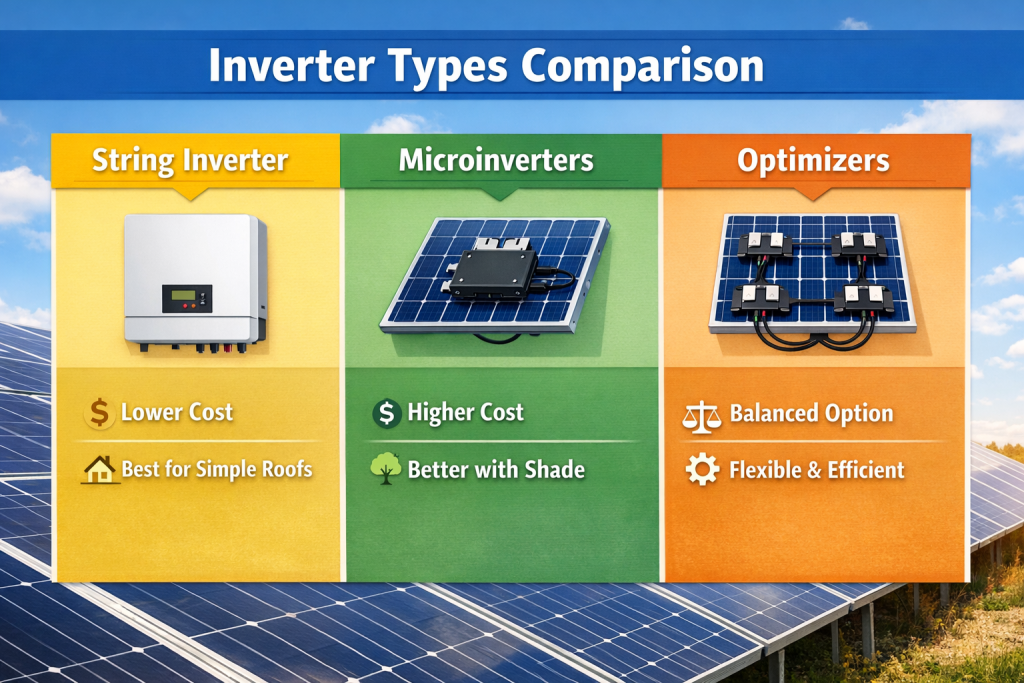
String inverters, microinverters, and optimizers all have their place.
If your roof is simple, open, and evenly lit, one setup may work beautifully. If your roof has multiple planes or patchy shade, a different setup may make more sense.
A good rule of thumb
- Simpler roof, less shade: simpler design may work
- Multiple roof faces or shading: module-level electronics deserve a serious look
That advice is backed by the shading research above. In short, roof design should drive hardware choice, not sales scripts.
Mistake #9: Forgetting your future energy life
Solar should match the life you are growing into, not just the one you had last summer.
Maybe you work from home now. Maybe you will buy an EV next year. Maybe your teenagers have discovered that every light in the house can, in fact, remain on forever.
A smart Solar Installation plan leaves room for real-world change.
Plan for what is next
Think about future:
- EV charging
- Heat pump upgrades
- Battery storage
- Home additions
- Electric cooking or water heating
A little forecasting now can prevent an undersized system later.
Mistake #10: Assuming batteries are always required
Batteries are useful. They are not automatically necessary.
If your goal is mainly bill savings, your best investment may still be the solar array itself. If your goal is backup power during outages, batteries become much more important. DOE notes that storage helps solar deliver power when the sun is not shining, especially for evening use or outages.
Do not let anyone convince you that every solar project needs every shiny add-on.
Mistake #11: Rushing the contract
Solar contracts deserve calm, unhurried reading. Not “skim while standing in the kitchen” reading.
DOE’s homeowner guide warns consumers not to give in to pushy sales tactics, to talk to certified installers, and to understand financing options. It also points readers to federal consumer materials on solar scams and misleading offers.
Slow down and review
Check:
- Total installed cost
- Financing assumptions
- Warranty length
- Production guarantee language
- Cancellation terms
- What happens if equipment changes
If the contract feels slippery, trust that feeling.
Mistake #12: Treating DIY like a casual weekend project
Small off-grid kits? Sure, many handy people can tackle those.
Full residential rooftop Solar Installation? That is a different animal.
DOE says the best way to install solar is through a qualified professional, with industry-standard certification commonly awarded through NABCEP.
There is a huge difference between assembling a backyard raised bed and drilling into a roof, wiring a system, and coordinating code compliance. Confidence is nice. Permits and safe electrical work are nicer.
Products that can help with solar installation prep
I screened for practical Amazon US products with clear buyer intent for planning, small-scale installs, off-grid setups, or maintenance. Amazon sometimes hides live rating totals in public snippets, so I’m focusing on real, useful products instead of freezing numbers that may change week to week.
1) Renogy 200 Watts 12 Volts Monocrystalline RV Solar Panel Kit
A strong starter kit if you are learning the basics of solar hardware or building a small off-grid setup. It includes two 100W panels, a 30A charge controller, cables, and mounting-related accessories. Best for RVs, sheds, cabins, or anyone who wants a recognizable all-in-one entry point.
2) Klein Tools MM325 Multimeter
This is the kind of tool that helps you stop guessing. It tests AC/DC voltage, current, resistance, batteries, diodes, and continuity. Best for DIYers who want to verify basic electrical conditions before or after small solar-related work.
3) ECO-WORTHY 16 Units Solar Panel Mounting Brackets
A practical bracket set made with aluminum alloy and stainless steel hardware for mounting panels to roof or wall surfaces. Best for smaller projects where corrosion resistance and simple hardware matter more than fancy extras.
4) BougeRV Solar Connectors Y Branch Parallel Adapter Cable Wire Plug Tool Kit
Useful when you need parallel connections between panels. It supports compatible solar cables, offers plug-and-play setup, and is built for outdoor use with waterproofing. Best for people expanding a small array without turning the wiring into spaghetti.
5) Unger Professional Lock-On HydroPower 10” Bi-Level Soft Wash Brush
Not glamorous, but honestly very helpful. Soft, non-scratch bristles are useful for cleaning delicate surfaces like glass and panel faces without being overly aggressive. Best for maintenance-minded owners who want safer, gentler cleaning tools.
What research says about smarter solar installation
One of the clearest takeaways from the research is that shade is not a tiny detail. A National Renewable Energy Laboratory study on partial shading in photovoltaic installations found average power loss of 8.3% across 542 systems, with panel-level electronics helping recover part of that lost output. That backs up a very practical rule: if your roof has uneven sun, hardware choice matters a lot.
The other big lesson is cost structure. The DOE solar photovoltaic system cost benchmarks and DOE solar guidance both stress that non-hardware “soft costs” like permitting, financing, installing, and project administration still shape what homeowners actually pay. In other words, cheap panels do not automatically mean a smart deal.
Not ready for rooftop panels? Start smaller
If a full home Solar Installation feels like too much right now, that is okay.
A smaller step can still teach you a lot about solar products, maintenance, outdoor durability, and what kind of lighting you actually like around your home. A good place to start is this guide to the best outdoor solar garden lights.
Sometimes the smartest move is not “go bigger.” Sometimes it is “get clearer.”
FAQs about solar installation
How long does solar installation usually take?
The physical install may only take a day or a few days, but the full process can take longer because of design, permits, inspections, and utility approval. Ask for both the install timeline and the permission-to-operate timeline.
Can I install solar panels myself?
For small off-grid kits, maybe. For full residential rooftop systems, professional installation is usually the safer and smarter route because electrical work, roof penetrations, permitting, and code compliance all matter.
What kind of roof is best for solar installation?
A roof in good condition with strong sun exposure and minimal shade is usually best. Roof direction, angle, usable space, and structural condition all affect performance.
Is solar installation worth it without net metering?
It can be, but the math changes. Your savings depend more heavily on how much solar power you use directly in the home, your electricity rates, and whether storage makes sense.
Should I replace my roof before solar installation?
If the roof is aging or likely to need work soon, yes, it is often better to handle the roof first or at the same time. Removing and reinstalling panels later can add unnecessary cost.