Solar Street Lights: Best Dusk-to-Dawn Options
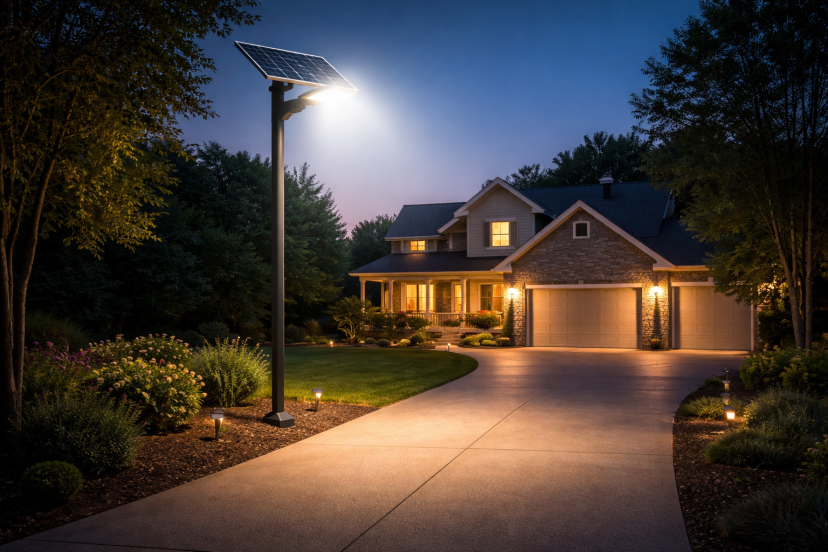
You know that feeling when you pull into your driveway and it’s weirdly dark—like your home suddenly turned into the opening scene of a suspense movie? Or maybe you’re responsible for lighting a farm path, a small parking area, a private road, or the front gate… and you’re tired of wiring, trenching, and electricity bills.
That’s exactly why solar street lights have become such a “wait… why didn’t I do this sooner?” upgrade. They’re simpler than traditional street lights, they can work in places where power is expensive or unavailable, and the best ones give you that dependable dusk-to-dawn glow that makes a space feel safer and more welcoming.
In this guide, I’ll help you choose solar street lights that actually make sense (no confusing specs, no marketing fluff), plus I’ll share product picks, install tips, and a research-backed reality check so you don’t waste money.
What solar street lights are (and what they aren’t)
Solar street lights are outdoor fixtures that use a solar panel to charge a battery during the day and power LEDs at night. Many run dusk-to-dawn automatically, and some add motion sensing to save energy.
What they aren’t: magic. If you live somewhere with heavy shade, poor winter sun, or constant storms, you’ll want to plan smarter (and pick better components), not just buy the cheapest “1000000W” listing and hope.
Why solar street lights feel like an instant upgrade
Here’s the honest charm: they remove the biggest pain points of outdoor lighting.
- No trenching (your lawn thanks you)
- No monthly power cost for that light
- Flexible placement (roads, gates, barns, lots, pathways)
- Fast installs for most setups
And emotionally? Good lighting does something subtle but real—it makes a place feel cared for. Like putting a welcome mat on your driveway.
Solar street lights vs wired street lights
If wired lights are a “built-in kitchen remodel,” solar is more like a “high-impact weekend upgrade.”
Wired street lights win when:
- You need consistent high output every night, year-round
- You can easily run power
- You’re lighting a long road or large public area
Solar street lights win when:
- Running power is expensive or unrealistic
- You want faster installation
- You’re lighting private property, farms, parking areas, or remote spots
How dusk-to-dawn solar street lights work in real life
Think of the system like a tiny self-running team:
- Solar panel = the “charger”
- Battery = the “fuel tank”
- Controller = the “brain” that prevents overcharge and manages output
- LEDs = the “engine” that turns stored energy into light
Most dusk-to-dawn models use a light sensor so they switch on automatically at night and off in the morning.
Brightness basics: lumens beat “watts” every time
If you remember one thing, make it this: lumens tell you how bright the light appears. “Watts” in solar listings often gets abused like a fish story.
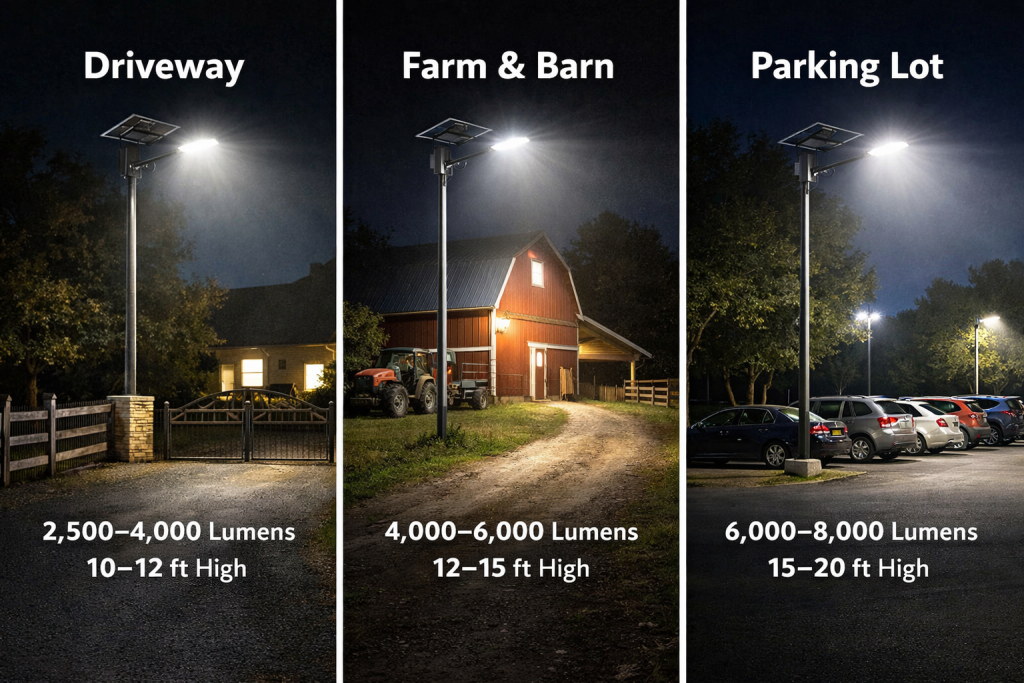
A practical lumen cheat sheet:
- 1,000–2,500 lumens: smaller driveway zones, gates, walkways
- 3,000–6,000 lumens: wider yards, barns, small parking areas
- 6,000+ lumens: larger open spaces (with good sun exposure)
And yes—beam angle matters. A super bright light aimed too narrowly can leave weird dark patches. You want coverage, not a spotlight that blinds you.
Battery types: the quiet decision that matters most
The battery is where “great on paper” products either shine… or disappoint.
Common options:
- Lithium (Li-ion / LiFePO4): strong performance, longer life, better for frequent cycling
- Lead-acid (less common in modern consumer units): heavier, shorter cycle life
If you want reliability, prioritize lithium—and look for brands that don’t hide the battery specs.
Panel placement: avoid the #1 reason solar lights underperform
Solar street lights can only charge as well as the sunlight they receive.
Quick placement rules:
- Aim for full sun (6+ hours direct light is a sweet spot)
- Avoid shade from trees, rooflines, poles, and fences
- Tilt toward the sun path if your mount allows it
- Clean panels occasionally (dust and pollen really add up)
If your solar panel is shaded for half the day, the light will behave like it’s always running on “low battery mode.” Because it is.
Motion sensor vs dusk-to-dawn: which one should you buy?
This is one of those “it depends on your life” questions.
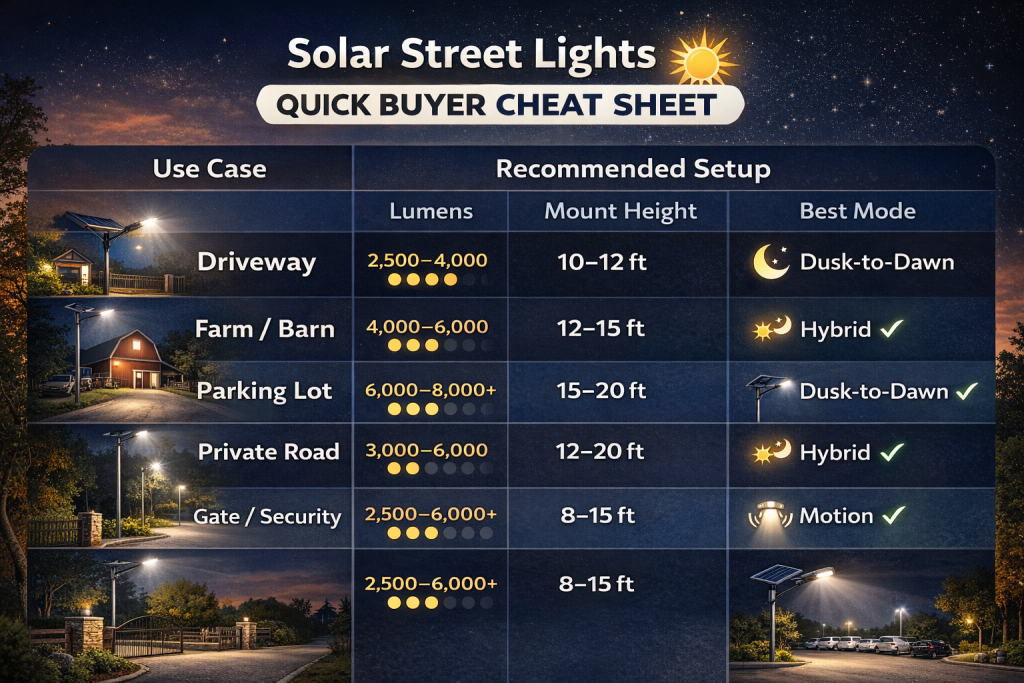
Go dusk-to-dawn if:
- You want steady all-night lighting
- You’re lighting a driveway, private road, or parking area
Go motion sensor (or hybrid modes) if:
- You want longer runtime in low-sun seasons
- You only need bright light when someone is nearby
- You’re focused on security and energy savings
A hybrid mode is often the best of both worlds: dim light all night + bright on motion.
Weatherproofing and durability: what to look for
Outdoor lighting is basically an endurance sport.
Look for:
- IP65 or IP66 (rain + dust resistance)
- Solid mounting hardware (cheap brackets wobble and shift)
- Materials that won’t crack in sun/heat cycles
Also: if your area gets strong winds, mount height and bracket strength matter more than the “max lumens” claim.
Installation tips that save time (and prevent regrets)
Here’s the friendly checklist I wish everyone had before they drilled a single hole:
- Mount the panel where it gets the best sun, not where it looks prettiest
- Test modes on the ground before mounting
- Install at a height that fits your goal:
- Lower = brighter concentrated area
- Higher = wider coverage, less intensity
- Angle the light downward to reduce glare (your neighbors will appreciate you)
Common solar street light problems (and simple fixes)
If your solar street light is acting moody, try these first:
- Not bright enough → move panel to better sun / clean it / check mode settings
- Turns off too early → battery not fully charging / winter sunlight / too-high brightness setting
- Flickers → loose connections / water intrusion / failing battery
- Only works on motion (when you want dusk-to-dawn) → wrong mode selected (it happens a lot)
And yes—sometimes the fix is simply: “Your panel is in shade.” Solar can’t outwork physics.
How to choose solar street lights for your space
Let’s make this easy. Pick the scenario that sounds like you:
- Driveway / front gate: dusk-to-dawn or hybrid, wide beam, 2,500–6,000 lumens
- Barn / farmyard: brighter output + durable mounting, wide coverage
- Parking lot / larger open area: higher lumen options + good panel exposure
- Private road: spaced fixtures + consistent dusk-to-dawn output
- Security-first: motion sensor + adjustable sensitivity + multiple modes
If you’re unsure, choose a model with multiple lighting modes—you can adapt it later.
🔹 Best solar street lights on Amazon
Below are five strong, buyer-friendly picks (based on rating volume and clear use case). Always double-check the current listing details since product bundles and specs can change.
1) Tuffenough Solar Outdoor Lights (210 LED, 2-Pack)
Short description: Bright, flexible, motion-sensor solar lights that are popular for driveways, garages, and entry zones.
Features:
- Remote control + multiple modes
- Wide-angle coverage with adjustable heads
- Built for outdoor exposure
Best for: You want “set it and forget it” security-style lighting around the home.
2) Aootek Solar Motion Sensor Lights (120 LED)
Short description: A long-standing favorite for affordable motion lighting where you need coverage without complicated installs.
Features:
- Motion sensor + wide-angle lighting
- Weather-resistant build
- Great for steps, paths, yards, side doors
Best for: You want budget-friendly brightness with lots of social proof.
3) LEPOWER Solar Security Light (Motion Sensor)
Short description: A sturdier, security-oriented option for people who want adjustable sensing and dependable flood-style coverage.
Features:
- Adjustable heads for aiming coverage
- Motion sensing for security use
- Designed for outdoor durability
Best for: Driveways, garages, and backyards where you want “movement = light.”
4) InnoGear Solar Lights Outdoor (Spotlight-style)
Short description: Great when you want directional lighting—trees, signage, landscape edges, or highlighting a gate area.
Features:
- Adjustable panel + light head (aimable)
- Multiple lighting modes
- Weather-resistant housing
Best for: You want control over where the light lands (not just how bright it is).
5) AmeriTop Solar Lights Outdoor (Multi-head security style)
Short description: Wide-coverage, motion-based lighting that works well for larger walls and broad yard zones.
Features:
- Multi-head design for broad spread
- Motion sensor for runtime efficiency
- Built for outdoor mounting
Best for: Yards, fences, garages—anywhere you need wide coverage without wiring.
🧪 What research says (and how to use it without overthinking)
Two research-based reminders can save you money and frustration:
First, LED efficiency is a real advantage. The U.S. Department of Energy notes that LEDs (especially ENERGY STAR-rated) use at least 75% less energy and can last up to 25 times longer than incandescent lighting—one reason solar + LED is such a practical pairing.
Second, real-world performance depends heavily on design choices and conditions—especially battery sizing, panel exposure, and how the system is used. A 2021 study looking at standalone solar streetlights highlighted a gap that can happen between “designed performance” and “in-the-field performance,” particularly when conditions and usage differ from assumptions. That’s exactly why choosing sensible brightness modes and good panel placement matters.
If you want a deeper (but still practical) example of how communities evaluate solar street lighting projects, this NREL report is a solid reference: solar street lighting project insights from NREL (2024).
And because batteries are the “make or break” piece in solar lighting, it’s worth understanding storage basics too—here’s a helpful internal guide on solar battery storage options and sizing.
FAQ: solar street lights
Are solar street lights bright enough for a driveway?
Yes—if you pick the right lumen range and mount height. For most driveways, 2,500–6,000 lumens with a wide beam (or adjustable heads) feels comfortably bright without turning your yard into a stadium.
Do solar street lights that run from dusk to dawn still perform well during winter?
They can, but expect shorter runtime if you get fewer sun hours. Winter performance improves a lot when you choose a model with hybrid modes (dim + motion boost) and place the panel in full sun.
How long can a solar street light battery typically last?
It varies, but lithium batteries generally last longer than older styles when cycled daily. The bigger factor is heat, charging quality, and whether the light runs at max brightness all night.
What height should solar street lights be installed?
For home and small property use, many people mount them around 10–20 feet depending on the fixture and coverage goal. Higher spreads light wider, but it won’t feel as intense on the ground.
Do solar street lights make more sense than wired lighting?
If wiring is easy and you need consistent high output every single night, wired can win. But if trenching is expensive, power access is limited, or you want faster installation, solar street lights are often absolutely worth it.
Conclusion
Solar street lights are one of those upgrades that quietly improves your everyday life: you pull in at night and feel safer, your guests can see where they’re walking, and your property looks more “finished.”
If you want the best experience, keep it simple:
- Choose lumens based on your space
- Prioritize a solid battery + panel setup
- Mount for sun exposure, not just convenience
- Use modes wisely (steady glow + motion boost is a great combo)
If you’re ready to pick one, start with the product section above—and choose the option that matches your real-life use case. You’re not just buying a light. You’re buying peace of mind after dark.