
Solar Power Calculator: How To Calculate Your Home’s Solar Power Needs
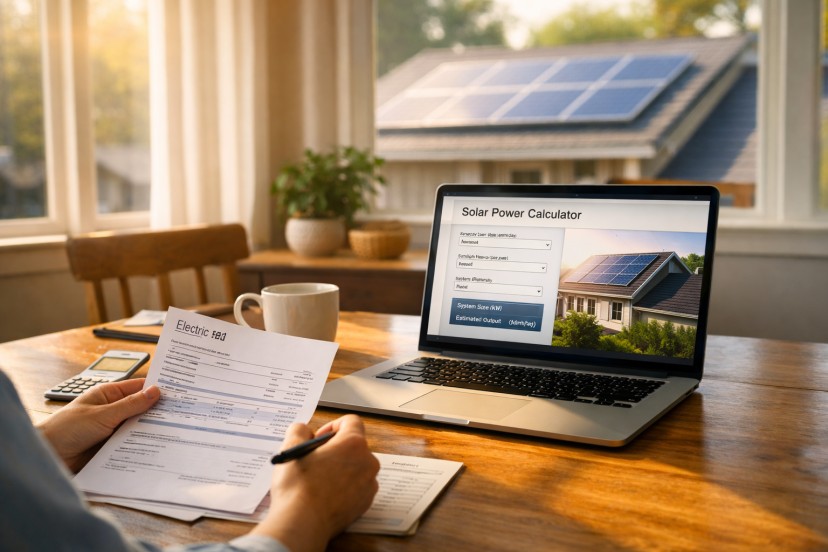
Your electric bill shows up, you glance at the total, and your brain instantly does that thing where it tries to “math” a solution with pure vibes. Been there.
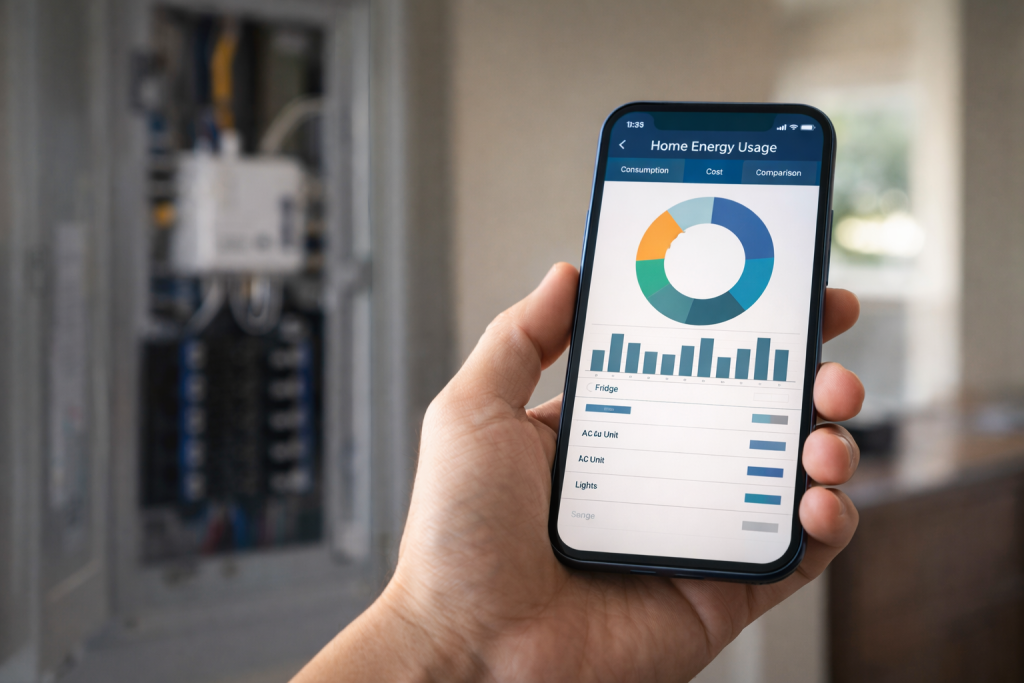
A Solar Power Calculator is basically the “no more vibes” tool. It helps you translate your real-life energy use (AC, fridge, lights, fans, that one gaming PC that practically breathes electricity) into a solar system size that actually makes sense—panels, inverter, and (if you want) batteries.
Affiliate note: This article includes a few Amazon product picks that can help you measure and plan your setup.
What a Solar Power Calculator Really Does
A Solar Power Calculator answers three practical questions:
- How much electricity do you use? (kWh per day/month)
- How much solar can your location produce? (sunlight in “peak sun hours”)
- How much system capacity do you need after losses? (real-world performance)
It’s not magic. It’s just organized reality.
And honestly? That’s why it’s comforting. You’re not guessing. You’re building a plan.
Start With Your “Energy Diary” (Your Usage Matters Most)
Before you size solar, you need your baseline: your energy consumption.
You can pull this from:
- Your utility bill (monthly kWh)
- A smart energy monitor (best for detail)
- Plug-in meters for specific appliances (great for “what is eating my power?” moments)
If you don’t know where to begin, start simple:
- List your “always on” stuff: fridge, Wi-Fi, lights, fans
- Add “big hitters”: AC, water heater, oven, dryer, pump, EV charging
A Solar Power Calculator is only as accurate as the inputs you give it—so the goal is honest inputs, not perfect ones.
Quick Math: From Monthly Bill to Daily kWh
If your bill shows monthly kWh, you can convert it fast:
- Daily kWh = Monthly kWh ÷ 30
Example:
- 900 kWh/month ÷ 30 = 30 kWh/day
If you want a “sanity check,” the U.S. EIA notes an average U.S. household uses about 10,500 kWh/year (≈875 kWh/month), but households vary a lot by region and home type.
Your home might be lower (small apartment) or way higher (big family home + AC + EV). No judgment—just numbers.
Decide Your Solar Goal (100% Offset… or Something Smarter)
Here’s the part people skip: Do you want solar to cover everything?
Common goals:
- 50–70% offset: lower cost, still big savings
- 80–100% offset: maximize bill reduction
- Backup-focused: cover essentials during outages
- Off-grid: full independence (and more batteries)
A Solar Power Calculator works best when you set a clear target, like:
- “I want to offset 80% of my usage.”
- “I want to run essentials for 8–12 hours during outages.”
This prevents overspending—and avoids the heartbreak of under-sizing.
Peak Sun Hours: The Secret Ingredient
Solar panels don’t produce their rated output all day. They produce based on sunlight intensity over time.
That’s why calculators use Peak Sun Hours (PSH):
- 1 peak sun hour = sunlight equivalent to 1 hour at full intensity
Typical PSH ranges (very roughly):
- Cloudy regions: 3–4 PSH
- Sunny regions: 4–6 PSH
- Very sunny/desert-like: 6+ PSH
Good solar calculators (and pros) pull this from solar resource datasets and models rather than guessing. Tools like PVWatts are widely used for production estimates.
System Losses: Why 5 kW ≠ 5 kW All Day
Real systems lose energy to:
- Heat (panels run hotter than test conditions)
- Wiring and connections
- Inverter conversion
- Dirt/dust
- Shade and mismatch between panels
- System downtime and clipping
Most calculators include a “system losses” or “performance ratio” assumption. PVWatts, for example, is built to estimate realistic output based on simplified inputs and model assumptions.
If you want a simple rule of thumb for planning:
- Use an overall efficiency factor of 0.75–0.85 (meaning 75–85% of “ideal” energy becomes usable AC power)
Sizing Your Solar Array (A Simple Formula You Can Trust)
Once you have:
- Daily energy use (kWh/day)
- Peak sun hours (PSH)
- Efficiency factor (0.75–0.85)
You can estimate:
Solar array size (kW) = Daily kWh ÷ (PSH × Efficiency)
Example:
- Daily use: 30 kWh
- PSH: 5
- Efficiency: 0.80
Solar size = 30 ÷ (5 × 0.80)
Solar size = 30 ÷ 4 = 7.5 kW
That’s the “starter truth” your Solar Power Calculator is trying to produce.
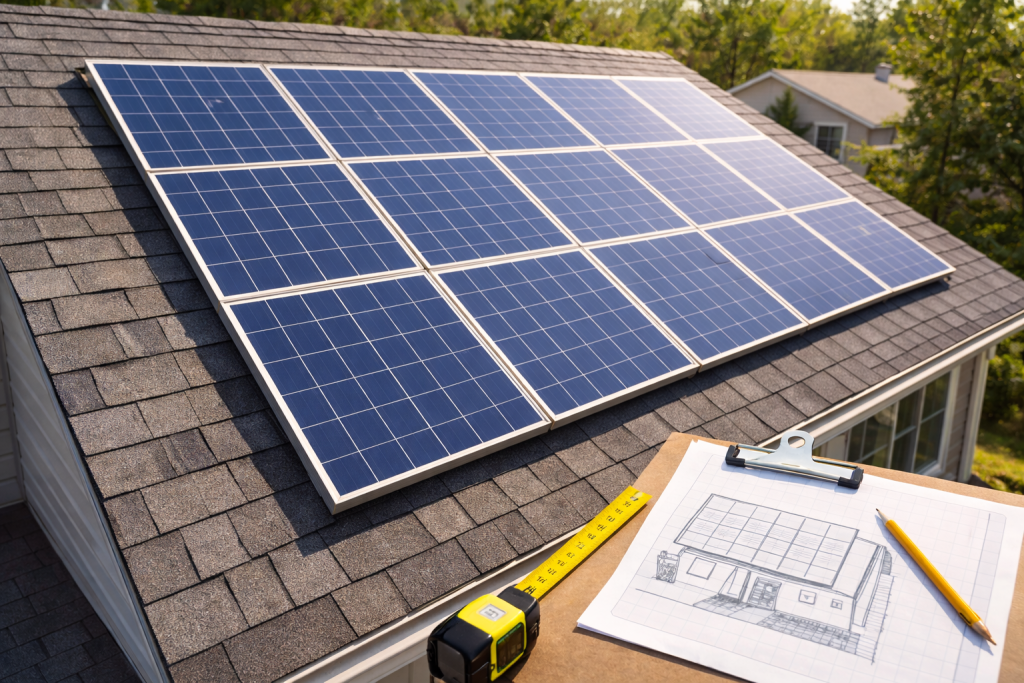
Picking Panel Count Without Guesswork
Now convert kW into panels.
If you choose 400W panels (0.4 kW each):
Panel count = System kW ÷ Panel kW
Example:
- 7.5 kW ÷ 0.4 = 18.75 panels
Round up → 19 panels
Reality check questions (the ones that save you money):
- Do you have roof space for 19 panels?
- Will shade hit part of the roof at 3–5 pm?
- Are you okay offsetting 80% instead of 100%?
A Solar Power Calculator gives you a number. Your roof gives you the final answer.
Inverter Sizing: Don’t Let One Box Bottleneck Everything
Think of the inverter like a bouncer at the club.
If your solar array is producing great power but the inverter is undersized, it will “clip” output (limit how much you can use).
A practical way to size:
- Inverter (kW) ≈ 80–120% of your solar array rating
- Or size to your expected peak load if backup matters (AC + fridge + lights + pump, etc.)
If you’re doing backup or off-grid:
- Pay attention to surge loads (fridge compressors, pumps, AC start-up spikes)
Battery Storage: Off-Grid and Backup Calculations
Batteries are where solar planning gets real.
Two key decisions:
- What do you want to power? (essentials only vs whole home)
- For how long? (hours of backup)
A simple battery sizing approach
- List essential loads (fridge, lights, fans, Wi-Fi, CPAP, etc.)
- Estimate their daily use in kWh
- Multiply by desired backup time
- Add a buffer
Example:
- Essentials: 6 kWh/day
- Backup time: 1 day
- Buffer: 20%
Battery need ≈ 6 × 1 × 1.2 = 7.2 kWh
Also note:
- Some battery systems recommend not using 100% capacity daily (depends on chemistry and setup)
- If you want multi-day autonomy, battery costs can climb fast
A Solar Power Calculator helps you see the tradeoff clearly: more backup = more storage = more budget.
Net Metering and Load Shifting: How the Grid Changes the Math
If you have net metering (sell excess power back to the grid or get credits), you can often:
- Use a smaller battery (or none)
- Focus on sizing panels to annual kWh rather than hourly self-consumption
If net metering is limited or buyback rates are low, load shifting matters:
- Run laundry midday
- Pre-cool the home in sunlight hours
- Time EV charging when solar is strongest
Same solar system, different savings—because policies and rates change the “scoreboard.”
Roof, Shade, and Orientation: The Reality Checks
A Solar Power Calculator is optimistic by nature. Your roof is… honest.
Check these before you fall in love with a system size:
- Shade: trees, nearby buildings, even a satellite dish
- Roof condition: if it needs replacing soon, do that first
- Orientation/tilt: not perfect? Still usually workable, just affects output
- Local weather patterns: long rainy seasons mean more variability
If your roof is complicated, the best move is to treat the calculator result as a target range, not a single sacred number.
A Real-Life Example (Small Home, Big Clarity)
Let’s say you’re in a small family home and your monthly usage is 600 kWh.
- Daily kWh = 600 ÷ 30 = 20 kWh/day
- Local PSH estimate = 4.5
- Efficiency factor = 0.80
System size = 20 ÷ (4.5 × 0.80)
= 20 ÷ 3.6
= 5.56 kW
If you pick 400W panels:
- 5.56 ÷ 0.4 = 13.9 → 14 panels
Now you can choose:
- 14 panels (close to full offset)
- 10–12 panels (lower budget, still meaningful)
- Add a small battery if outages are common
That’s the win: the Solar Power Calculator turns “should I go solar?” into a plan you can adjust.
Watch Your Inputs: The 5 Mistakes That Skew Results
- Using last month only (seasonal AC swings are real)
- Ignoring big appliances (water heaters and AC are sneaky monsters)
- Forgetting losses (heat + inverter + wiring add up)
- Overestimating sun (cloudy seasons matter)
- Sizing for 100% when 80% fits better (budget and roof space win sometimes)
Product Picks: Tools That Make Your Solar Power Calculator More Accurate
These aren’t “required,” but they make your numbers way less guessy—especially if you want to measure real usage before buying panels.
Emporia Vue Gen 2 Smart Home Energy Monitor
Short description: Whole-home monitoring that helps you see exactly where your kWh is going.
Features: Circuit-level sensors, real-time tracking, app insights.
Use cases: Ideal if you want accurate load data for a Solar Power Calculator instead of relying on estimates. (Emporia’s Vue Gen 2 shows thousands of ratings on Amazon marketplaces.)
P3 P4400 Kill A Watt Electricity Usage Monitor
Short description: A plug-in meter that reveals what one appliance actually uses.
Features: Tracks kWh, watts, voltage, frequency, and cost estimates.
Use cases: Great for measuring a fridge, dehumidifier, PC setup, or window AC to stop “worst-case guessing.”
Kasa Smart Plug Mini with Energy Monitoring (KP115)
Short description: Smart plug + energy tracking so you can watch consumption over time.
Features: App-based energy monitoring, schedules, voice assistant support.
Use cases: Perfect for tracking devices that run in patterns (fans, air purifiers, office setups).
Victron Energy BMV-712 Smart Battery Monitor
Short description: A “fuel gauge” for your battery bank—super helpful in off-grid or backup planning.
Features: Bluetooth/app insights, shunt-based measurement, detailed battery stats.
Use cases: Best if your Solar Power Calculator plan includes batteries and you want accurate state-of-charge tracking.
Renogy 500A Battery Monitor with Shunt
Short description: A popular, budget-friendlier battery monitor for solar + battery setups.
Features: Shunt measurement, programmable alarms, real-time voltage/current/capacity display.
Use cases: Good for RVs, cabins, and backup systems where you want battery data
If you’re also thinking about powering outdoor lighting efficiently, check out solar street lights and smart outdoor setups.
Research-Backed Reality: What the Experts Say About Solar Output
Two credible sources that explain why solar calculators work the way they do (and why “real-world output” is the only output that matters):
- PVWatts technical reference (NREL, 2013) explains the modeling approach behind PVWatts—how solar irradiance becomes estimated AC energy, and why assumptions and losses are baked into the results.
- IEA PVPS Trends in Photovoltaic Applications (2022) provides an expert market and deployment view of PV systems worldwide, helping contextualize performance expectations and how rapidly solar is scaling globally.
And if you like measuring impact: the EPA’s equivalencies resources include an electricity emissions factor used for conversions (updated references shown by EPA).
FAQs
What is a Solar Power Calculator and how accurate is it?
A Solar Power Calculator estimates solar system size using your kWh usage, local sunlight (peak sun hours), and expected system losses. It’s accurate enough for planning, but roof shade, panel temperature, and inverter limits can shift real output.
How many solar panels would I need if my home uses about 1,000 kWh per month?
1,000 kWh/month is about 33 kWh/day. If you get 5 peak sun hours and assume 0.80 efficiency, you’d estimate: 33 ÷ (5 × 0.80) ≈ 8.25 kW. With 400W panels, that’s roughly 21 panels. (Then adjust for roof/shade.)
What inputs do I need to use a Solar Power Calculator correctly?
At minimum: monthly kWh, your location (for sun hours), your offset goal, and whether you want batteries. If you can add appliance measurements or whole-home monitoring, your estimate gets much tighter.
Can a Solar Power Calculator help size batteries for outages?
Yes. You’ll need your essential-load kWh and desired backup hours/days. The calculator can translate that into battery capacity (kWh) and help you decide whether backup-only or whole-home backup is realistic.
Is it a good idea to size my solar system a bit larger than I need, just to be safe?
Not automatically. Oversizing can help future-proof, but it can also waste roof space and budget—especially if your utility limits net metering or export credits. Many households do better sizing for a smart target (like 70–90%) and improving efficiency first.
Conclusion
If you take one thing from all this, let it be this: solar is a numbers game you can actually win—as long as you start with your real usage.
Run your Solar Power Calculator with honest inputs, give yourself a realistic loss factor, and treat the result like a flexible plan (not a final verdict). Then you can choose what fits: lower bill, better backup, or full independence.
When you’re ready, do one small next step today: pull your last 12 months of kWh, or measure your top 3 “power hogs.” That’s how this goes from “maybe someday” to a plan you can act on.