The Best Solar Power Banks
You know that specific kind of panic where your phone is at 7%, you’re nowhere near an outlet, and your charger cable is… of course… in a different bag? That’s exactly why Solar Power Banks are so loved. They’re like a tiny “backup plan” you can toss in your backpack, glove box, or emergency kit—no drama, no begging a stranger for a wall plug.
And let’s be real: the solar part is the most misunderstood piece. A solar power bank can absolutely save your day, but only if you buy it with the right expectations (and use it the smart way). This guide will walk you through what actually matters, how to avoid the “this thing is useless” feeling, and which features are worth paying for.
Why Solar Power Banks Matter (Even If You’re Not “Outdoorsy”)
A lot of people think solar power banks are only for campers with hiking boots and a suspiciously cheerful attitude at 5 a.m.
But honestly? They’re for:
- commuters who forget to charge things (hi, it’s most of us)
- travelers stuck in airports, bus stations, or long layovers
- parents who need phones alive for maps + photos + “where are you??”
- anyone living in an area with occasional outages
- “just-in-case” folks who sleep better knowing they’re prepared
A solar power bank is less about being extreme… and more about being calmly capable.
Solar Power Banks 101: What You’re Buying
At its core, a solar power bank is simply:
- a battery (like a regular power bank), and
- a solar panel that can recharge that battery slowly in sunlight.
Most of the time, you’ll charge it from a wall outlet or car charger like normal. The solar part is your backup option—like having an umbrella in your bag. You won’t use it every day, but when you need it, you’re very happy it’s there.

The Solar Charging Truth (It’s a Trickle, Not a Tap)
Here’s the heart-to-heart moment:
Built-in solar panels on most solar power banks are small. Small panel = small power.
So if you buy one expecting, “Cool, I’ll fully recharge this in the sun today,” you may end up disappointed.
But if you buy one thinking, “I want a safety net that can slowly top up my bank or keep my phone alive in a pinch,” you’ll be thrilled.
Solar power banks shine (pun intended) when you treat solar charging as emergency refueling, not your main power source.
Capacity Made Simple: mAh vs Wh (Without the Headache)
Most listings scream numbers like 10,000mAh, 20,000mAh, 38,800mAh.
Here’s the friendly translation:
- 10,000mAh: usually ~2 phone charges
- 20,000mAh: usually ~4–5 phone charges
- 25,000mAh+: more breathing room for longer trips or multiple devices
Two quick notes:
- Bigger capacity usually means more weight.
- The usable power is always a bit less than the advertised number (normal battery physics, not necessarily a scam).
If you want a “throw it in my bag” option, 10k–20k is a sweet spot. If you want “family trip insurance,” go bigger.
Panel Design: Single Panel vs Fold-Out Panels
This is where solar power banks separate into two personalities:
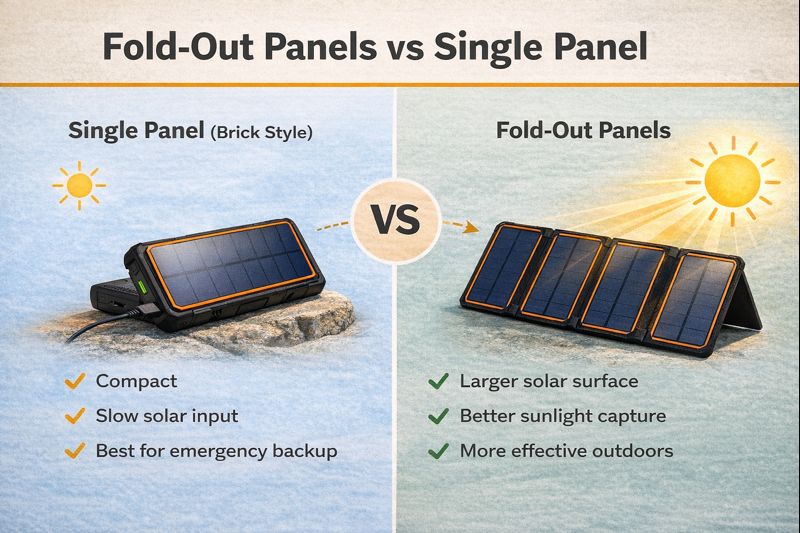
Single-panel “brick” style
- looks like a normal power bank with a tiny solar panel on the front
- solar charging is usually slow and inconsistent
- best for: everyday carry + emergencies
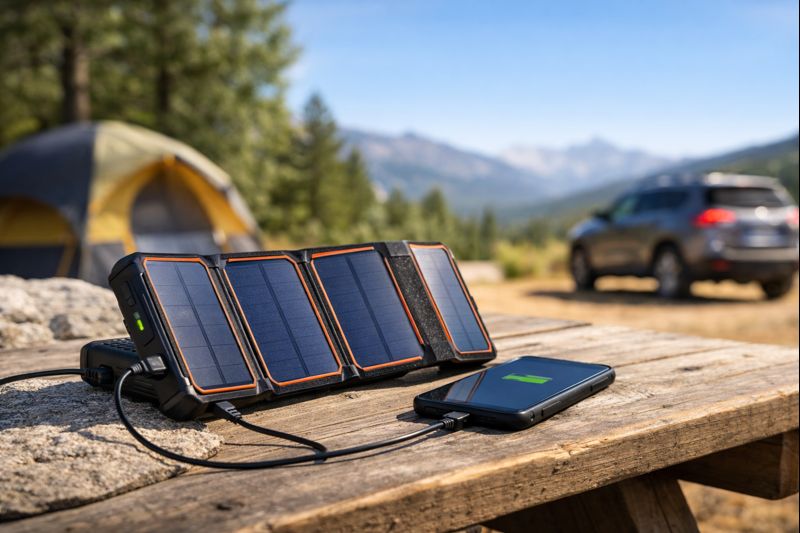
Fold-out panel style
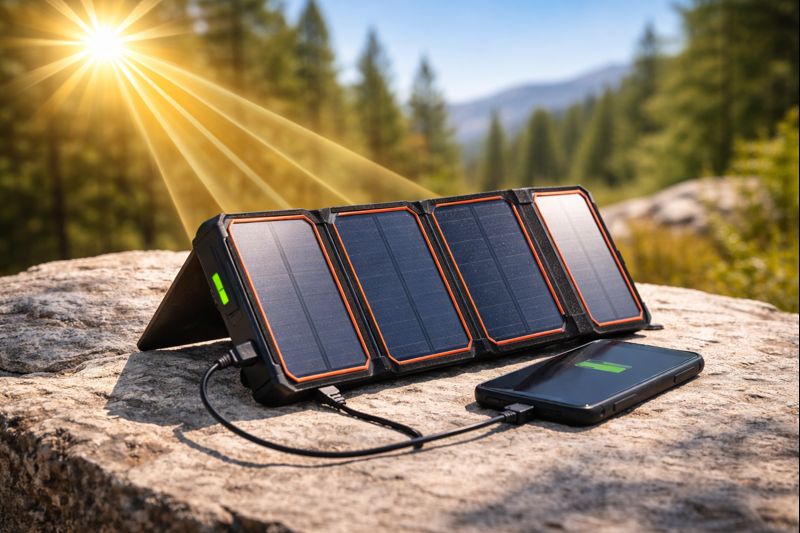
- has multiple panels that unfold like a little solar flower
- gathers more sunlight = better solar performance
- best for: camping, road trips, and longer time outside
If solar charging is a serious reason you’re buying, fold-out panels usually perform better than the tiny single-panel designs.
Charging Speed: USB-C Fast Charging Is the Real MVP
Here’s the ironic truth:
For most people, fast wired charging matters more than solar charging.
Look for:
- USB-C input/output (so the bank can recharge faster and charge your phone faster)
- “PD” (Power Delivery) if you want speed with modern phones/tablets
- multiple outputs if you charge more than one device
Solar is your backup plan. Fast USB-C is your daily convenience.
Ports & Extras: Wireless Charging, Built-In Cables, Flashlights
These features can be either “amazing” or “meh,” depending on your life.
- Wireless charging: great if you hate cables (but slower and less efficient)
- Built-in cables: convenient for travel (less “where’s my cord?”)
- Flashlight / camping light: surprisingly useful in outages
- Compass / carabiner: nice-to-have, not the reason to buy
My rule: prioritize core performance first (capacity + ports + build quality). Extras are bonus sprinkles.
Durability: Water Resistance, Dust, and Drops
If you’re buying Solar Power Banks for outdoors or emergencies, durability isn’t “extra.” It’s the whole point.
Look for:
- rubberized edges (helps with drops)
- port covers (keeps dust/water out)
- water resistance claims (even light splash resistance helps)
Also: don’t assume “waterproof” means “submarine.” Most are built for splashes, rain, or damp hands—not swimming.
Safety & Quality: What to Look for (Without Getting Nerdy)
This part matters more than the average person realizes.
A power bank is basically a controlled box of stored energy. You want it controlled well.
Green flags:
- clear brand identity (not a keyboard-smash name)
- basic safety protections listed (overcharge, short-circuit, temperature control)
- decent warranty/support language
Red flags:
- “mAh” numbers that feel impossible for the size/weight
- ultra-cheap pricing with huge claims
- confusing specs that don’t match the ports shown
If your gut says “this looks sketchy,” trust that instinct.
Picking the Right Solar Power Bank for Your Vibe
Let’s make this easy. Pick the one that sounds like you:
- “I want something light for my purse/bag.” → 10k–20k capacity, simple design
- “I camp or road trip a lot.” → fold-out panels, rugged build, multiple ports
- “I want emergency power at home.” → 20k–30k+, flashlight, reliable wired charging
- “I share with family.” → higher capacity + 2–4 outputs
- “I hate cords.” → wireless charging (but keep a cable anyway… trust me)
How to Use Solar Power Banks Smarter (Tiny Habits, Big Results)
If you want better solar performance, do these things:
- Angle the panels toward the sun (yes, it’s that simple)
- Keep the panel surface clean (dust blocks light)
- Avoid shade patches (even small shadows can reduce output)
- Charge in the middle of the day when possible
And here’s a sneaky win:
Use solar to refill the bank slowly while you’re doing other stuff, then use the bank’s fast wired output to charge your phone later.
Think: “store sunlight now, spend power later.”
Mistakes That Make Solar Power Banks Feel Disappointing
These are the top “why is this not working?” moments:
- expecting solar to recharge it quickly like a wall outlet
- leaving it flat on a table in weak sunlight
- assuming cloudy-bright is the same as direct sun
- charging your phone directly from solar (often unstable) instead of charging the bank first
- buying based on the biggest number without checking ports/build quality
Fix those, and the experience improves dramatically.
Quick Field Checklist: What to Test in the First 10 Minutes
When your solar power bank arrives:
- Charge it fully from the wall once (baseline test)
- Test each port with your actual devices
- Check if it gets unusually hot (warm is normal; hot is not)
- Confirm it recharges at a reasonable speed via USB-C (if included)
- Put it in sunlight and see if the solar indicator behaves consistently
This tiny “first date” test saves you from finding out it’s unreliable… during an actual emergency.
Product Picks: 5 Solar Power Banks (Worth a Look)
Below are five Solar Power Banks that show up often in hands-on testing roundups and buyer shortlists, with designs that make sense for real-life use. (Ratings and review counts can change over time, so I always recommend checking the current listing before buying.)
1) Hiluckey HIS025 25000mAh Power Bank (fold-out style)
Short description: Big capacity + fold-out panel design that’s more “solar-capable” than tiny single-panel bricks.
Features: multi-panel array, high capacity, built-in light (varies by model)
Best for: camping, travel, “I want solar to actually contribute”
2) BLAVOR PN-W12 Pro 20000mAh (fold-out style)
Short description: A popular fold-out solar power bank format—portable, outdoorsy, and built for top-ups rather than miracles.
Features: fold-out panels, USB outputs, rugged extras (often flashlight/compass)
Best for: hikers, road trips, emergency kits
3) FEELLE Solar Charger Power Bank 27,000mAh (fast charge + 4 panels)
Short description: A higher-capacity fold-out panel option that leans into faster wired charging when the sun isn’t cooperating.
Features: 4 solar panels, 22.5W fast charging, USB-C in/out
Best for: road trips, festival weekends, multi-device households
4) BioLite SolarPanel 5+ (panel-first, small built-in battery)
Short description: Not a classic brick-style bank—more like a compact solar panel with a small integrated battery, designed for better solar usability
Features: panel-focused design, smaller battery, good for steady sunlight charging
Best for: backpackers who want solar-first behavior in a compact setup
5) Riapow 26800mAh (brick-style solar bank)
Short description: A high-capacity, brick-style solar power bank that’s mainly a power bank first—with solar as a backup feature.
Features: big capacity, multiple outputs, emergency-light style extras (varies)
Best for: glove box storage, everyday “just in case” power
If you’re planning beyond phones (think router, fans, fridge “survival mode,” or longer outages): a solar power bank is a great first layer—but a bigger home solution may fit better. Here’s a practical guide to choosing a battery backup for home.
Research, FAQs, and Your Next Step
- Solar performance in real testing: OutdoorGearLab’s hands-on testing found that many single-panel “brick” solar power banks produced little to no meaningful charge in indirect sunlight, while fold-out designs generated measurable (but still modest) hourly gains—numbers like ~214–265 mAh per hour for certain fold-out models in their indirect light testing.
- Safety matters (especially with lithium batteries): UL created UL 2056, a dedicated safety standard for power banks, meant to reduce risks like fire/explosion and to address protections and abuse testing; it also explicitly covers power banks that include integral photovoltaic cells.
And one more “why sunlight claims feel confusing” note: solar products are often described using standard test conditions (STC)—lab-like conditions that don’t match everyday shade/heat/cloud reality.
FAQs
1) Do Solar Power Banks really charge phones with sunlight?
Yes—but usually slowly. Most of the time you’ll charge the bank by wall/car power, then use solar as a backup top-up when you’re outside.
2) How much time does it take for a solar power bank to charge in the sun?
It depends on panel size, sun strength, and design. In general, built-in solar is best for gradual refills, not fast full recharges.
3) What size solar power bank should I buy?
For most people:
- 10,000–20,000mAh for daily carry/travel
- 25,000mAh+ for longer trips or multiple devices
If you’re buying for emergencies, it’s usually better to go a bit bigger.
4) Are fold-out solar power banks better than single-panel ones?
If you care about solar charging performance, usually yes—more panel area tends to mean more usable solar input.
5) Are Solar Power Banks safe?
They can be, especially from reputable brands with clear safety protections and testing. Avoid sketchy, too-cheap models with unrealistic claims, and don’t leave any power bank baking in a hot car for long periods.
Conclusion
If you remember one thing, make it this: Solar Power Banks are peace-of-mind tools, not miracle machines. Buy one with good wired charging, enough capacity for your life, and solar that can help in a pinch—then use it like a calm little safety net.
You don’t need perfect prepper energy. You just need a backup plan that actually fits in your hand.