Solar Panel Series vs Parallel: Key Differences
You can get weirdly far into planning a solar setup before one simple question stops everything: should your panels go in series or in parallel?
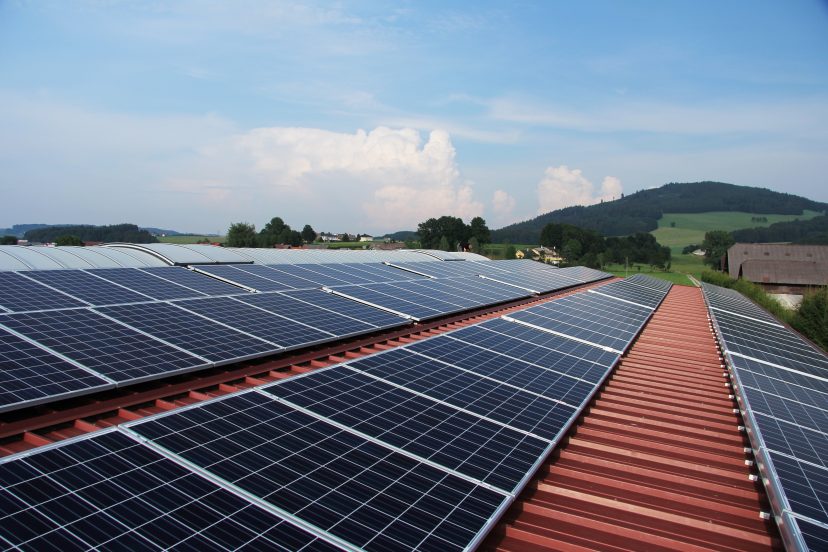
That sounds technical, but it’s really a “how do I want this system to behave?” question. And it matters more now because solar keeps growing fast. The IEA says distributed solar PV is set to account for 42% of overall PV expansion in its 2025 outlook, so more homeowners, RV owners, and off-grid tinkerers are running into this exact choice.
The good news is that solar panel series vs parallel is not some mysterious electrician-only riddle. Once you understand what happens to voltage and current, the fog lifts pretty quickly. By the end of this article, you’ll know which setup usually works better, what shading changes, what gear helps, and when a mixed setup is the smartest move.
Affiliate note: This article includes product suggestions for reader convenience. If you use affiliate links on your site, add your normal disclosure there.
Why this choice matters more than people think
People often focus on panel wattage first. Fair enough. Bigger number, shinier promise.
But wiring choice affects whether your system actually plays nicely with your inverter or charge controller. It also changes how your setup behaves in shade, over long cable runs, and in small off-grid systems where every watt feels personal. Think of it like choosing between a taller ladder and a wider doorway. Both can get you where you’re going, but only one fits the job.
What solar panel series vs parallel actually means
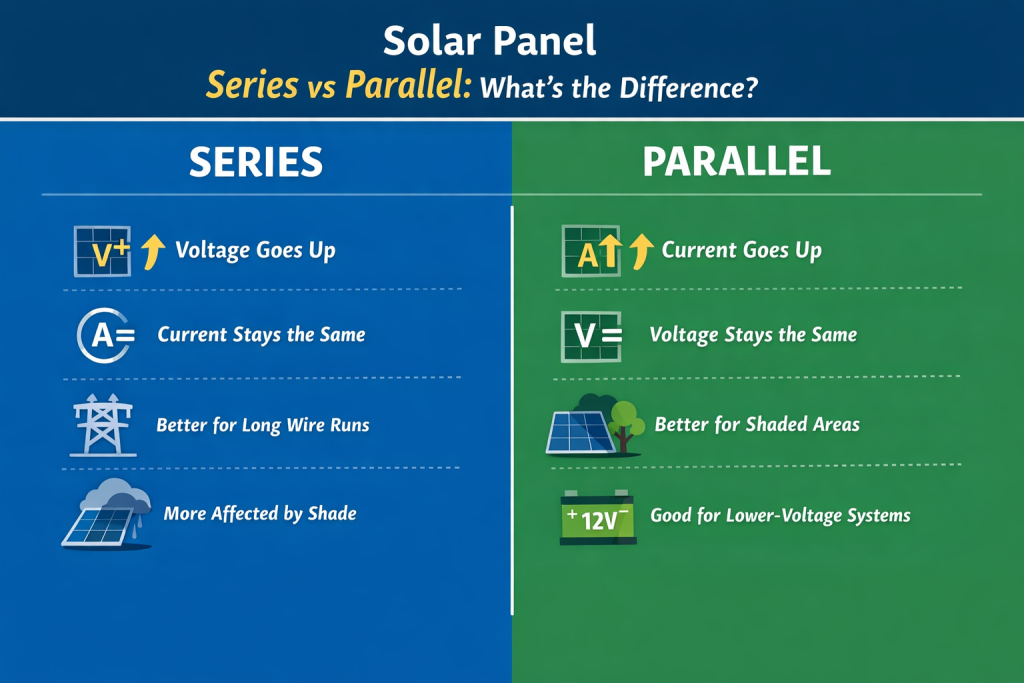
In plain English, series wiring, the voltage increases but the current remains unchanged. With parallel wiring, the current increases while the voltage stays the same.
A quick mental shortcut
If series is like stacking batteries end to end to get more “push,” parallel is like opening more lanes on a highway so more energy can move at once.
Not poetic enough for a greeting card, maybe, but very useful.
How series wiring works in plain English
When panels are wired in series, you connect positive to negative from one panel to the next. The array voltage rises, but the amperage stays at the level of a single panel. This is why series wiring is often attractive when your inverter or charge controller needs a higher input voltage to wake up and work efficiently.
Series also tends to help with longer cable runs, because higher voltage and lower current can reduce resistive losses in the wiring. Less wasted energy in the “trip” from roof to equipment room is always nice.
How parallel wiring works in plain English
With parallel wiring, you connect positive to positive and negative to negative. Voltage stays the same, while amperage increases as you add panels. This is often a comfortable fit for 12V-style systems, smaller battery setups, and situations where you want to keep voltage within a controller’s limits.
Parallel can feel a little more forgiving, too. If one panel underperforms, the entire array is usually less bottlenecked than a simple series string. That matters in real life, where trees, vents, and mysterious neighbor shadows love ruining perfect diagrams.
The biggest difference: voltage vs current
This is the fork in the road.
Choose series when your system benefits from higher voltage. Choose parallel when your system needs more current at the same voltage. Most “which is better?” debates get messy only because people compare two setups serving different electrical goals.
A simple example helps. Two 12V panels in series give you roughly 24V. The same two panels in parallel keep you around 12V, but current doubles. Same panels, same sunlight, very different behavior.
Why inverters and charge controllers matter
Your panels do not get the final vote. Your equipment does.
String inverters often need a minimum voltage window, which is one reason series wiring is common in larger rooftop systems. Charge controllers also have input limits, so going too high in series can become a problem just as quickly as going too low. In other words, the right answer is not “series” or “parallel.” It is “what matches your equipment specs without drama?”
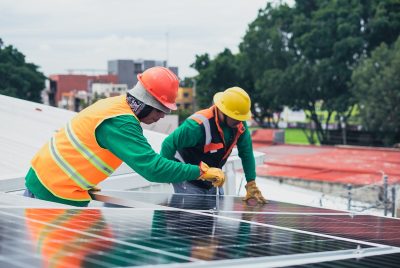
This is also where working with a qualified solar contractor can save you from an expensive guess dressed up as confidence.
When series is usually the smarter pick
Series often makes the most sense when:
- your inverter needs a higher startup or operating voltage
- your cable run is long
- your panels get fairly even sunlight
- you’re building a larger residential array
That doesn’t make it “better” in a universal way. It just means it shines when uniform conditions and higher voltage targets are the goal. Expert guides from SolarReviews and Renogy both frame series this way.
When parallel makes more sense
Parallel usually deserves a hard look when:
- you’re working with a 12V off-grid setup
- shading is hard to avoid
- you want the system to be less sensitive to one weak panel
- your controller is happier with lower voltage input
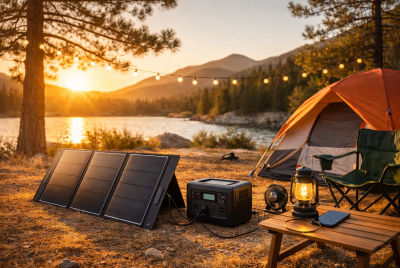
This is common in RVs, boats, cabins, and smaller DIY systems. It’s the solar version of not putting all your eggs in one oddly expensive basket.
What shading changes in real life
Shade is where the clean theory gets humbled.
NREL’s work on partially shaded PV systems found that shading causes nonlinear losses, meaning a small shaded area can trigger a surprisingly large drop in output. The study also explains how bypass diodes protect groups of cells, which helps prevent damage but still reduces module voltage and power.
That’s why series strings can be more vulnerable when one panel is dragged down by shade. You still get benefits from series, but shade makes panel mismatch a bigger headache. If your roof has chimneys, trees, or shifting shadows, this part should not be brushed off.
Can you combine series and parallel
Absolutely. In fact, many real systems do exactly that.
A series-parallel layout lets you build strings to hit the voltage target you need, then combine multiple strings in parallel to raise total current and system output. It’s a practical middle path, not cheating. SolarReviews notes that most solar systems are designed with both series and parallel connections rather than one pure form only.
Common mistakes people make with solar panel wiring
The most common mistake is mixing “more power” with “same power, different electrical shape.”
Other big mistakes include mixing mismatched panels, ignoring controller limits, forgetting how shade affects strings, and underestimating wiring loss on long runs. NREL also notes that mismatch can come from shading, soiling, debris, and degradation, not just obvious panel damage.
A simple checklist before you choose
Before you lock in series or parallel, ask yourself:
- What input voltage range does my inverter or charge controller require?
- How much unavoidable shade hits the array?
- How long is the cable run?
- Am I building for a roof, RV, cabin, or portable setup?
- Are all panels the same model and rating?
If you can answer those five questions honestly, you’re already ahead of a lot of “I watched half a video and now I’m an engineer” energy.
5 Amazon products that make series or parallel setups easier
Renogy Branch Y Connector in Pair MMF+FFM for Parallel Connection
This is the simple, practical pick for parallel wiring. It’s built specifically for parallel panel connections and Amazon lists weather-resistant construction with IP67 protection. Best for DIYers who want a clean, low-fuss way to join panel leads.
Renogy Rover 40A MPPT Solar Charge Controller
A strong fit if you need a smarter controller for changing sunlight conditions. Amazon’s product page highlights 12V/24V compatibility and MPPT tracking that helps under clouds and partial shading. Best for RV, cabin, and off-grid users who want better harvesting than a basic PWM unit.
Renogy 200 Watts 12 Volts Monocrystalline RV Solar Panel Kit
This is a beginner-friendly kit because it bundles panels, controller, and mounting hardware into one system. Amazon describes it as an off-grid kit for RVs, boats, trailers, and similar use cases. Best for readers who want fewer moving parts and less second-guessing.
CNLonQcom 6 Strings Metal Solar PV Combiner Box
If you’re combining multiple strings, a combiner box makes the setup neater and safer. Amazon lists built-in circuit protection, surge protection, and waterproof housing. Best for larger arrays where string management starts to matter more than people expect.
BougeRV 20 Feet 10AWG Solar Extension Cable
This is the quietly useful item that saves awkward cable routing headaches. Amazon’s listing emphasizes 10AWG copper cable, weather resistance, and MC4-style connectivity. Best for longer runs where solid cabling helps keep losses and frustration down.
What research and expert guidance say
A National Renewable Energy Laboratory study on partial shading showed that shade can reduce PV output in a nonlinear way, and that bypass diodes help protect shaded cell groups but do not magically erase the performance hit. That supports the common advice to be careful with simple series strings in tricky shade conditions.
A second NREL analysis of distributed power electronics in photovoltaic systems found that under partially shaded conditions, distributed electronics such as micro-inverters and DC-DC converters can recover a meaningful share of annual performance loss. In plain terms, if mismatch and shade are part of your life, smarter electronics can soften the blow.
Expert guidance lines up with that. SolarReviews explains that series wiring raises voltage while parallel raises current, and that many systems combine both to match inverter requirements and site conditions.
What works better for an RV: wiring solar panels in series or in parallel?
For many RV setups, parallel is easier to work with because it keeps voltage lower and can be more forgiving when one panel gets partial shade from a vent, rack, or tree. Still, some RV systems use series or mixed wiring if the controller is designed for it. Check the controller’s input specs first, always.
Can solar panels with different power ratings be wired in series or parallel?
You can, but it usually isn’t ideal. Mismatched panels can pull performance downward because the system has to operate around the weakest or least compatible part of the group. If you can avoid mixing panel specs, do. You’ll save yourself a headache later.
Will solar panels charge more quickly in series or parallel?
Neither setup magically creates extra sun. What changes is how that power is delivered. Series can help your system reach the voltage your equipment needs, while parallel can increase available current. “Faster” depends on what your battery bank, controller, and inverter are built to accept.
How does the system perform if one solar panel is shaded or stops working?
In a simple series string, one shaded panel can drag down performance more noticeably because current flows through the chain together. In parallel, the rest of the array usually has an easier time continuing to contribute. That does not make parallel invincible, but it does make it less all-or-nothing.
Do I need an installer to decide series vs parallel?
Not always. If you’re building a small, low-voltage DIY setup and you understand your equipment specs, you can often make the decision yourself.
But if you’re dealing with rooftop solar, code compliance, larger arrays, battery integration, or expensive components, getting professional design help is smart. Not because you can’t learn it, but because one wiring mistake can be very good at teaching lessons the expensive way.
Conclusion
So, solar panel series vs parallel really comes down to this: series raises voltage, parallel raises current, and the best choice depends on your equipment, your shading, and your real-world layout.
If your site gets steady sun and your inverter wants higher voltage, series may be the better fit. If shade is a regular guest or you’re building a smaller off-grid setup, parallel often feels safer and more flexible. And in plenty of cases, a mixed design gives you the best balance of both.
You do not need to memorize every electrical term to make a smart decision. You just need to match the wiring style to the job in front of you. Start with your specs, be honest about shade, and get help when the system moves beyond basic DIY territory. If you want a second set of eyes, talking with a solar contractor who understands real installations is a solid next step.