
Hybrid Solar Inverter: Smarter Power for Homes
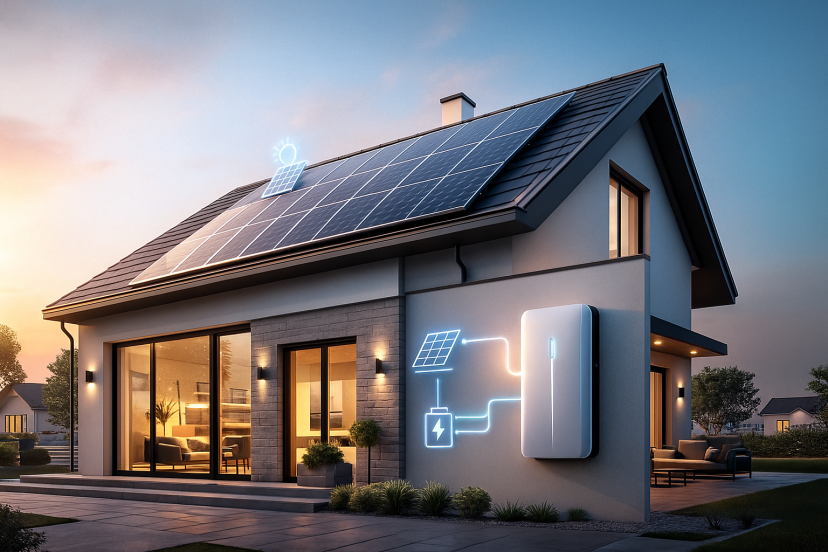
You want lower electric bills and backup when the grid blinks? A hybrid solar inverter is like a bilingual friend who speaks solar, battery, and grid—switching smoothly so your home always has a plan B. In this friendly guide, you’ll learn what a hybrid inverter does, how to size it, which features actually matter, and which models people love. We’ll also share two credible research sources so you can make decisions with confidence. By the end, you’ll know exactly whether a hybrid setup fits your home, your budget, and your goals.
(Heads-up: If you buy gear later via Amazon, assume affiliate relationships may apply.)
What Is a Hybrid Solar Inverter (in plain English)?
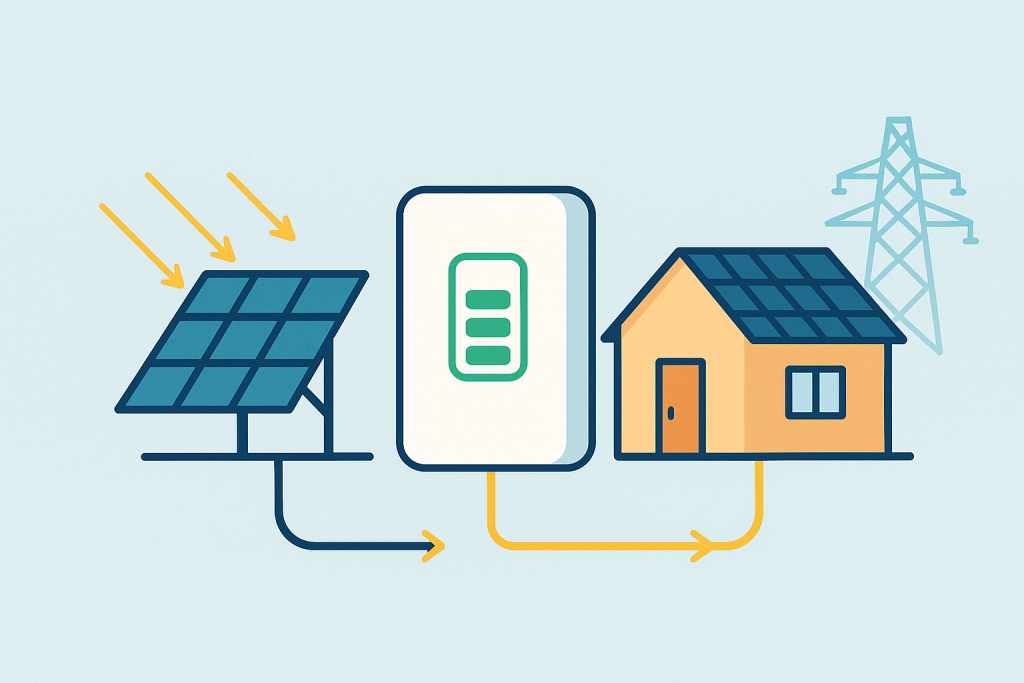
A hybrid solar inverter takes the DC power from your solar panels, turns it into household AC, and manages batteries—charging them when you have extra solar and discharging them during outages or pricey peak hours. It also coordinates with the utility grid, so you can export excess or draw power when it’s cheaper. Think of it as your home’s energy traffic controller—smart, calm, and always optimizing.
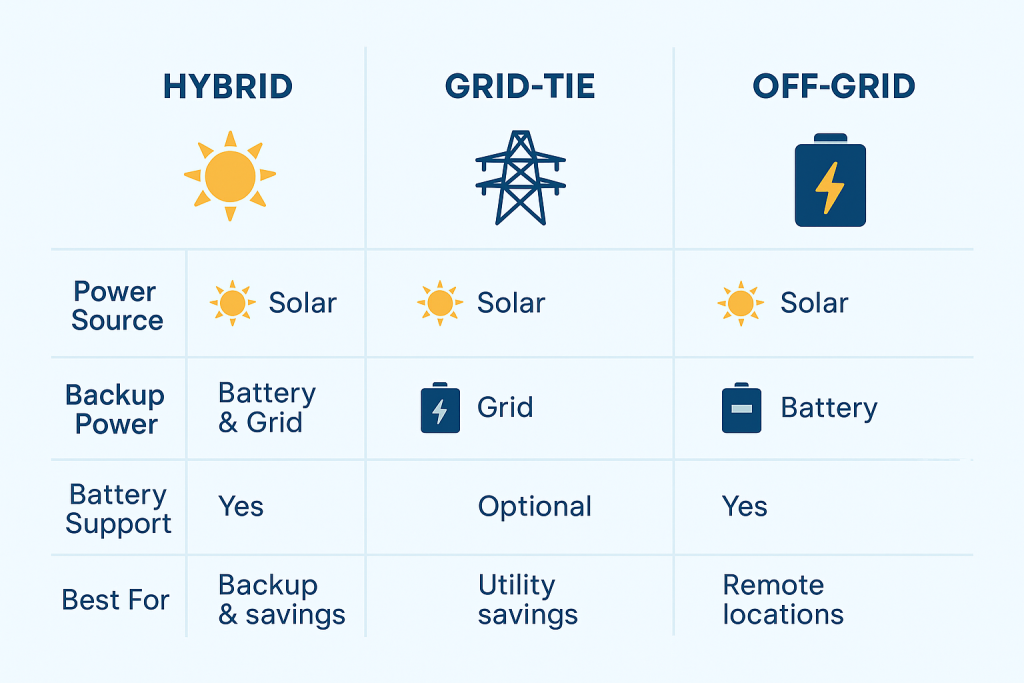
Hybrid vs. Grid-Tie vs. Off-Grid: How Each Solar Setup Works
- Grid-tie inverter: Solar only. Cheapest, but no batteries or backup.
- Off-grid inverter: Works with batteries and solar, not the grid. Great for remote sites.
- Hybrid solar inverter: Best of both—solar + battery + grid. Seamless backup and smart bill control.
How a Hybrid Solar Inverter Works (Day to Night)
- Sunny daytime: Feeds your home, charges batteries, exports extra.
- Evening peaks: Discharges battery to cut time-of-use rates.
- Grid outage: Island mode kicks in; critical loads keep running.
- Rainy spells: Pulls from grid if the battery dips too low.
The Big Benefits You’ll Actually Feel
- Resilience: Keep lights, fridge, internet, and fans alive during blackouts.
- Bill control: Store cheap energy, use it when rates spike.
- Solar stretch: Increase self-consumption instead of exporting for pennies.
- Future-proofing: Most hybrids support software updates, smart meters, and EV chargers.
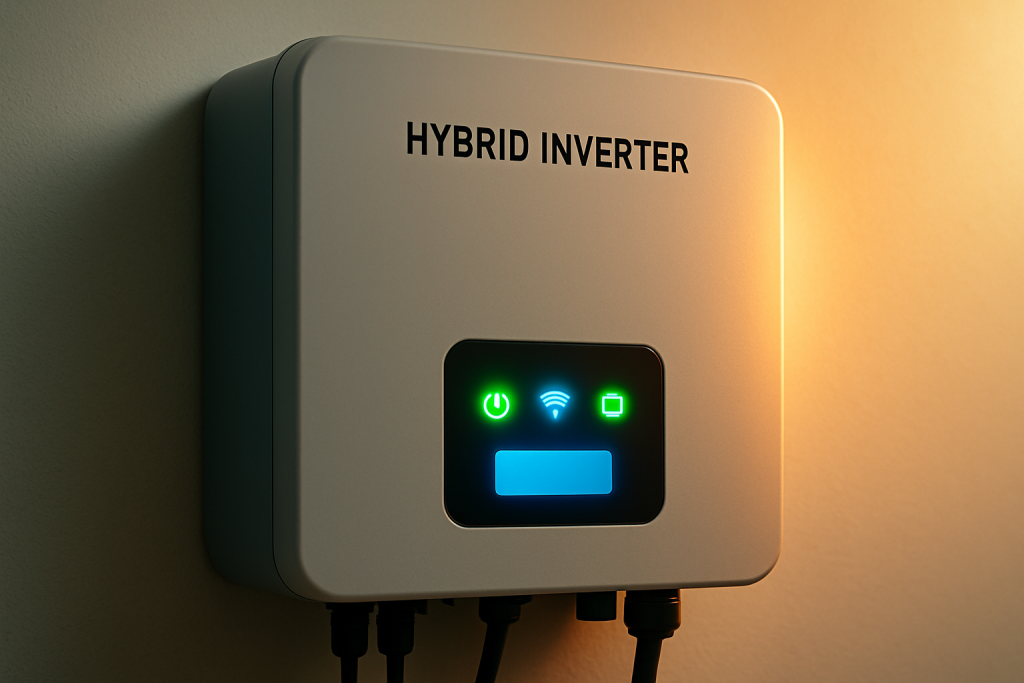
Key Specs That Matter (and what they mean)
- AC output (kW): Continuous power to your home. Size it to your peak essential loads.
- Battery voltage: 48 V systems are common for home scale; higher voltages = lower current.
- MPPT rating: How much PV (kW) and voltage window the inverter can handle.
- Surge rating: Short bursts to start motors (pumps, fridges).
- Transfer time: How fast it switches during outages (lower milliseconds feel seamless).
- Certifications: Look for UL 1741 SB / IEEE 1547 (for grid support in North America)
Sizing 101: A Quick, Friendly Framework
- List essentials: Lights, router, fridge, a few outlets, maybe a small air-con or fan.
- Add watts + surge: Fridge might surge 1200–1500 W; pump might surge 2–3× its running watts.
- Pick inverter: Choose continuous output plus healthy surge headroom.
- Match battery: Aim for at least one evening of autonomy (e.g., 5–10 kWh for light loads).
- PV array: Enough daytime production to cover use and recharge batteries before night.
Tiny analogy: If your home is a café, the inverter is the barista, the PV is the coffee beans, and the battery is the thermos. You want the right-size thermos and a barista that can keep up during the morning rush.
Battery Chemistry & Your Hybrid Inverter
- LFP (LiFePO₄): Stable, long cycle life, great for daily cycling.
- NMC: Higher energy density, more common in EVs.
- Lead-acid (AGM/GEL): Lower upfront cost, heavier, fewer cycles—okay for occasional backup.
(NREL notes Li-ion can handle thousands of cycles if operated within safe temperature and depth-of-discharge windows—key for long life.)
AC-Coupled vs. DC-Coupled: Which Path Fits You?
- DC-coupled hybrid: Panels feed the inverter’s MPPT directly; typically higher round-trip efficiency and simpler wiring for new builds.
- AC-coupled hybrid: Great for adding batteries to an existing string inverter; flexible upgrades with minimal disruption.
Installation & Safety: Don’t Skip the Boring (Important) Stuff
- Use appropriately sized breakers, fuses, conductors, and isolation switches.
- Respect clearances and ventilation; inverters and batteries dislike heat.
- Confirm compliance with local codes and utility interconnection rules.
- Favor certified equipment (UL 1741 SB / IEEE 1547 in U.S. markets).
Costs & ROI: How People Make the Math Work
- Save via self-consumption: Use your own solar instead of buying at retail.
- TOU arbitrage: Charge off-peak; discharge on-peak.
- Resilience value: Hard to price peace of mind, but priceless in storm season.
- Market trend: Solar and storage keep scaling; the IEA projects PV dominance through 2030, strengthening the case for PV + batteries.
Common Mistakes (and how to avoid them)
- Undersizing batteries: Leads to shallow autonomy and early frustration.
- Ignoring surge loads: Fridge or well pump can trip a too-small inverter.
- Poor ventilation: Heat throttles performance; plan airflow.
- No critical-loads panel: Backing up everything gets expensive; split essentials.
Monitoring & Apps You’ll Actually Use
Most hybrids include Wi-Fi or Ethernet monitoring. Look for:
- Live production/consumption graphs
- Battery state of charge and cycle tracking
- Time-of-use schedules and export limits
- Remote firmware updates
Who a Hybrid Solar Inverter Is Perfect For
- Work-from-home folks who can’t lose internet.
- Families needing refrigeration and lights during storms.
- Small businesses that want peak-shaving and backup on a budget.
- Homeowners planning to add EV charging or heat pumps soon.
Sustainability Snapshot (because the planet matters)
NREL’s 2024 update shows hybrid PV + storage is becoming a mainstream part of the grid build-out, with a rising share of hybrid projects. That momentum helps integrate more renewables reliably.
A Fun DIY Inspiration Break (optional)
Want a tiny backyard energy touch? Pair your system’s smarts with a low-power water feature and discover delightful ways to power garden fountains with solar—see these creative solar power fountain ideas for inspiration.
Amazon Picks: 5 Hybrid-Ready Inverters People Love
Note: Specs vary by model/region; always verify compatibility (battery voltage, grid standard, certifications) before purchasing.
1) SUNGOLDPOWER UL1741 5000W 48V Hybrid Solar Inverter
An all-in-one unit with MPPT solar charger and AC charger—UL listed for grid-tie/backup flexibility. Good fit for essential-loads panels and 48 V battery banks.
Features
- 5000 W (48 V) pure sine output
- Built-in 80A MPPT + 40A AC charger
- UL 1741 compliance for interconnection
Pros
- All-in-one simplicity
- UL listing adds peace of mind
Cons
- 120 V output; split-phase needs workarounds
Best for: Homes wanting a code-friendly, single-box solution.
Review snapshot: Owners praise easy setup and clear display; some wish for quieter fans.
2) LiTime 5000W Solar Hybrid Inverter Charger (48V)
A value-forward hybrid inverter/charger with integrated MPPT and parallel options for split-phase.
Features
- 5000 W 120 V output; parallel for 240 V
- Built-in ~100A MPPT
- Works with lead-acid and Li-ion
Pros
- Strong spec for the price
- Parallel capability for 240 V loads
Cons
- App and docs can feel “DIY” to beginners
Best for: Cost-conscious homeowners stepping into hybrid for the first time.
Review snapshot: Common praise for value; critiques mention setup learning curve.
3) VoolexGo 5000W Hybrid Solar Inverter (48V)
A compact 5 kW hybrid with 80A MPPT and wide PV voltage window—handy for varied string layouts.
Features
- 5000 W 120 V output
- 80A MPPT, up to ~5500 W PV input
- Lead-acid/Li-ion compatible
Pros
- Wide PV input range
- Clear LCD interface
Cons
- Limited brand footprint/support in some regions
Best for: Tinkerers and DIYers who value flexible PV strings.
Review snapshot: Users like the MPPT range; some note sparse third-party tutorials.
4) VEVOR 6000W All-in-One Hybrid Inverter (48V)
High-power “all-in-one” with 120A MPPT for larger arrays; great when you have plenty of roof space.
Features
- 6 kW output (single-phase)
- Built-in 120A MPPT controller
- Battery and grid charging options
Pros
- Big MPPT headroom
- Attractive price per watt
Cons
- Support/firmware varies by region
Best for: Larger essential-loads panels or small businesses.
Review snapshot: Good value; some feedback mentions fan noise under heavy load.
5) Victron Energy MultiPlus-II (48 V, models vary)
Technically an inverter/charger that pairs beautifully with batteries and AC-coupled solar; renowned reliability and flexible control via GX devices.
Features
- 3–5 kVA class models; PowerAssist load support
- Works wonderfully in AC-coupled hybrids
- Deep ecosystem (Cerbo GX, VRM portal)
Pros
- Rock-solid build, excellent monitoring
- Superb surge handling and configurability
Cons
- Premium price; DC-coupled MPPT requires separate charge controller
Best for: Users who want top-tier reliability and advanced control.
Review snapshot: Loved for durability and app/portal; cost is the common complaint.
Quick Comparison Table
| Model | Key Spec(s) | Warranty | Approx Price/Tier | Best For |
| SUNGOLDPOWER UL1741 5000W 48V | 5 kW, 80A MPPT, UL 1741 | Varies by seller | Mid | Code-friendly single-box |
| LiTime 5000W 48V Hybrid | 5 kW, ~100A MPPT, parallel 240 V | Varies | Budget | First-time hybrid builds |
| VoolexGo 5000W 48V | 5 kW, 80A MPPT, wide PV window | Varies | Budget-Mid | Flexible PV strings |
| VEVOR 6000W 48V | 6 kW, 120A MPPT | Varies | Budget | Larger arrays |
| Victron MultiPlus-II 48 V | 3–5 kVA, PowerAssist (AC-coupled) | Strong brand support | Premium | Reliability & control |
Tip: If you need 240 V split-phase for well pumps or dryers, look for models that parallel/sync for split-phase or consider a transformer/alternative wiring strategy.
🧪 Research-Backed Confidence (Short & Clear)
- Hybrid growth & grid role. NREL’s Fall 2024 Solar Industry Update notes that hybrid PV + battery projects make up a significant portion of new capacity additions (e.g., ~45% of battery capacity paired with PV in 2023)—evidence that the hybrid approach isn’t niche; it’s part of the new normal.
- Why storage strengthens solar economics. The IEA’s Renewables 2024 – Electricity analysis projects solar PV leading capacity additions through 2030. Pairing PV with batteries enhances flexibility and value by shifting energy to when people need it most.
(Bonus context you’ll appreciate: Falling battery costs and rapid global scale-up continue to improve the case for home storage.)
Practical Setup Examples (because real life is messy)
- Urban condo (limited roof): Smaller PV array + 5 kWh battery + hybrid inverter to shave peaks and ride short outages.
- Suburban family: 6–8 kW PV + 10–15 kWh battery for evening use and storm backup; critical-loads panel for lights, fridge, internet, fans.
- Home office / micro-business: Prioritize transfer time and surge rating; add monitoring alerts so your router never naps.
Reflective Questions to Choose with Confidence
- What must stay on during an outage?
- Do I face time-of-use pricing that a battery could exploit?
- Will I add an EV or heat pump soon (bigger future loads)?
- Do I need 240 V split-phase today—or later?
Maintenance & Longevity Tips
- Keep the inverter and batteries in a cool, ventilated space.
- Update firmware periodically.
- Set depth-of-discharge and charge limits the manufacturer recommends for longer life.
- Review logs monthly; small tweaks add up over time.
FAQs (Snippet-Friendly)
What size hybrid solar inverter do I need for a typical home?
Start with your critical loads. Many homes do well with a 5–6 kW hybrid inverter for essentials. If you have heavy 240 V equipment (well pump, big AC), check split-phase support or consider parallel units.
Is a hybrid solar inverter worth it without batteries?
You can install a hybrid now and add batteries later. You’ll gain flexibility today and an easy upgrade path tomorrow—no rewiring drama.
How long will a battery last in daily cycling?
Quality LFP batteries commonly rate 3000–6000 cycles (8–15 years at one cycle/day) when kept within recommended temperature and depth-of-discharge. Proper settings matter.
Do hybrid inverters support net metering?
Many do—but utility interconnection rules vary. Look for UL 1741 SB/IEEE 1547 compliance and check with your utility before you buy.
AC-coupled vs. DC-coupled—which is more efficient?
DC-coupled can shave conversion losses in new builds. AC-coupled shines for retrofits where you already own a string inverter. Either can work beautifully when designed well.
Conclusion: Your Energy, Your Rules
A hybrid solar inverter gives you choice: when to store, when to share, and how to ride out rough weather without missing a beat. If you want lower bills, stronger backup, and a system that grows with you, a hybrid is a thoughtful, future-ready step.
Ready for a small, joyful project that shows solar’s magic? Explore these solar power fountain ideas and imagine what a full hybrid system could do for your home.
You’ve got this. Start with your essentials list, pick a right-size inverter, choose a sensible battery, and build the resilient home you’ve always wanted.