Best Solar Batteries for High Power Demand Homes
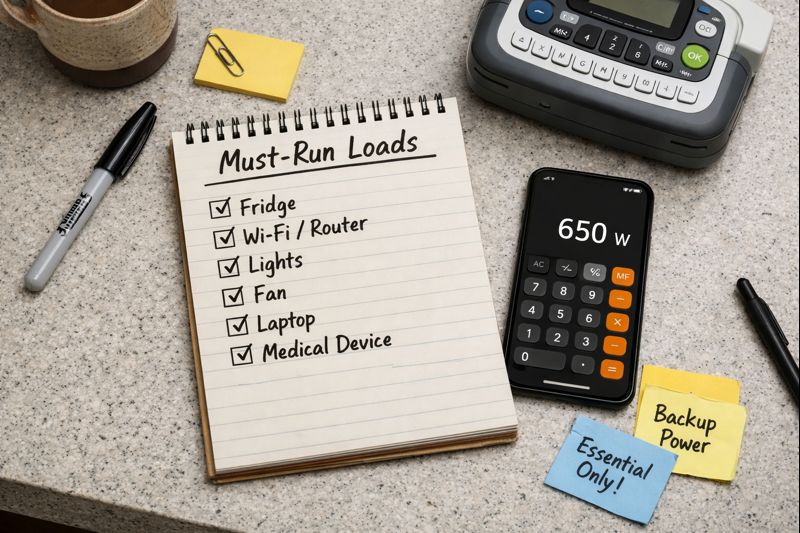
You know that moment when the lights flicker… and your brain instantly does the math on what has to stay on? Fridge. Wi-Fi. A fan or AC if it’s brutal. Maybe a medical device. Maybe the laptop you’re working on.
That’s why shopping for the best solar batteries isn’t really about “the biggest battery” or “the most expensive brand.” It’s about the right kind of power for your life—steady, safe, and sized for what you actually need.
What you’ll learn: how to size a battery, which specs matter, what to avoid, and a shortlist of Amazon options that fit real-world buyer intent.
Affiliate note: This article includes Amazon product links that may earn a small commission at no extra cost to you.
What “best solar batteries” really means for high-demand homes
For a high-demand home, the “best” battery does three things well:
- Handles surges (fridge compressors, well pumps, power tools, AC startups)
- Stores enough energy to get you through the hours you care about
- Plays nicely with your solar setup (or works as a standalone backup)
If you only look at capacity, you might buy a battery that can store a lot… but can’t deliver the burst of power your home demands. That’s like owning a huge water tank with a tiny straw.
Your home’s power personality: peak loads vs daily usage
Two homes can use the same “daily energy,” but feel totally different to power:
- A work-from-home family might have steady loads (routers, laptops, lights).
- A rural home might have spiky loads (well pump, freezer, power tools).
- A hot-climate home may have one boss-level load: air conditioning.
Your goal is to cover your peaks without wasting money oversizing everything else.
The sizing shortcut: “must-run” circuits first
If you want sizing to feel instantly less overwhelming, do this:
- List your must-run items (not your “nice-to-have” items).
- Estimate watts (or check labels).
- Pick how many hours you want them to run.
Quick example (simple on purpose):
- Fridge: ~150W average (but big startup surge)
- Wi-Fi + devices: 50–150W
- A few lights + fan: 50–200W
That’s often 300–700W average depending on your setup.
Now you’re shopping with clarity instead of vibes.
kWh vs kW: capacity vs surge power in plain English
- kWh (kilowatt-hours) = how long you can run stuff (the “fuel tank”).
- kW / W (watts) = how much you can run at once (the “engine strength”).
- Surge/peak watts = short bursts for startups (the “sprint”).
If your home has high power demand, you usually need strong watts first, then enough kWh to last.
Battery chemistries: LiFePO4, NMC, AGM—quick pros/cons
LiFePO4 (Lithium Iron Phosphate)
- Pros: long cycle life, stable chemistry, great for frequent use
- Cons: bigger/heavier than some lithium types at same kWh
NMC (Lithium Nickel Manganese Cobalt)
- Pros: high energy density (compact), common in some premium systems
- Cons: typically more thermal-management sensitive
AGM / Lead-acid
- Pros: cheaper upfront
- Cons: heavier, fewer usable cycles, less efficient for daily cycling
For many “high-demand + value” shoppers, LiFePO4 is the sweet spot—especially for portable power stations and DIY battery banks.
Round-trip efficiency: where your power “leaks”
Every battery system loses some energy charging/discharging. Higher efficiency means more of your solar power becomes usable electricity.
Here’s the practical takeaway:
If you’re trying to run a hungry home, efficiency matters more than you think—because losses feel like “my battery ran out early.”
Cycle life & warranties: the fine print that changes everything
A battery can be “cheap” and still cost more over time if it wears out quickly.
What to look for:
- Cycle life (especially at a stated depth of discharge)
- Warranty length (and what it actually covers)
- Battery management system (BMS) protections: over-temp, over-current, low-temp charging cutoff, etc.
Think of this like shoes: the cheapest pair hurts if you replace them constantly.
Safety & certifications: the non-negotiables
For high power demand, you want safety built in—especially if the battery lives inside your home or garage.
Strong signs:
- A serious BMS (not “marketing BMS”)
- Thermal protections and clear operating limits
- For larger installs: look for systems aligned with recognized safety standards (your installer will care a lot here)
If a listing feels vague on safety, that’s not a “maybe.” That’s a “no.”
Portability vs whole-home: choosing the right form factor
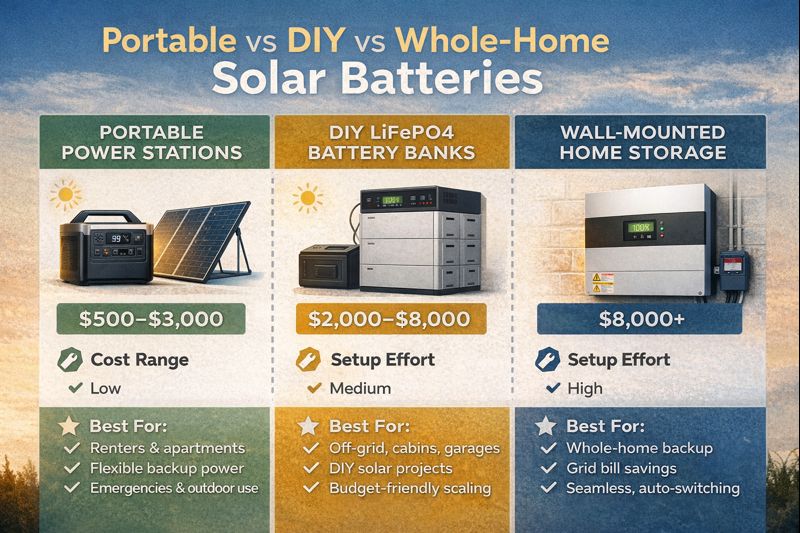
You’ve got three common paths:
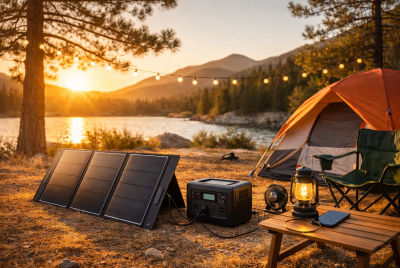
- Portable power station (“solar generator”)
- Best for renters, emergencies, flexible backup, no-permit setups
- DIY battery bank (LiFePO4 batteries + inverter + solar charge controller)
- Best for tinkerers, off-grid builds, RV/van, budget-controlled scaling
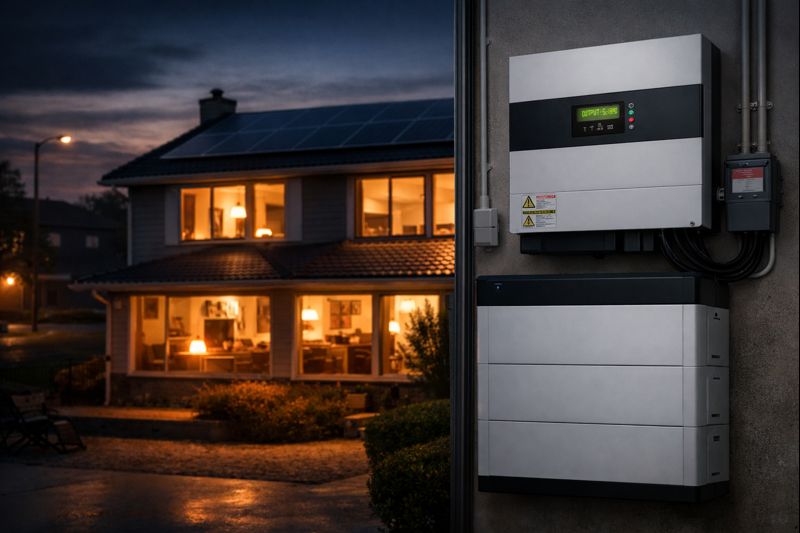
- Wall-mounted residential ESS
- Best for seamless whole-home backup (but usually not Amazon shopping)
This article focuses on portable + DIY-friendly options you can actually buy and deploy quickly.
Solar compatibility: charge controllers, inverters, and input limits
Before you buy, match the battery to your solar reality:
- Portable power stations have solar input limits (voltage/watts).
- DIY banks need:
- a solar charge controller (MPPT)
- an inverter sized for your loads
- wiring/fusing that doesn’t turn “backup power” into “smoke test”
If you’re not sure, pick a system with clear expansion paths and conservative ratings.
Expandability: stacking packs, parallel banks, and future-proofing
High power demand homes rarely stay “small” forever.
Future-proof questions:
- Can you add extra battery modules later?
- Can you run two units in parallel (more watts)?
- Are replacement parts/batteries easy to find?
Buying expandable is like buying a couch that fits through the door and your future living room.
Budgeting & ROI: cost per kWh stored
A simple way to compare value is to think in cost per usable kWh (not just sticker price).
Also ask:
- Are you buying for outages (peace of mind)?
- Or for daily bill savings (time-of-use shifting)?
- Or both?
Your “best solar batteries” pick changes depending on which win you care about most.
Common buying mistakes (I’ve made at least two of these)
- Mistake #1: Buying only by kWh. Then your fridge trips it with a startup surge.
- Mistake #2: Ignoring recharge speed. A huge battery that recharges slowly can feel useless during back-to-back outage days.
- Mistake #3: Forgetting the boring stuff. Cables, fuses, connectors, safe ventilation, and proper load planning.
If you want a battery that feels like a hero in real life, build around surge + safety + usability.
Product Section: 5 best solar batteries worth considering
Below are five popular Amazon options that align with high-demand needs (surge capability, expansion potential, and strong buyer intent). Ratings/review counts can change over time, so consider them a “signal,” not a guarantee.
1) EF ECOFLOW DELTA 2 Max Portable Power Station
- Why it stands out: strong backup vibe without committing to a permanent install
- Features: expandable capacity, high AC output for heavier loads, fast recharge options
- Best for: outage backup, home office stability, fridge + essentials + some comfort loads
2) BLUETTI AC200L Portable Power Station
- Why it stands out: a strong “middle heavyweight” option—serious wattage, still portable-ish
- Features: high AC output, solar input support, expandable ecosystem
- Best for: powering more devices at once (and handling those annoying startup surges)
3) Jackery Solar Generator 2000 v2
- Why it stands out: simple interface, “plug-in and breathe” experience
- Features: solid capacity for emergency use, multiple AC ports, designed for backup + travel
- Best for: households that want a reliable, user-friendly backup system without DIY wiring
4) LiTime 12V 200Ah LiFePO4 Lithium Battery
- Why it stands out: a building block for DIY battery banks (off-grid, shed, cabin, backup circuits)
- Features: LiFePO4 chemistry, BMS protections, high capacity per battery
- Best for: DIY solar battery storage paired with a quality inverter/charge controller
5) CHINS LiFePO4 Battery 12V 200Ah
- Why it stands out: lots of social proof, commonly used in off-grid and RV-style builds
- Features: LiFePO4 chemistry, built-in BMS, strong capacity for battery bank scaling
- Best for: expanding an off-grid battery bank on a budget (when paired with safe system design)
Research-Backed Section: what experts say (plus one resource to bookmark)
Here are two solid, reputable references that make battery shopping feel less like guesswork:
- Efficiency benchmark (why “usable energy” matters): NREL’s Annual Technology Baseline notes a round-trip efficiency assumption around 85% for battery storage modeling—useful context for why your “stored kWh” doesn’t always equal “usable kWh.” (2025)
- What to compare when choosing a solar battery: EnergySage breaks down buyer-facing factors like capacity, power, round-trip efficiency, degradation, and warranty—which maps nicely to real purchasing decisions.
Bonus bookmark (especially if you’re building a mobile system):
If your “high power demand” includes road trips, camping, or a van/RV setup, this guide is a practical next read: RV solar power basics for building a reliable battery setup
FAQs: quick answers before you click “Buy”
How many kWh of battery storage do I need for a high power demand home?
Start with your must-run loads and decide how many hours you want. Many homes feel “covered” with a few kWh for essentials, but high-demand comfort (like AC) often pushes you into much larger storage—especially overnight.
Are LiFePO4 batteries better than lithium-ion for home solar storage?
LiFePO4 is lithium-ion—just a specific chemistry. Many buyers like it because it tends to offer long cycle life and strong stability, which fits frequent cycling and backup use well.
Can a portable solar generator run a refrigerator and an air conditioner?
A fridge is usually doable if the unit has enough surge power. AC is tougher—some setups can run a small or efficient AC, but runtime depends heavily on battery size and the AC’s actual draw.
What specs matter most when comparing the best solar batteries?
Prioritize: continuous watts, surge watts, usable capacity (kWh), recharge speed, warranty, and safety protections (BMS). Everything else is secondary.
Do solar batteries save money or are they just for outages?
Both. If your utility has time-of-use rates, batteries can reduce peak purchases. But for many people, the first “profit” is peace of mind—keeping life running when the grid doesn’t cooperate.
Conclusion:
The best solar batteries for high power demand homes aren’t always the biggest—they’re the ones that match your surges, your must-run list, and your real-life routine. If you do one thing today, do this: write your must-run loads and pick your target hours. Once you’ve got that, choosing the right battery gets way easier—and you’ll feel confident you’re buying power you’ll actually use.