What Does Solar Panel Warranty Cover?
A solar installation is supposed to serve your home for decades, so what happens if a panel stops working after the installer leaves? A Solar Panel Warranty can protect you from certain defects and unexpected performance losses, but it rarely pays for every problem that could occur on your roof. You may have separate coverage for the panels, installation work, inverter, and other equipment, each with its own rules.
Understanding those differences before signing a contract can prevent an expensive surprise later. This guide explains what manufacturers normally cover, what they exclude, how long protection lasts, and how to document a claim. It also shows what to check when comparing full rooftop systems with smaller panels sold for RVs, cabins, or portable charging.
What Does a Solar Panel Warranty Actually Cover?
Most residential modules have two manufacturer promises: one concerning physical defects and another concerning minimum power output as the panel ages. The installation company may provide a third warranty for its work. These protections address different problems.
A warranty is a contract, not an all-risk insurance policy. Model-specific terms determine eligibility.
An output guarantee is not a promise of a free repair. One company may supply replacement modules but leave troubleshooting and rooftop labor to the homeowner. Ask who performs the work and who pays before comparing headline durations.
Product Warranty: Manufacturing Defects and Failures
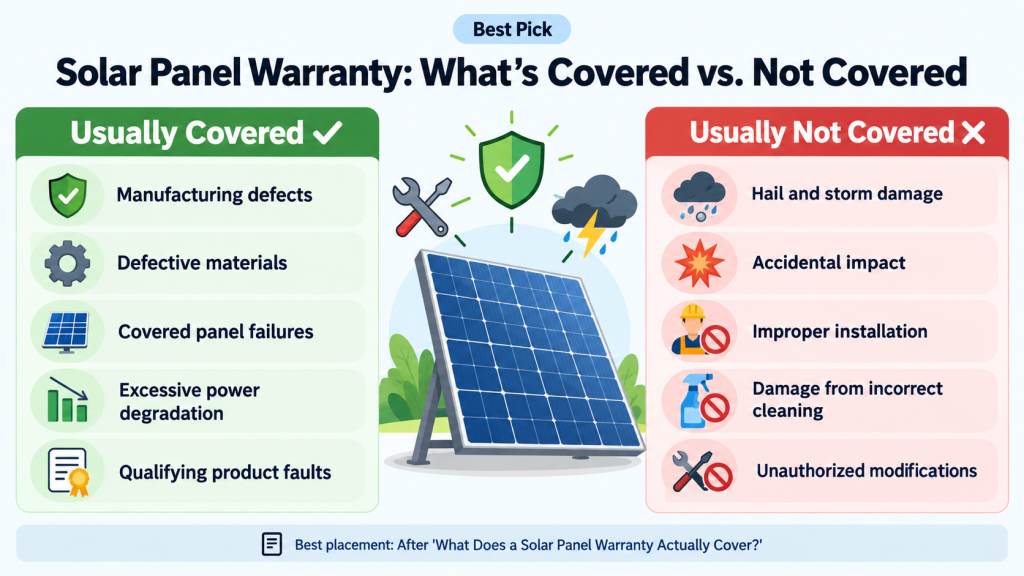
A product warranty generally addresses faults caused by defective materials or manufacturing. Examples include faulty junction boxes, delamination, or internal failures.
It does not automatically cover a cracked panel struck by a falling branch. You may need evidence the module caused the problem.
Check the remedy, too. A company may choose repair, replacement with a comparable model, or reimbursement under specified conditions. Replacement does not necessarily include installation labor.
Performance Warranty: The Minimum Output Promise
Solar cells gradually lose some power-producing capacity as they age. A performance warranty sets a minimum output level for specified years, based on rated wattage under specified test conditions.
For example, a hypothetical 400-watt panel guaranteed to retain 85% capacity at year 25 would have a warranty threshold of 340 watts under the specified testing method. Actual production also depends on weather, shade, and losses.
Compare stepped versus annual guarantees, not only their duration.
Installation Workmanship Warranty: Who Fixes Mounting Mistakes?
Your installer typically handles faults arising from poor installation rather than defective solar cells. Depending on the agreement, workmanship protection may address mounting problems, badly made connections, or leaks caused by covered roof penetrations.
Check roof-leak coverage and inspection fees. An installer warranty may end much earlier than the panel manufacturer’s performance guarantee.
Identify the responsible service company. Contracts should also cover subcontractor work.
What Is the Typical Length of a Solar Panel Warranty?
Warranty length can differ depending on the model and the market where it is sold. Many standard rooftop modules have historically offered roughly 10–15 years of product coverage and around 25 years of performance protection. Premium products may offer 25-year or longer product terms, while some performance promises now extend to 30 years.
Portable folding panels and small off-grid kits may follow shorter consumer-product warranties instead. Camping panels can have different terms.
Check the starting date and registration rules.
What Damage Is Usually Excluded?
Typical exclusions concern events outside the manufacturer’s control. Common restrictions include:
- Storm, hail, flood, fire, or accidental impact damage
- Improper installation, unauthorized modifications, or unsuitable components
- Misuse, neglect, or cleaning methods prohibited by the manufacturer
- Ordinary dirt, shading, or other external causes of lower production
Weather damage differs from a manufacturing defect. Check your insurance policy’s solar coverage and deductible.
If you are maintaining panels yourself, follow their specific cleaning manual. See our tips on cleaning solar panels safely and effectively.
Will Labor, Shipping, and Testing Cost Extra?
A replacement part may be free while the service visit is not. Removal, freight, and testing may be excluded or capped.
Ask for an example claim involving one failed roof-mounted module in year 15. Who pays the electrician, roof access equipment, and return freight? What if the model is discontinued?
Performance claims can be especially demanding because the manufacturer may require calibrated measurements rather than a screenshot of your monitoring app. Check requirements early.
Do Inverters, Batteries, and Roofing Have Separate Warranties?
Yes. A panel warranty generally does not cover the inverter, battery, monitoring hardware, wiring, or mounting equipment unless a specific system-wide plan says otherwise. Each can have separate coverage.
A drop in home energy production could result from an inverter fault rather than deteriorating modules. Batteries also have their own terms, sometimes including capacity or usage limits. Roofing materials and leak repairs may fall under roof warranties or installation agreements instead.
Keep a schedule of component warranties and service contacts.
Can a Solar Warranty Be Transferred to a New Homeowner?
Some solar warranties transfer to the next owner; others impose deadlines, paperwork, fees, or eligibility conditions. Transfers must meet the written requirements.
Before listing your property, locate the original invoices, panel model numbers, serial numbers, and warranty certificates. Confirm the rules in writing.
A leased array is different from an owned one. A buyer might need to assume a separate agreement.
How to Make a Solar Panel Warranty Claim
Begin with the installer or designated service provider, especially if the system is still under workmanship coverage. Request an inspection. Avoid climbing onto the roof or disconnecting live photovoltaic wiring yourself.
Collect the purchase invoice, commissioning record, panel serial numbers, monitoring history, clear photographs taken safely, and correspondence. Record error messages.
Ask the provider to identify which warranty applies, what evidence is required, and who pays for diagnosis and labor. Save claim records and obtain approval before repairs.
How to Compare Solar Warranties Before Buying
Longer is not always better. Compare the product and performance terms independently, then examine remedies and costs.
Prioritize these questions:
- Is the warranty attached to the exact model and intended installation type?
- What power percentage is guaranteed at years 10, 20, and 25?
- Are removal, labor, return shipping, and testing included?
- Can coverage transfer, and who handles claims locally?
- What happens if the model is discontinued or the installer closes?
Prioritize dependable service for rooftops, and compatibility for smaller systems.
Recommended Solar Panel Products Worth Comparing
These five options serve different small-scale solar needs. They are useful comparisons, not substitutes for choosing a professionally engineered rooftop system; confirm the current model-specific warranty certificate before purchasing.
1. Renogy Solar Panels 100 Watt, N-Type Solar Panel 25% High-Efficiency 16BB
Best for: Compact fixed installations on RVs or off-grid structures.
This rigid 100-watt N-type module is marketed for 12-volt battery systems and offers a straightforward starting point for a modest fixed array. Its framed construction suits planned mounting better than repeated packing. You still need compatible charging equipment and secure installation, and the coverage terms should be checked for the particular version sold.
2. Newpowa Bifacial 200 Watt 12 Volt Solar Panel 10BB Monocrystalline
Best for: Ground or elevated mounting with useful reflected sunlight.
Newpowa’s rigid 200-watt bifacial design can collect some reflected light through its rear side when mounting conditions allow. That benefit depends on clearance and the surface below, so it is less useful when mounted flush against an opaque roof. Verify mounting requirements, electrical ratings, and the applicable product and output warranties before installation.
3. ECO-WORTHY 200 Watts 12 Volt/24 Volt Solar Panel Kit with 30A PWM Charge Controller
Best for: Beginners assembling a small battery-charging system.
This kit combines monocrystalline panels with a 30-amp PWM controller for compatible 12- or 24-volt off-grid arrangements. Bundled hardware simplifies initial planning, although the controller may not suit every battery chemistry or performance goal. Confirm battery settings, wiring requirements, and whether accessories carry different warranty terms from the panels.
4. Jackery SolarSaga 100W Air Solar Panel
Best for: Portable power-station charging during travel.
The SolarSaga 100W Air is a foldable bifacial panel designed for portable use, with an advertised IP65 protection rating. Folding makes storage easier than with framed rooftop modules, but wind exposure and connector compatibility deserve attention. Its portable-device warranty should be compared separately from long residential panel performance guarantees.
5. Anker SOLIX PS100 Solar Panel with Adjustable Kickstand
Best for: Campers who regularly reposition their solar charger.
Anker’s 100-watt foldable PS100 uses an adjustable stand and carries an advertised IP67 ingress-protection rating. It is convenient for aiming toward the sun without permanent mounting, and the manufacturer’s guide describes compatible charging cables. The panel does not store electricity, so a suitable power station is required; check the exact region-specific warranty.
What Field Research Shows About Solar Panel Degradation
Warranty curves are commercial promises, not measurements of every panel’s actual lifespan. A 2023 field study published in Progress in Photovoltaics followed 834 modules representing 13 types from seven manufacturers across three climates. Its median measured degradation rate was approximately 0.58% per year, although rates varied and some systems were projected to exceed warranty limits.
The Photovoltaic Lifetime Project likewise explains that gradual degradation can be difficult to distinguish from measurement uncertainty in a system’s early years. That helps explain why a single disappointing month of electricity production does not prove a warranty violation.
These findings support checking performance systematically, investigating inverter faults and shading first, and relying on qualified testing when a manufacturer requires it. They do not establish that any particular new panel will last a guaranteed number of years.
Frequently Asked Questions About Solar Panel Warranty
Does a 25-year warranty mean the entire solar system is covered?
No. A 25-year label may refer only to a panel’s guaranteed power output, not its physical defects or the inverter, mounting hardware, and installation. Review separate certificates for product, performance, workmanship, and other components. The shortest relevant coverage period can determine who pays for a particular failure.
Will hail damage to solar panels be covered?
Usually not by a standard manufacturer’s defect warranty when hail is an external cause, although exact exclusions vary. Ask your homeowners insurer about storm coverage for permanently installed solar equipment. Do not assume a panel’s hail-resistance test rating means the manufacturer will pay for any actual hail damage.
Can poor solar production qualify for a performance claim?
Yes, if qualified testing establishes that a covered module falls below its contractual output threshold. Lower monthly production alone is insufficient because cloud cover, shade, dirt, heat, and inverter problems can reduce energy generation. Have the system checked before assuming the panels have degraded beyond their promised limits.
Can cleaning your solar panels affect or void the warranty?
Not necessarily. Cleaning according to approved manufacturer instructions generally differs from damage caused by abrasive tools, unauthorized chemicals, high-pressure washing, or unsafe handling. Read the exact module manual because requirements differ. If panels are on a steep or inaccessible roof, use a qualified professional rather than risking a fall or damage.
What happens to my solar panel warranty if the manufacturer goes out of business?
A manufacturer’s closure can make warranty enforcement difficult, especially if no successor assumes its obligations. Some contracts may have separate backing, but do not assume that is included. Keep documentation and ask the original installer whether another responsible party or insurance arrangement exists. Check the provider’s long-term service arrangements before purchase.
Conclusion: Choose Coverage You Can Actually Use
A Solar Panel Warranty is most valuable when you understand which promise applies to each problem. Product coverage addresses qualifying defects, performance coverage sets an aging-related output threshold, and workmanship protection concerns installation mistakes. None should be mistaken for unlimited protection against storms, accidents, or every future service expense.
Before choosing a system, compare exact warranty documents, not brochure headlines. Confirm labor and shipping responsibilities, exclusions, transfer rules, and the company that will handle a claim. For small off-grid projects, the Renogy rigid 100-watt panel or ECO-WORTHY kit may suit different installation needs, but neither should be judged by rooftop warranty expectations alone.
Choose the equipment that fits your application, backed by clear terms and a realistic repair process.