
Hybrid Inverter Guide: How It Works, How to Size It, and What to Choose
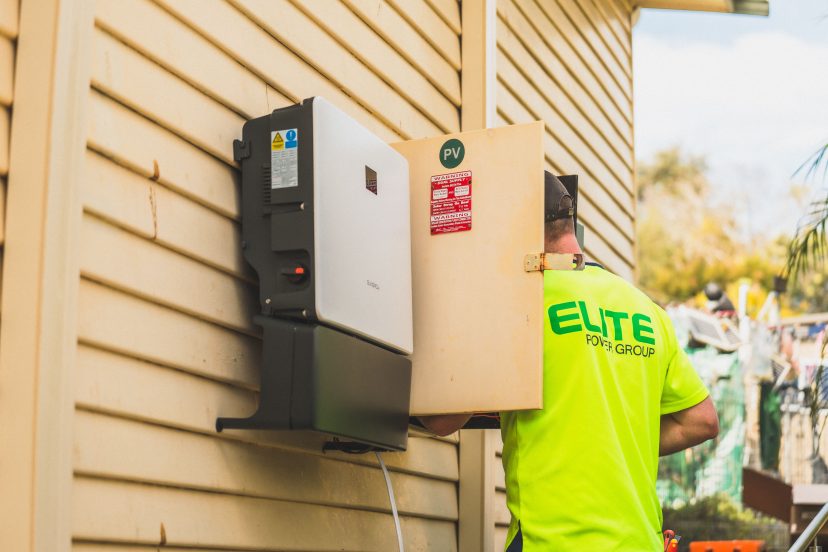
A solar array can lower your daytime electricity use, but many homeowners want more: battery charging, outage backup, and smarter control over when grid power enters the picture. A hybrid inverter brings those jobs together in one system. That sounds simple until you face questions about battery voltage, surge capacity, solar-input limits, split-phase output, permits, and whether backup power will actually start when the grid fails.
This guide explains how the equipment works, where it makes sense, what specifications matter, and how to compare suitable models without getting buried in electrical jargon. You will also learn how to size a system around your real loads, spot compatibility problems early, and decide when professional design help is worth the cost.
What a Hybrid Inverter Really Does
A hybrid inverter is a device that converts direct current from solar panels or batteries to alternating current for the purpose of powering household appliances. It can also send surplus solar energy to a battery, draw from the grid when needed, and recharge batteries from AC power when supported.
Think of it as a translator and traffic controller in one box. However, features vary. Some units support grid export; others are mainly off-grid inverter-chargers with utility backup.
Hybrid Inverter vs. Grid-Tied and Off-Grid Models
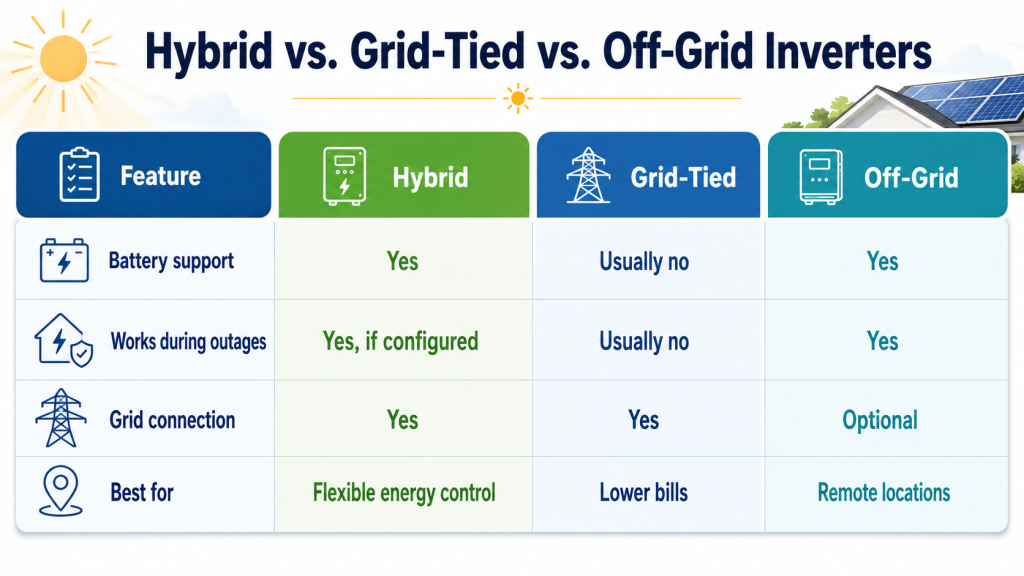
A conventional grid-tied inverter serves household loads and may export surplus solar, but it usually shuts down during an outage without approved backup equipment. An off-grid inverter serves an isolated system and normally depends on batteries or a generator.
A hybrid inverter coordinates solar, storage, loads, and sometimes the utility grid. Still, “hybrid” does not guarantee legal export, whole-home backup, or universal battery compatibility. Confirm the exact model’s documented operating modes.
When a Hybrid Inverter Makes Sense
This equipment suits outage-prone homes, cabins using solar plus generator support, and households that want to store midday energy for evening use. An all-in-one design can also reduce the number of separate components.
A simpler grid-tied system may cost less when backup is unnecessary. Meanwhile, separate off-grid components can be easier to replace individually. Choose hybrid architecture because its energy-management functions match your needs, not simply because it offers more settings.
How Power Moves Through the System
In daylight, solar can supply active loads and charge the battery with the remainder. As production falls, the battery may cover demand until the grid or generator takes over at a programmed threshold.
That order changes with solar-first, battery-first, utility-first, and time-of-use settings. Review the manual’s operating diagrams before buying. They show whether the unit can deliver the backup behavior, export control, and grid-charging rules you expect.
Battery Voltage and Compatibility
Many larger residential units use 48-volt batteries because higher voltage lowers current for the same power. Never connect a bank outside the inverter’s specified voltage range.
Chemistry matters too. Lithium iron phosphate batteries may need communication between the battery-management system and inverter for accurate limits and state-of-charge reporting. Lead-acid batteries use different charge stages. Check supported protocols, charge current, low-voltage settings, and approved battery lists rather than assuming two 48-volt products will work together.
Size Your Hybrid Inverter Around Real Loads
List appliances that may run together and total their continuous watts. Then identify surge loads. Refrigerators, pumps, compressors, and tools can draw several times their running power during startup.
A 5,000-watt unit may handle lighting, refrigeration, and electronics yet struggle when a water heater and pump overlap. Oversizing can also increase standby use and cable requirements.
Check output format. Most North American homes need 120/240-volt split-phase service, while a 120-volt-only model cannot directly serve 240-volt appliances. Ask an electrician to calculate motor-starting current and whole-home demand.
Match the Solar Array to MPPT Limits
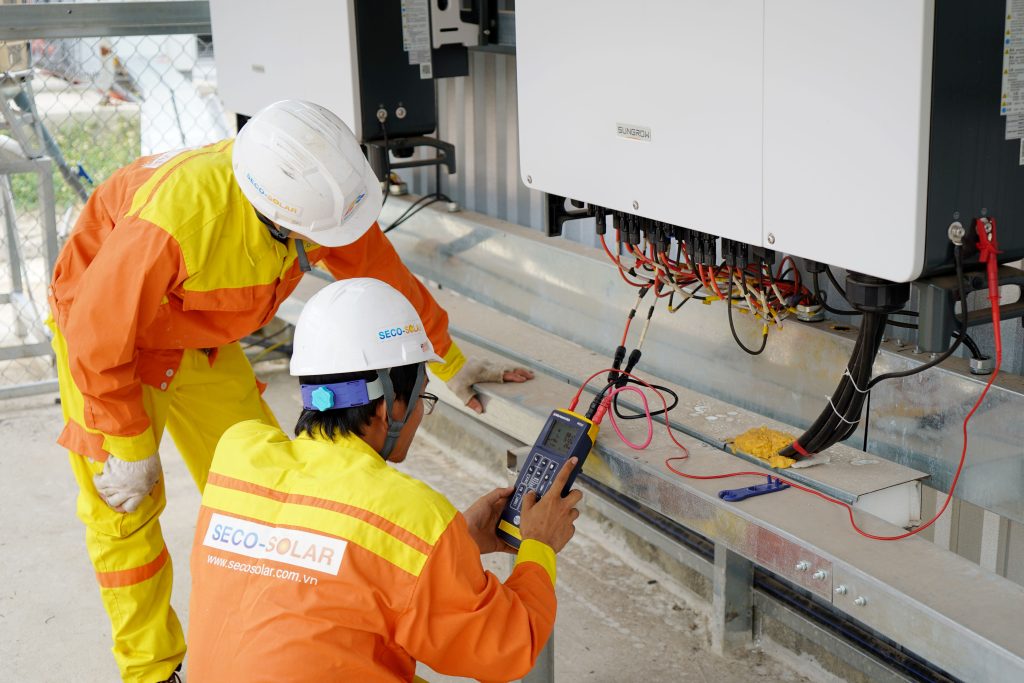
The maximum power point tracker has a voltage window, maximum open-circuit voltage, current limit, and solar-wattage limit. Panel strings must remain inside all four, including on cold mornings when voltage rises.
Do not match the array by watts alone. String length, panel voltage, temperature correction, and parallel-string current also matter. For a remote cabin or homestead, the SolarFlez guide to solar panels for off-grid living can help you estimate panel wattage before finalizing inverter size.
Backup Power, Transfer Time, and Critical Loads
Transfer time varies by model. Sensitive electronics may notice a brief interruption even when the lights appear to remain on, so check whether the backup output is intended for uninterruptible-power applications.
Next, decide what truly needs power. A critical-load panel for refrigeration, internet, lighting, medical equipment, or a water pump is often more practical than backing up every appliance. Battery capacity must support both the load and the desired runtime.
Grid Connection, Export Rules, and Safety Standards
A unit that accepts utility power is not automatically approved to export electricity. Grid-interactive systems must meet utility rules, electrical codes, anti-islanding requirements, and equipment-listing requirements for the exact model.
In the United States, installers commonly verify applicable UL 1741 certification and IEEE 1547 functions. Other countries follow different standards. Before ordering, ask the utility and local authority which certifications, disconnects, meters, and documents they require.
Research-Backed Guidance for a Safer Decision
The U.S. Department of Energy explains that modern inverters may support voltage, frequency, communications, and other grid functions beyond DC-to-AC conversion. Its inverter and grid-services guidance shows why buyers should compare controls, not just wattage.
The department’s solar resilience guidance notes that typical solar-only systems do not power homes during outages. Backup needs suitable controls, grid isolation, and stored energy. Verify the complete architecture rather than assuming panels alone provide resilience.
For U.S. projects, UL Solutions’ certification overview covers UL 1741, while IEEE 1547-2018 addresses interconnection, power quality, islanding, and testing. Local authorities still determine project requirements.
The National Renewable Energy Laboratory’s 2024 battery-storage assumptions use kilowatts for power and kilowatt-hours for energy. Inverter kilowatts govern simultaneous load; battery kilowatt-hours influence runtime.
Features Worth Paying For
Prioritize adequate surge capacity, a useful MPPT range, programmable charging, generator support, battery communication, and clear monitoring. Dual MPPT inputs help when panels face different directions.
Also compare idle consumption, temperature limits, noise, warranty terms, manuals, and replacement support. Parallel operation aids expansion only when the manufacturer documents the approved arrangement. A long feature list has little value when certification, support, or battery compatibility remains unclear.
Recommended Hybrid Inverter Options
These hybrid inverter options cover distinct needs rather than presenting five near-identical choices. Confirm current manuals, certifications, battery compatibility, and local approval before purchasing.
| Product | Best fit | Output | Standout feature |
| ECO-WORTHY 5000W | Expandable 120V backup | 5,000W | Up to six-unit parallel operation |
| LiTime 5000W | Compact 48V starter system | 5,000W | Integrated 100A MPPT controller |
| Y&H 7200W Split Phase | Flexible 120/240V systems | 7,200W | Battery-free operating mode |
| ZLPOWER 8000W | Pumps and motor loads | 8,000W | Low-frequency design with high surge rating |
| SUNGOLDPOWER SPH6548P | Mixed roof orientations | 6,500W | Two MPPT solar inputs |
ECO-WORTHY UL1741 5000W 48V Solar Inverter Charger, 48V DC to 120V AC, Built-in 100A MPPT Solar Charge Controller, 40A AC Charger, Works with Lead Acid/LiFePO4, Home Backup
Best for: Budget-conscious users planning a scalable 120V system
This 48-volt model combines 5,000-watt pure-sine-wave output, a 100-amp MPPT controller, and a 40-amp AC charger. Parallel capability suits growing cabins, workshops, or future expansion. However, each unit supplies 120-volt output, so verify the approved configuration before planning split-phase loads.
LiTime 5000W Hybrid Solar Inverter, 48VDC to 110V/120VAC (Support Parallel), 100A MPPT, 40A AC Battery Charger, Pure Sine Wave, Lead Acid/LiFePO4, Home Backup
Best for: A compact all-in-one 48V battery system
LiTime integrates 5,000-watt output, a 100-amp MPPT controller, and a 40-amp AC charger. It supports lead-acid and lithium settings plus parallel operation. The compact package suits a first serious backup system, although 240-volt appliances require a correctly designed multi-unit arrangement.
Y&H 7200W Split Phase Hybrid Solar Inverter 48V DC to 120/240V AC, UL1741, Built-in 150A Solar Charger, 6-Unit Parallel to 43.2kW, Supports Battery-Free and Lithium/Lead-Acid
Best for: Homes or cabins needing native 120/240V split-phase output
This 48-volt unit provides 7,200 watts, native 120/240-volt split-phase output, and a 150-amp solar charger. Battery-free operation and parallel expansion add flexibility. However, the many operating choices increase setup complexity, so string voltage, charging limits, and priorities require careful configuration.
ZLPOWER UL1741 8000W 48V Off-Grid Inverter Charger, Peak Power 24000W for 20s, 240V AC Input, 120/240V Split Phase Output, Pure Sine Wave, Built-in 2 MPPT, Low Frequency
Best for: Systems with well pumps, compressors, or other starting surges
ZLPOWER uses a low-frequency design, delivers 8,000-watt split-phase output, and lists a 24,000-watt peak for up to 20 seconds. Dual MPPT inputs improve array flexibility. Its surge specification suits motor-heavy systems, though the unit is larger and more installation-intensive than compact choices.
SUNGOLDPOWER UL1741 SPH6548P 6500W DC 48V Split Phase Solar Inverter, 120V/240V AC Input/Output, Built-in 2 MPPT Solar Controllers, Max 140A Battery Charging, Parallel
Best for: Arrays split across different roof faces or orientations
The SPH6548P supplies 6,500 watts at 120/240 volts and includes two MPPT controllers, so separate solar groups can track independently. It also supports parallel expansion. Dual trackers suit mixed orientations, but each string must remain within its assigned voltage and current limits.
Installation, Maintenance, and Expected Service Life
A hybrid inverter handles hazardous DC and AC energy. Use the specified breakers, fuses, disconnects, grounding, conductor sizes, clearances, and battery protection. Grid-connected work generally requires a qualified professional and inspection.
After commissioning, keep vents clear, review fault logs, and follow the approved maintenance plan. Heat, dust, moisture, overloads, and loose connections can shorten service life. Warranty length matters, but local service and replacement availability matter too.
Commonly Asked Questions about Hybrid Inverters
Does a hybrid inverter need a battery to work?
Some models can power loads from solar and grid input without a battery, while others require one to start or stabilize the DC bus. Battery-free operation also cannot provide stored backup energy. Check the exact manual for permitted modes; never assume this feature applies to every hybrid inverter.
Will it power my house during a blackout?
Only when the system includes a supported backup output, correct isolation equipment, sufficient battery energy, and approved wiring. Grid-interactive equipment must stop energizing utility lines during an outage. A dedicated critical-load panel often makes runtime and surge management easier than whole-home backup.
How large should my battery be?
Estimate the watt-hours essential loads use during your desired backup period, then account for usable depth of discharge, conversion losses, temperature, and reserve capacity. Battery kilowatt-hours influence runtime, while inverter kilowatts control simultaneous load. Seek a professional calculation for pumps, heating equipment, or long outages.
Can I add batteries later?
Often yes, provided the model supports the chemistry, voltage, communication protocol, and planned capacity. Mixing old and new batteries or different models can create imbalance and violate instructions. Planning cables, protection, cabinet space, and communication ports initially makes later expansion safer and cleaner.
Are hybrid inverters worth the additional expense?
It can be worthwhile for outage backup, solar self-consumption, time-of-use control, or coordinated generator charging. It may be unnecessary when you only want to reduce daytime grid use and outages are rare. Compare the complete installed system—including batteries, switchgear, permits, and labor—not inverter prices alone.
Final Recommendation: Choosing the Right Hybrid Inverter
Choose a hybrid inverter by working backward from your loads, electrical service, battery plan, solar-string design, and local approval requirements. A compact 5,000-watt model such as the LiTime may suit a modest 120-volt backup system, while the Y&H 7200W or SUNGOLDPOWER SPH6548P better serves users who need native split-phase output. The ZLPOWER option deserves attention when motor-starting surge is a priority.
Before purchasing, confirm four items in writing: battery compatibility, PV voltage limits, output configuration, and the certifications accepted by your utility or inspector. Then have the wiring and protection designed around the manufacturer’s manual. The best final choice is not the unit with the longest specification sheet; it is the one that safely supports the loads and operating modes you will genuinely use.