Top 10 LiFePO4 batteries
LiFePO4 batteries use lithium iron phosphate chemistry to store dependable power for RVs, boats, solar systems, cabins, golf carts, camping equipment, and backup loads. Compared with traditional lead-acid batteries, they are generally lighter, provide more usable capacity, and require less routine maintenance. However, voltage, capacity, BMS limits, dimensions, temperature protection, and charging compatibility vary considerably. We evaluated these products by verified specifications, practical features, installation needs, portability, safety controls, warranty information, and overall value. The right choice should fit your electrical system rather than simply offering the largest capacity or longest feature list.
Quick Comparison
| Product | Best for | Key feature | Main limitation | Price category | Overall recommendation |
| ECO-WORTHY 100Ah | Overall use | SOC display and Bluetooth | Slow shipping may occur | Mid-range | Versatile |
| Renogy 100Ah Core | Beginners | Compact mainstream design | Monitoring needs accessory | Mid-range | Easy starting point |
| Vatrer 100Ah Heated | Cold weather | Automatic self-heating | Heating adds complexity | Mid-range | Winter-ready |
| Power Queen 50Ah | Portability | 640Wh compact format | Limited capacity | Budget | Small-load pick |
| LiTime 24V 100Ah | 24V systems | Bluetooth and 2,560Wh | Wrong for 12V systems | Premium | Strong 24V choice |
| LiTime 165Ah Marine | Boat starting | Dual-purpose design | Application-specific | Premium | Marine specialist |
| Redodo 100Ah Group 24 | RV replacement | Compact Group 24 case | No self-heating | Mid-range | Practical retrofit |
| CHINS 48V 100Ah | Golf carts | Charger and monitor included | Large, specialized package | Premium | Complete conversion |
| GrenerPower 100Ah | Simple value | Group 24 footprint | No Bluetooth | Budget | Straightforward |
| Renogy 300Ah Mini | High capacity | 300Ah and 200A BMS | Heavy investment | Premium | Serious storage |
1. ECO-WORTHY 12V 100Ah Upgrade 2.0 LiFePO4 Battery — Best for Overall Use
Overview: This 12V 100Ah battery balances capacity, monitoring, and protective features for RV, camping, solar, and trolling-motor systems. Its built-in display makes basic status checks possible without opening an app.
Key Features: The manufacturer lists a 100A BMS, Bluetooth monitoring, an SOC display, low-temperature charging protection, and a flame-retardant case.
Pros: Convenient local and phone-based monitoring; familiar 100Ah capacity; broad deep-cycle usefulness.
Cons: It is not designed for engine starting, and current delivery timing should be checked.
Best For: Buyers wanting one adaptable battery for a conventional 12V house-power system.
Verdict: Its useful monitoring tools and balanced specifications make it the strongest all-around choice here.

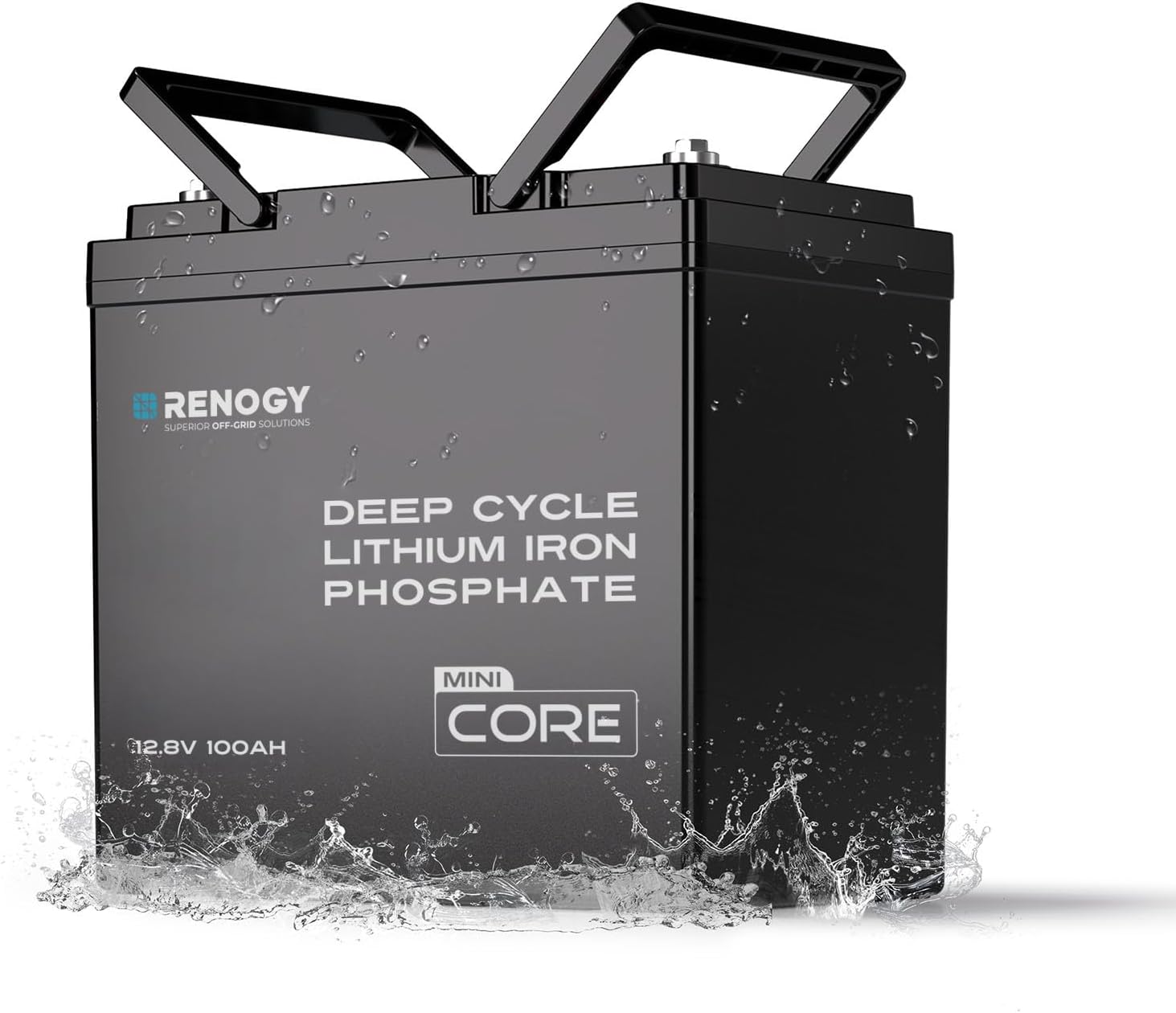
2. Renogy 12V 100Ah Core Series LiFePO4 Battery — Best for Beginners
Overview: Renogy’s compact Core Series model targets first-time lithium upgrades in RVs, cabins, boats, and off-grid systems. Its conventional 12V 100Ah format is easier to plan around than specialized high-voltage alternatives.
Key Features: Amazon lists a 100A BMS, IP65 protection, compact dimensions, remote-monitoring compatibility, and a five-year material-and-workmanship warranty.
Pros: Recognizable ecosystem; manageable capacity; compact case; clear general-purpose positioning.
Cons: Remote monitoring requires compatible additional hardware rather than built-in Bluetooth.
Best For: Beginners replacing a house battery and willing to verify charger settings first.
Verdict: It offers a sensible entry point without forcing buyers into unusual voltage or installation requirements.
3. Vatrer 12V 100Ah Self-Heating LiFePO4 Battery — Best for Cold Weather
Overview: This Group 31-style battery is designed for users who may need to charge in freezing conditions. Its heating system distinguishes it from batteries that only stop charging when temperatures fall too low.
Key Features: Vatrer specifies automatic self-heating, Bluetooth app monitoring, a 100A BMS, high-temperature cutoff, and support for series-parallel configurations.
Pros: Better suited to winter charging; app-based status checks; standard 100Ah energy class.
Cons: Self-heating consumes energy, and installation must still respect the stated temperature and current limits.
Best For: Cold-climate RVs, cabins, and seasonal off-grid systems.
Verdict: It earns its place by addressing a real winter limitation rather than merely adding another display feature.

4. Power Queen 12V 50Ah LiFePO4 Battery — Best for Compact Portability
Overview: Power Queen’s 50Ah model trades total runtime for a smaller, easier-to-carry battery. It suits kayaks, camping setups, electronics, and modest trolling-motor or backup loads where 100Ah is unnecessary.
Key Features: The Amazon page lists 640Wh capacity, a 50A BMS, IP65 protection, a portable case, and support for up to 4P4S configurations.
Pros: Lower weight and footprint; sufficient for smaller systems; easier handling than larger batteries.
Cons: Half the capacity of typical 100Ah models and a lower BMS current ceiling.
Best For: Portable projects with controlled power demands.
Verdict: It is a better fit than an oversized battery when portability matters more than maximum runtime.

5. LiTime 24V 100Ah Bluetooth LiFePO4 Battery — Best for 24V Systems
Overview: This battery provides a native 24V platform for trolling motors, solar storage, RV equipment, and off-grid systems. Using one 24V battery can simplify wiring compared with pairing two unmatched 12V units.
Key Features: LiTime lists 2,560Wh, a 100A BMS, Bluetooth monitoring, IP65 protection, low-temperature charging cutoff, and expansion up to 4P2S.
Pros: High energy in one enclosure; native 24V output; app monitoring; fewer interbattery connections.
Cons: It cannot directly replace a 12V battery, and compatible charging equipment is essential.
Best For: Purpose-built 24V electrical systems.
Verdict: This is the clearest choice for buyers who already know their equipment requires 24V power.

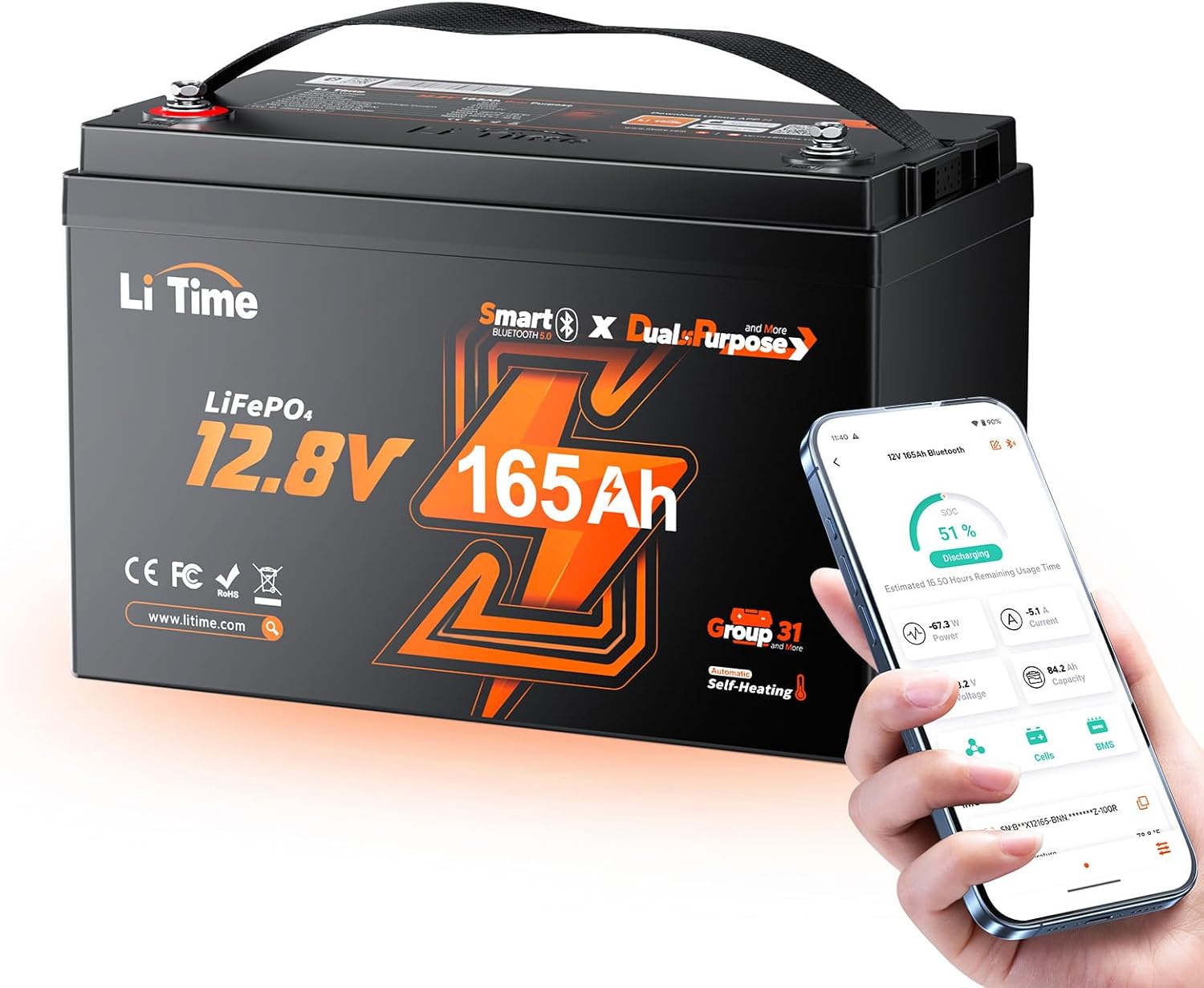
6. LiTime 12V 165Ah Dual-Purpose Marine LiFePO4 Battery — Best Premium Marine Option
Overview: Unlike ordinary deep-cycle batteries, this Group 31 model is marketed for both outboard-engine cranking and onboard energy storage. That dual-purpose design suits boat owners trying to reduce separate battery banks.
Key Features: Amazon lists 1,200 CCA, 165Ah capacity, self-heating, IP67 protection, and compatibility claims for selected Mercury, Honda, and Suzuki outboards.
Pros: Combines starting and cycling functions; substantial capacity; weather-focused enclosure; integrated heating.
Cons: Buyers must confirm exact engine compatibility, alternator requirements, and installation guidance before purchase.
Best For: Compatible marine systems needing premium, space-efficient dual-purpose power.
Verdict: Its specialized starting capability and larger capacity justify premium consideration for properly matched boats.
7. Redodo 12V 100Ah Bluetooth Group 24 LiFePO4 Battery — Best for RV Retrofits
Overview: Redodo packages 100Ah into a compact Group 24 case intended to fit many existing RV, marine, and solar battery compartments. Bluetooth provides visibility without adding a separate monitor.
Key Features: The verified Amazon page lists a 100A BMS, Bluetooth monitoring, low-temperature charge cutoff, 1,280Wh, and Group 24 dimensions.
Pros: Retrofit-friendly footprint; useful app data; standard 12V capacity; low-temperature charging protection.
Cons: Low-temperature cutoff prevents harmful charging but does not warm the battery.
Best For: RV owners replacing a Group 24 lead-acid house battery.
Verdict: It combines modern monitoring with a case format that can reduce installation headaches.

8. CHINS 48V 100Ah Lithium Golf Cart Battery — Best for Golf Cart Conversions
Overview: This high-voltage package is built specifically for 48V golf carts rather than general 12V house systems. It includes major conversion components, reducing the need to source a charger and display separately.
Key Features: Amazon lists a 200A BMS, 100Ah capacity, an included 18A charger, a monitor, and a manufacturer claim of more than 5,000 cycles.
Pros: Complete conversion-oriented package; high BMS current rating; native 48V architecture.
Cons: Expensive, heavy, and unsuitable for ordinary 12V appliances without proper conversion equipment.
Best For: Owners upgrading a compatible 48V golf cart.
Verdict: Its focused package and included hardware make it the strongest specialized selection.

9. GrenerPower 12V 100Ah Group 24 LiFePO4 Battery — Best Budget Option
Overview: GrenerPower focuses on the essentials: 12V, 100Ah, a compact Group 24 case, and a built-in BMS. It omits app monitoring, which may appeal to buyers who prefer fewer electronics.
Key Features: Amazon lists cylindrical Grade A+ cells, a 100A BMS, Group 24 sizing, 1,280Wh capacity, and a five-year manufacturer warranty.
Pros: Competitive value; familiar footprint; straightforward controls; useful capacity for common deep-cycle loads.
Cons: No Bluetooth, onboard SOC display, or self-heating feature.
Best For: Cost-conscious buyers who already use an external battery monitor.
Verdict: It delivers the core specifications many 12V systems need without charging extra for connected features.

10. Renogy 12V 300Ah Mini LiFePO4 Battery — Best for High-Capacity Storage
Overview: This model triples the nominal capacity of a typical 100Ah battery while using a compact “Mini” enclosure. It targets larger RV, cabin, marine, home-backup, and solar storage requirements.
Key Features: Amazon lists 300Ah capacity, a 200A BMS, remote-monitoring compatibility, 12V output, and a five-year prorated material-and-workmanship warranty.
Pros: Large single-battery capacity; higher BMS current ceiling; fewer parallel connections than three separate 100Ah batteries.
Cons: Premium cost, substantial weight, and monitoring hardware may be additional.
Best For: High-demand systems with adequate mounting space, cabling, fusing, and charging capacity.
Verdict: It is the most practical high-capacity pick for buyers who want fewer battery-to-battery connections.

How to Choose the Best LiFePO4 batteries
Start with system voltage. A 12V appliance bank needs a 12V battery arrangement, while 24V and 48V equipment requires correctly matched batteries, chargers, controllers, inverters, fuses, and wiring. Never assume a higher-voltage battery is a simple upgrade.
Next, estimate usable energy in watt-hours by multiplying nominal voltage by amp-hours. Capacity should cover daily consumption plus a reasonable reserve, but excessive capacity costs more, weighs more, and takes longer to recharge. Check the BMS continuous-current rating against inverter demand and motor startup loads.
Measure the tray, terminal clearance, cable reach, and ventilation area. Group numbers describe case formats, but actual dimensions and terminal positions still need confirmation. RV owners planning a full system should also review this practical guide to an RV solar power setup before choosing battery capacity.
Temperature protection matters. A low-temperature cutoff blocks charging below a safe threshold; self-heating actively raises cell temperature when its operating conditions are met. These are different functions. Also confirm that your converter, solar controller, alternator charger, or shore charger supports an appropriate LiFePO4 profile.
Portability and maintenance also deserve attention. A smaller battery is easier to remove for seasonal storage, but handles, terminal covers, and case strength influence real-world convenience. Before storage, follow the maker’s recommended state-of-charge range, disconnect parasitic loads, and keep the battery within its specified temperature limits. Bluetooth can simplify troubleshooting, although apps may require permissions, updates, or nearby phone access; a physical display remains useful when connectivity fails. For marine or exposed installations, verify the ingress-protection rating and do not interpret “water-resistant” as permission to submerge the case. Starting batteries and deep-cycle batteries are not interchangeable merely because their voltage matches. Engine cranking, trolling motors, inverters, and household loads create different current demands. Calculate cable gauge and fuse size from the maximum expected current and cable length, not only battery capacity. When uncertain, have an installer review the complete system, especially alternator charging, large inverters, and multi-battery banks.
Finally, compare warranty terms, service channels, app requirements, water-resistance claims, included hardware, and expansion rules. Use identical models, ages, capacities, and states of charge when connecting batteries together, following the manufacturer’s instructions.
Frequently Asked Questions About LiFePO4 batteries
Are LiFePO4 batteries safe?
They are generally considered a thermally stable lithium chemistry, but safe use still requires a functioning BMS, correct fusing, suitable cables, secure mounting, compatible charging, and compliance with manufacturer limits.
Can I replace an AGM battery directly?
Sometimes physically, but electrical compatibility is not automatic. Confirm charger profile, alternator protection, low-temperature behavior, terminal layout, dimensions, and maximum current before replacing AGM.
How long do LiFePO4 batteries last?
Cycle-life claims vary by brand, depth of discharge, temperature, charging practices, and load. Treat published cycle counts as manufacturer claims, not guaranteed real-world service life.
Can different LiFePO4 batteries be connected together?
Avoid mixing brands, capacities, voltages, ages, or states of charge unless the manufacturers explicitly permit it. Mismatched batteries can charge and discharge unevenly.
Do I need a special charger?
Use charging equipment whose voltage limits and profile match the battery manufacturer’s instructions. A charger designed only for lead-acid batteries may not charge safely or completely.
Final Verdict
Among these LiFePO4 batteries, the ECO-WORTHY 100Ah Upgrade 2.0 is best overall for its balanced monitoring and protection features. GrenerPower’s 100Ah model is the best budget option, while the Renogy 300Ah Mini is the premium choice for substantial storage. Renogy’s 100Ah Core is best for beginners, and the CHINS 48V 100Ah package is the best specialized option for golf-cart conversions. Compare verified specifications, confirm dimensions and system compatibility, review current warranty terms, and check the latest Amazon.com product information before purchasing.