What Is an Inverter and How Does It Work?
You know that little moment when the power goes out, the fan stops, the Wi-Fi dies, and everyone in the house suddenly becomes very aware of electricity? That’s usually when people start asking, what is an inverter, and why does it matter so much?
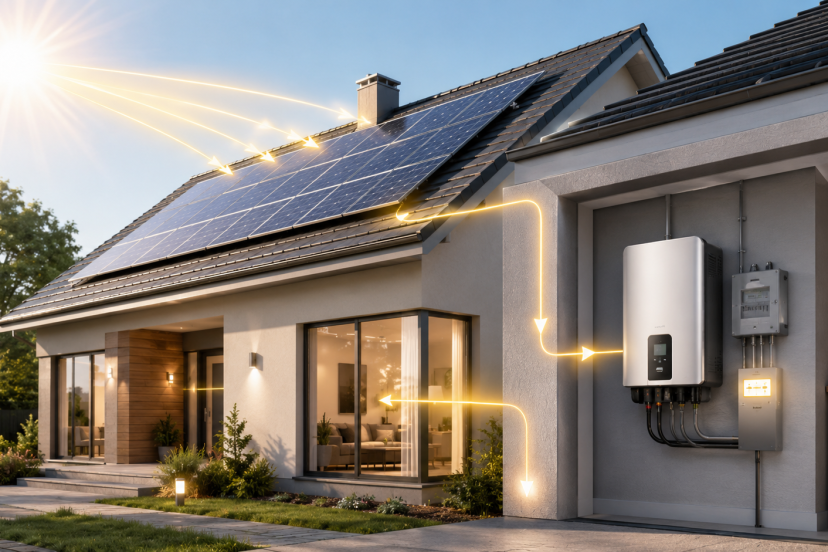
Here’s the simple version: an inverter is the quiet middleman that helps solar power become useful inside your home. Solar panels create one kind of electricity, but your fridge, lights, laptop, TV, and phone charger need another kind. The inverter does the “translation.”
In this guide, you’ll learn what an inverter does, how it works, the main types, how to choose one, and which Amazon inverter products may fit different solar power setups.
Affiliate note: This article includes product suggestions that may support the site if you buy through affiliate links.
What does an inverter do?
An inverter is a device that converts direct current electricity into alternating current electricity.
Solar panels produce DC power. Most homes use AC power. So, without an inverter, your solar panels would be like someone speaking a language your appliances cannot understand.
The U.S. Department of Energy explains that inverters convert DC electricity from solar panels into AC electricity used by the grid and most household devices.
Why Solar Panels Need an Inverter
Solar panels are great at collecting sunlight, but they do not send out the same type of power your home usually uses.
Think of solar panels as the garden. They grow the energy. The inverter is the kitchen. It prepares that energy so your home can actually use it.
A solar inverter helps power:
- Lights
- Refrigerators
- Fans
- Wi-Fi routers
- Laptops
- TVs
- Washing machines
- Small kitchen appliances
Without it, your solar setup is incomplete.
How Does an Inverter Work?
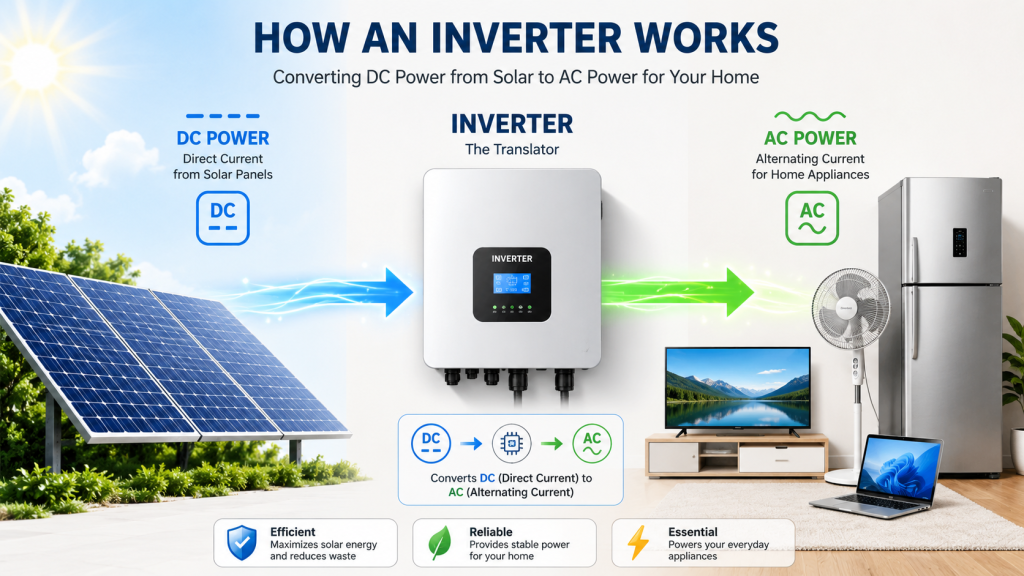
An inverter takes DC power from your solar panels or battery and switches it into AC power.
Although it may sound technical, the idea is simple: DC power moves in one constant direction. AC power undergoes numerous direction changes every second. Your inverter reshapes the electricity so it matches what your appliances expect.
It also helps manage voltage, improve safety, and, in many solar systems, communicate with the grid.
DC vs AC Power Explained
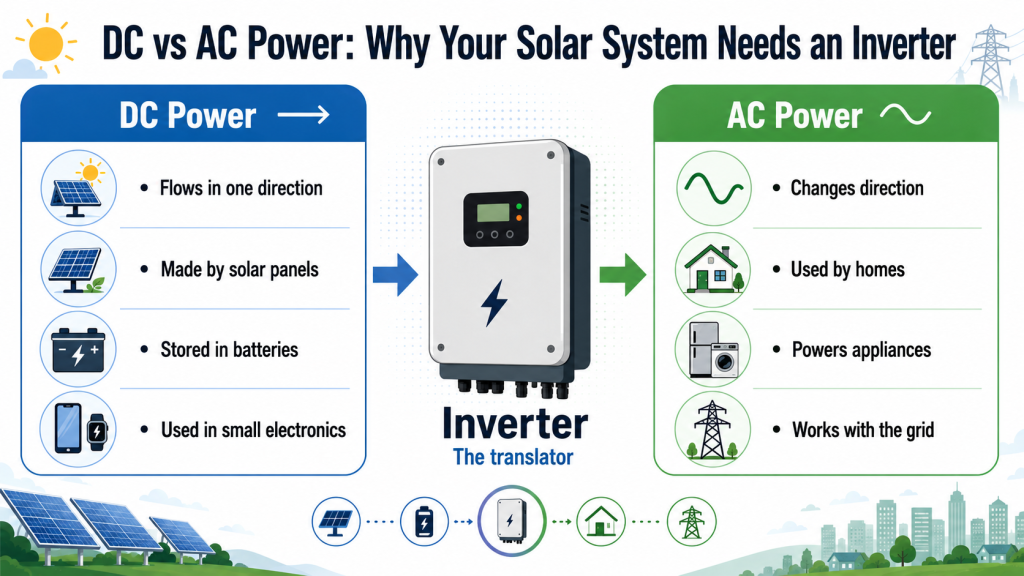
DC power is steady. It flows one way. Batteries, solar panels, and many small electronics use it.
AC power moves back and forth. Homes and electrical grids use AC because it travels well over long distances and works with standard household wiring.
So, when someone asks, what is an inverter, the most practical answer is this: it turns solar or battery power into home-friendly electricity.
The Main Types of Solar Inverters
Not every solar inverter works the same way. Some are simple. Some are smart. Some are better for shaded roofs. Others are better for full-home backup.
The main types include:
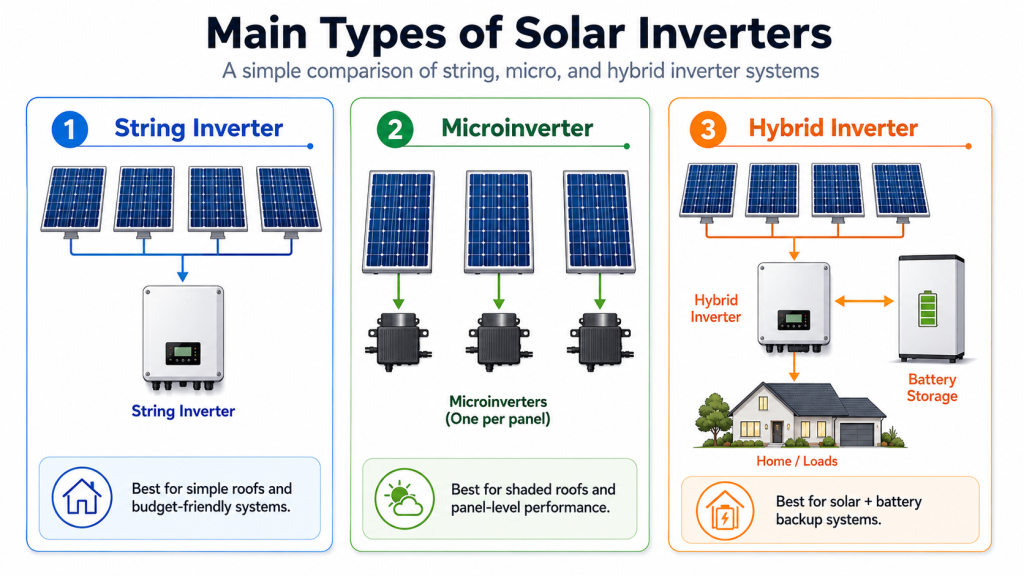
- String inverters
- Microinverters
- Power optimizers
- Hybrid inverters
- Inverter chargers
Each one has a different role, so choosing the right type depends on your roof, budget, battery plans, and energy goals.
String Inverters
Several solar panels are connected in a “string” by a string inverter, which subsequently transforms the combined DC electricity into AC power.
This is one of the most common choices for residential solar systems.
Best for:
- Simple roof layouts
- Sunny areas with little shade
- Budget-conscious homeowners
- Grid-tied solar systems
The downside? If one panel gets shaded, the whole string may lose performance. A little shade can act like one slow dancer messing up the whole line dance.
Microinverters
Microinverters sit behind individual solar panels. Each panel gets its own small inverter.
This means one shaded panel will not drag down the rest of the system as much.
Best for:
- Roofs with shade
- Complex roof angles
- Homes with panels facing different directions
- People who want panel-level monitoring
Microinverters often cost more upfront, but they can make sense when your roof is not perfectly sunny all day.
Hybrid Inverters
A hybrid inverter works with both solar panels and battery storage.
It can send power to your home, charge your solar battery, and sometimes pull power from the grid when needed.
Best for:
- Home battery backup
- Off-grid solar systems
- Areas with frequent outages
- Homeowners who want energy independence
If your dream is to keep lights on during blackouts, a hybrid inverter deserves a close look.
Inverter Charger vs Solar Inverter
Solar DC power is transformed into AC power using a standard solar converter.
An inverter charger can also charge a battery bank from another power source, such as grid power or a generator. For example, Renogy’s product listing explains that an inverter charger works as a DC-to-AC converter and can also charge and maintain a battery bank when connected to shore power.
Best for:
- RVs
- Cabins
- Backup power systems
- Off-grid homes
- Solar battery banks
If you want solar plus backup charging, an inverter charger can be more flexible.
Comparing Modified and Pure Sine Waves
Cleaner, smoother electricity is produced by a pure sine wave inverter. It is closer to the power you get from the grid.
A modified sine wave inverter is usually cheaper, but it may not work well with sensitive electronics.
Choose pure sine wave for:
- Laptops
- Medical devices
- Refrigerators
- TVs
- Microwaves
- Power tools
- Modern appliances
For a serious solar power system, pure sine wave is usually the safer pick.
How to Choose the Right Inverter Size
Choosing inverter size is not about guessing. You need to know what you want to power.
Start by listing your appliances and checking their wattage. Next, total the watts of everything you might run concurrently.
Practical tip:
Choose an inverter with more capacity than your expected load. Appliances like refrigerators, pumps, and tools may need extra surge power when they start.
For example, Renogy lists one 3000W pure sine wave inverter with 3000W continuous power and 6000W peak surge capacity.
Inverter Efficiency Matters
No inverter is perfect. Some energy gets lost during conversion.
A more efficient inverter wastes less power, which matters when you are relying on solar energy. DOE notes that power electronics, including inverters, are important for improving solar system performance and lowering costs.
Look for efficiency ratings, safety certifications, cooling features, and overload protection before buying.
Where an Inverter Fits in a Solar Power System
A basic solar setup usually works like this:
Solar panels collect sunlight.
The charge controller manages charging.
The battery stores power, if included.
DC power is transformed into AC power via the inverter.
Your home uses the energy.
If you are planning your home around smart energy use, solar works even better when paired with good design choices like insulation, orientation, shade control, and natural lighting. You can also explore passive solar design ideas for a more energy-efficient home.
Common Inverter Mistakes to Avoid
Buying the wrong inverter can create headaches later.
Avoid these mistakes:
- Choosing too little wattage
- Ignoring surge power
- Buying modified sine wave for sensitive appliances
- Skipping safety certifications
- Forgetting battery compatibility
- Installing it in a hot, cramped space
- Treating DIY electrical work too casually
Electricity is useful, but it is not a toy. For permanent home solar setups, work with a qualified installer.
Product Section: 5 Relevant Inverter Picks
Here are five inverter products commonly found through Amazon-style listings and useful for different solar, RV, backup, and portable power needs.
Renogy Inverter P2 3000W Pure Sine Wave Inverter
This is a strong option for RVs, trucks, camping, emergency backup, and off-grid solar use.
Features:
- 3000W continuous power
- 6000W peak surge
- 12V DC to 120V AC
- Pure sine wave output
- Useful for larger loads
Best for: Home backup, RV owners, and off-grid users who need serious power.
GIANDEL 2000 Watt Pure Sine Wave Power Inverter
This inverter is built for RVs, campers, and off-grid solar setups. The Amazon listing notes 2000W output, 4100W surge peak power, GFCI outlets, USB-C, and remote monitoring features.
Features:
- 2000W output
- Pure sine wave power
- USB-C charging
- Remote with battery monitor
- GFCI outlets
Best for: Campers, van life setups, and medium home backup loads.
AIMS Power 2000 Watt 12 VDC Pure Sine Inverter Charger
This one is more than a simple inverter. It also works as a charger for battery systems. The Amazon listing describes 2000W continuous power, 6000W surge, an auto transfer switch, and a 70A smart battery charger.
Features:
- 2000W continuous power
- 6000W surge
- Pure sine wave
- Battery charging support
- Auto transfer switch
Best for: Off-grid cabins, solar battery systems, and backup power setups.
Victron Energy 1200VA 12-Volt 120V AC Pure Sine Wave Inverter
Victron is known for professional-grade power equipment. This model offers 1200VA continuous power and 2200W peak power, according to its Amazon listing.
Features:
- Pure sine wave output
- 1200VA continuous power
- 2200W peak power
- Low idle draw ECO mode
- VE.Direct monitoring compatibility
Best for: Smaller premium setups, RVs, boats, and carefully designed battery systems.
BESTEK 300W Car Power Inverter
This is a smaller portable inverter for light-duty charging. It is not meant to run a house, but it can be handy for travel.
Features:
- 300W power output
- Car-friendly 12V design
- AC outlets
- USB charging ports
- Compact body
Best for: Phones, tablets, small laptops, and road trips.
Research-Backed Reasons Inverters Matter More Than You Think
Solar power is growing quickly, and that makes the inverter more important than ever. According to the International Energy Agency, solar PV generation increased by a record 320 TWh in 2023, rising 25% from 2022 and reaching 5.4% of global electricity generation. That means more homes, businesses, and communities are depending on solar systems that need smart, reliable power conversion. You can see the bigger picture in the IEA’s report on solar PV becoming one of the fastest-growing electricity sources.
But here’s the part many beginners miss: your panels are only half the story. The inverter is what helps solar electricity become usable inside your home. The U.S. Department of Energy explains that solar inverters convert DC electricity from panels into AC electricity used by homes and the grid. Their guide to how solar inverters support grid-ready home power makes it clear that inverters also help manage safety, voltage, and grid communication.
What Is an Inverter Used for at Home?
An inverter can power household appliances from solar panels, batteries, or a backup system.
You might use one for:
- Emergency power
- Solar battery backup
- RV electricity
- Off-grid cabins
- Small workshops
- Camping setups
- Home solar systems
The right inverter depends on how much power you need and how often you use it.
Can an Inverter Run a Whole House?
Yes, but only if it is sized correctly and paired with the right solar panels, batteries, and installation.
A small inverter may run lights and a router. A larger inverter may support refrigerators, fans, outlets, and selected appliances. Whole-home backup usually needs a professionally designed system.
Do not size it based on hope. Hope is lovely, but watts are stricter.
Is an Inverter the Same as a Battery?
No. Electricity is stored in a battery. An inverter converts electricity.
Although they frequently collaborate, they are not the same.
Think of the battery as a water tank and the inverter as the faucet system that makes the stored water usable where you need it.
What is the lifespan of a solar inverter?
Many solar panels can last 25 years or more, but inverters may need replacement sooner depending on type, heat exposure, workload, and product quality.
This is why warranty, brand reputation, ventilation, and proper installation matter. A cooler, well-installed inverter usually has a better chance of lasting longer.
Is a Solar Inverter Worth It?
Yes, if you want to use solar power for normal household electricity.
Without an inverter, solar energy stays in a form most home appliances cannot use. With the right inverter, your solar setup becomes practical, flexible, and much easier to live with.
FAQs About What Is an Inverter
What does an inverter do, in simple terms?
A device that converts DC power into AC power is called an inverter. In solar power systems, it helps turn solar panel energy into power your home appliances can use.
What does an inverter do in a solar power system?
In solar power, an inverter converts the DC electricity made by solar panels into AC electricity for lights, outlets, appliances, and sometimes the electric grid.
What size inverter do I need for home use?
Add together the wattage of all the appliances you want to use at the same time. Then choose an inverter with extra capacity for startup surge. Large systems should be sized by a solar professional.
Is a pure sine wave inverter a better option?
Yes, pure sine wave inverters are usually better for sensitive electronics, refrigerators, medical devices, laptops, and modern appliances because they produce cleaner power.
Can I use an inverter without solar panels?
Yes. You can use an inverter with a battery, vehicle, generator, or backup power system. Solar panels are only one possible power source.
Conclusion
So, what is an inverter? It is the bridge between solar energy and everyday comfort. It turns DC power from panels or batteries into AC power your home can actually use. Whether you are building a full solar system, preparing for outages, setting up an RV, or just learning how clean energy works, the inverter is one of the most important pieces of the puzzle. Choose it carefully, size it wisely, and treat it like the quiet hero of your solar setup. Small steps toward energy independence still count—and honestly, every watt you understand makes the whole journey feel a little less intimidating.