How Do Photovoltaic Panels Work? Easy Explanation
If you have ever looked at solar panels on a roof and wondered, “How does sunlight turn into electricity?” you are not alone. It sounds simple at first. Sun hits panel. Power comes out. Nice.
Then someone mentions photovoltaic cells, DC current, inverters, semiconductors, and suddenly it feels like you walked into an engineering lecture by mistake.
So, how do photovoltaic panels work in plain, everyday language? They capture sunlight, use solar cells to turn that light into electricity, and send the power through equipment that makes it usable for your home, RV, cabin, battery bank, or small off-grid setup.
That is the short answer. But once you understand what is happening inside the panel, solar energy starts to feel a lot less mysterious and a lot more practical.
Affiliate note: This article includes product suggestions, and your site may earn from qualifying purchases at no extra cost to readers.
What Does Photovoltaic Mean?
The word “photovoltaic” looks intimidating, but it is easier than it sounds.
“Photo” means light. “Voltaic” refers to electricity. So photovoltaic simply means electricity made from light.
That is why photovoltaic panels are often called PV panels. They are solar panels designed to turn sunlight directly into electrical power.
A single photovoltaic cell does not produce much electricity on its own. That is why many cells are connected together inside one panel. Then multiple panels can be connected to make a larger solar array.
So when you see a rooftop solar system, you are really looking at hundreds or even thousands of tiny solar cells working together.
The Solar Cell Does the Real Work
The solar cell is the most important part of a photovoltaic panel.
You can think of each cell as a tiny power station. It does not make noise. It does not burn fuel. It does not have spinning parts. It simply reacts when sunlight hits it.
Most solar cells are made from silicon because silicon has the right electrical properties for this job. It can absorb sunlight and help create an electric current.
One cell alone is small, but when many cells are wired together, they can create enough power to charge batteries, run appliances, or support a home’s energy needs.
That is what makes solar energy so clever. It takes something ordinary—sunlight—and turns it into something useful.
Why Semiconductors Matter
A semiconductor is a material that can partly conduct electricity. It is not as conductive as metal, but it is not an insulator either.
That middle-ground behavior makes it perfect for solar cells.
Inside a photovoltaic cell, the semiconductor material is designed to create an electric field. When sunlight hits the cell, electrons get knocked loose. The electric field helps guide those electrons in one direction.
That organized movement becomes electrical current.
Think of it like a busy market street. If everyone moves randomly, it becomes chaos. But when there is a clear path, people flow in the same direction. A solar cell does something similar with electrons.
The Main Parts of a Photovoltaic Panel
A solar panel may look like one flat sheet, but it is actually made of several layers. Each layer protects the panel or helps move electricity.
The main parts include:
- Solar cells: These convert sunlight into electricity.
- Glass cover: This protects the cells from weather and damage.
- Encapsulant: This holds the cells in place.
- Backsheet: This adds insulation and protection.
- Frame: This gives the panel strength, usually with aluminum.
- Junction box: This connects the panel to the system wiring.
All of these parts work together so the panel can sit outside for years and handle heat, rain, dust, wind, and the occasional bird that treats your roof like a personal rest stop.
What Happens After the Panel Makes Electricity?
Once the solar cells create electricity, the power needs somewhere to go.
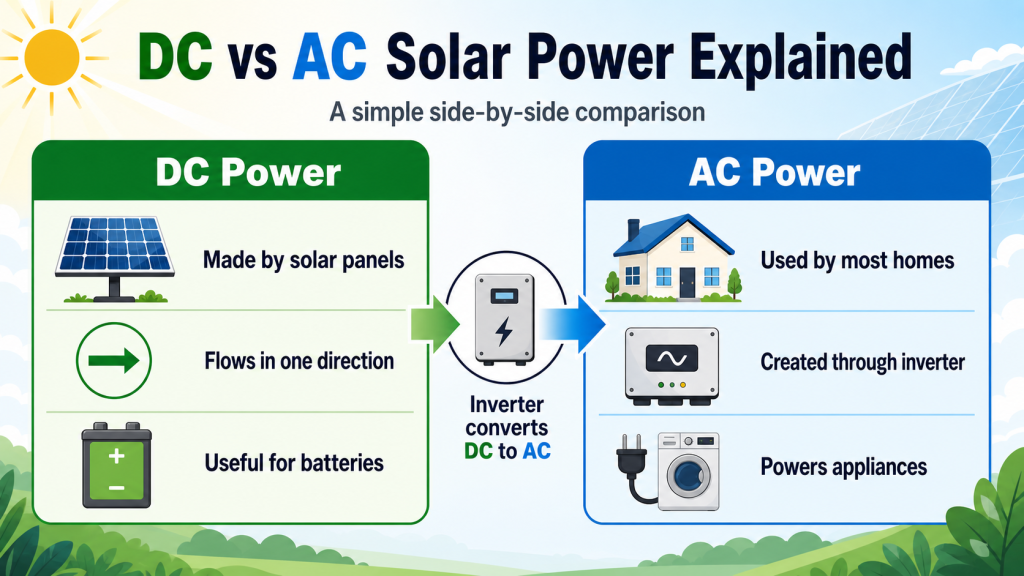
Photovoltaic panels produce DC electricity. That works well for batteries and some devices, but your home usually runs on AC electricity.
That is why your solar system needs an inverter.
DC power is converted to AC power via the inverter. Once that happens, the electricity can run lights, appliances, chargers, tools, and other everyday devices.
Without the inverter, your panels may be producing power, but your home would not be able to use it properly.
What Is the Function of a Solar Inverter?
In a solar PV system, the inverter is one of the hardest-working components.
Its main job is simple: it changes DC electricity into AC electricity.
You can think of it as a translator. The solar panels speak one electrical language. Your home speaks another. The inverter stands between them and makes sure everyone understands each other.
Some systems use one central inverter. Others use microinverters, which are attached to individual panels. Microinverters can be helpful when parts of a roof get shade at different times of day.
The right choice depends on your roof layout, shade, budget, and energy goals.
Do Photovoltaic Panels Work When It Is Cloudy?
On cloudy days, photovoltaic panels do really function. They just make less electricity.
Clouds block some sunlight, so fewer photons reach the solar cells. With less sunlight, the panels produce less power.
However, solar panels do not need blazing summer sun to function. They can still generate electricity in cloudy regions, during cooler seasons, and even when the sky looks a little gloomy.
Of course, output will always be better when panels receive strong, direct sunlight. That is why panel placement matters so much.
What Affects Solar Panel Output?
Solar panel performance depends on more than just sunshine.
Several factors can affect how much electricity your system produces:
- Roof direction
- Panel angle
- Shade from trees or nearby buildings
- Dust, leaves, or dirt on the panels
- Weather conditions
- Temperature
- Panel quality
- Inverter quality
- Wiring and system design
Shade is one of the biggest issues. Even partial shade can reduce output, especially if the system is not designed to handle it well.
That is why a good solar setup starts with a good site check. Before buying panels, it helps to understand where sunlight hits your roof or outdoor space throughout the day.
Solar Panel Efficiency Made Simple
Solar panel efficiency means how much sunlight a panel can turn into electricity.
No panel converts all sunlight into power. If it did, every sunny roof would be a tiny power plant superhero. Nice idea, but not quite reality.
Higher-efficiency panels can produce more electricity from the same amount of space. This matters if you have a small roof or limited installation area.
For example, if two panels are the same size, the more efficient one will usually produce more power under the same conditions.
Still, efficiency is not the only thing to consider. Cost, durability, warranty, system design, and your energy needs also matter.
Common Types of Photovoltaic Panels
There are three main types of photovoltaic panels you will usually see: monocrystalline, polycrystalline, and thin-film.
Monocrystalline Panels
Monocrystalline panels are common in home solar systems. They usually have a dark, clean look and strong efficiency.
They are a good choice when you want solid performance and have limited roof space.
Polycrystalline Panels
Polycrystalline panels are often more affordable. They may have a bluish appearance and slightly lower efficiency than monocrystalline panels.
They can still be useful when you have enough space and want a budget-friendly option.
Thin-Film Panels
Thin-film panels are lighter and sometimes flexible. They are often used for special applications rather than typical home rooftops.
They usually need more space to produce the same amount of electricity as crystalline panels.
Batteries, Charge Controllers, and Supporting Equipment
Solar panels may get most of the attention, but the rest of the system matters too.
A complete solar setup may include:
- Photovoltaic panels
- Solar inverter
- Charge controller
- Battery bank
- Mounting hardware
- Wiring
- Monitoring system
- Safety disconnects
If your solar system includes batteries, a charge controller is especially important. It controls how electricity moves from the panels into the batteries. This helps prevent overcharging and protects the battery system.
And if you are interested in using sunlight in other practical ways, this guide to a solar water heater setup is a helpful next read.
Practical Tips Before Buying Solar Equipment
Before buying solar panels, pause for a moment and think about what you actually need.
Ask yourself:
- Do I want solar for my whole home or a small setup?
- Am I trying to lower bills, charge batteries, or prepare for outages?
- How much sunlight does my roof, yard, RV, or cabin receive?
- Is there shade during the day?
- Do I need portable panels or fixed panels?
- Will I need batteries?
- Are there local rules, permits, or utility requirements?
A small portable panel for camping is very different from a full rooftop system. Although they address different issues, both can be helpful.
Start with the goal. Then choose the gear.
Helpful Products for Learning and Small Solar Setups
These Amazon products can help readers explore solar energy, build small off-grid systems, or understand how photovoltaic panels work in real life.
1. Renogy 100 Watt 12 Volt Monocrystalline Solar Panel
This is a useful starter panel for RVs, cabins, boats, sheds, and small backup power projects. It is compact, beginner-friendly, and practical for hands-on solar learning.
Features:
- 100W monocrystalline design
- Aluminum frame
- Shatter-resistant glass
- Pre-drilled mounting holes
Best for: Beginners, RV owners, cabin users, and DIY solar learners.
2. Anker SOLIX PS100 Solar Panel
The Anker SOLIX PS100 is a foldable portable solar panel designed for outdoor charging. It pairs well with portable power stations and works nicely for camping, road trips, and emergency backup.
Features:
- 100W foldable solar panel
- Adjustable kickstand
- Portable design
- IP67 waterproof rating
Best for: Campers, outdoor workers, emergency kits, and portable power users.
3. ECO-WORTHY 200 Watts Solar Panel Kit
This kit gives you more than a single panel. It includes solar panels and a charge controller, making it a helpful option for small off-grid builds.
Features:
- 200W solar kit
- Monocrystalline panels
- 30A PWM charge controller
- Useful for several off-grid setups
Best for: RV owners, shed power, small cabins, and starter solar projects.
4. Renogy Wanderer Li 30A Solar Charge Controller
A charge controller helps manage the power going from your panels into your batteries. This one is useful for DIY systems because it works with several battery types.
Features:
- 30A PWM controller
- Compatible with multiple battery types
- Temperature sensor function
- Simple charging control
Best for: DIY solar systems with batteries.
5. RICH SOLAR 200 Watt 24 Volt Monocrystalline Solar Panel
This panel works well for larger small-scale setups. It is built for outdoor use and can support RVs, trailers, cabins, boats, and off-grid projects.
Features:
- 200W monocrystalline panel
- 24V design
- Heavy-duty frame
- Outdoor-ready construction
Best for: RVs, trailers, boats, cabins, and more serious off-grid power systems.
Research-Backed Solar Energy Insights
Photovoltaic technology is not new guesswork. It is proven, widely used, and improving every year.
The U.S. Department of Energy explains that solar photovoltaic technology converts sunlight directly into electrical energy using PV cells made from semiconductor materials. These cells are grouped into modules, which become the panels used on rooftops, RVs, solar farms, and off-grid systems.
The U.S. Energy Information Administration also explains that photovoltaic cells convert sunlight into electricity when photons from sunlight interact with the PV cell and create an electric current. In simple terms, sunlight gives energy to particles inside the cell, and that movement becomes usable electricity.
Solar is also growing quickly worldwide. The International Energy Agency reported that solar PV generation increased by 600 terawatt-hours in 2025, showing how important photovoltaic technology has become in the global energy mix.
FAQs About How Photovoltaic Panels Work
How do photovoltaic panels work at night?
Since photovoltaic panels require light, they cannot generate electricity at night. If you want power after sunset, you need batteries, grid electricity, or another backup source.
Do photovoltaic solar panels function when it’s raining?
Yes, they can still work during rainy weather if there is daylight, but output will be lower. Rain can also help wash dust and dirt off the panels.
What is the difference between solar panels and photovoltaic panels?
People often use the terms together, but photovoltaic panels specifically make electricity. Solar panels can also refer to solar thermal panels, which use sunlight to heat water.
How long do photovoltaic panels last?
Many photovoltaic panels are designed to last 25 years or more. They slowly lose some output over time, but quality panels can keep producing useful electricity for decades.
Can photovoltaic panels power a whole house?
Yes, photovoltaic panels can power a whole house if the system is sized correctly. Your energy use, sunlight, roof space, battery needs, and local rules all affect the final setup.