Is A Solar Power Air Conditioner The Right Fit For You?
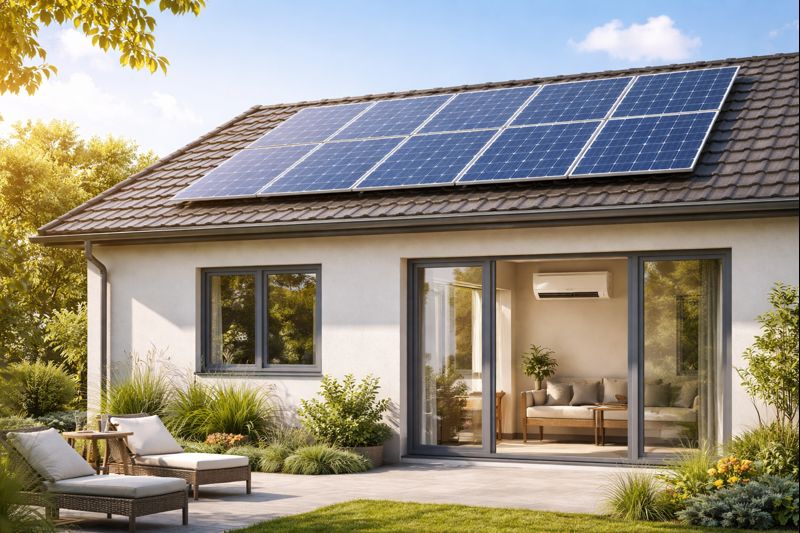
If you’ve ever stared at your AC remote and thought, “I want cold air… but not that electric bill,” you’re not alone. A Solar Power Air Conditioner setup can give you real comfort using sunshine—whether you’re trying to cut costs, handle outages, or cool an off-grid room.
You’ll learn the easiest ways to run AC on solar, simple sizing math (no engineer brain required), and what actually matters with batteries. Along the way I’ll naturally cover terms people search for—solar AC system, off-grid air conditioning, solar generator for air conditioner, solar panels for AC, battery storage, inverter air conditioner, and mini split—so you can plan with confidence.
(Quick affiliate note: the Amazon picks below are examples; I may earn a commission if you buy through those links.)
What a Solar Power Air Conditioner really is (and isn’t)
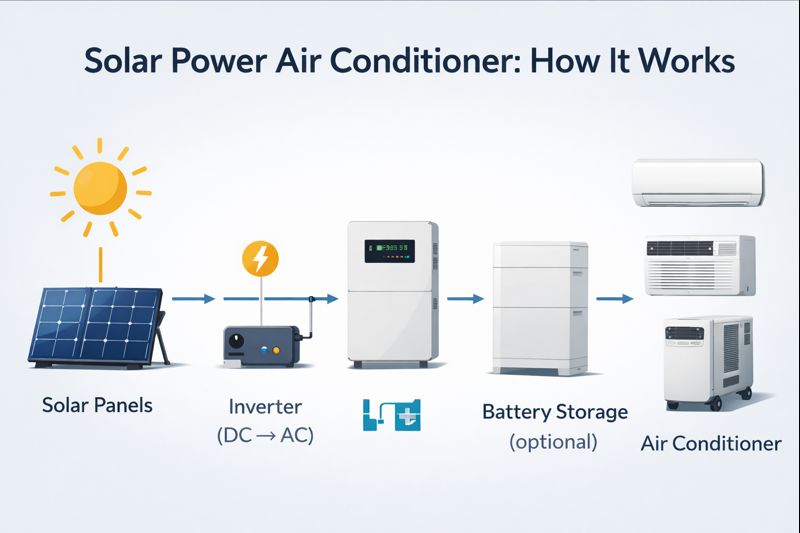
Most of the time, “Solar Power Air Conditioner” means a normal air conditioner (window, mini split, or portable) that’s powered by solar (directly or through an inverter/“solar generator”), and often backed by a battery so you can keep cooling when solar output dips.
It’s not a tiny panel powering a full AC by itself. Cooling takes real energy—the win is choosing an efficient unit so solar has a realistic job.
The 3 ways people run AC on solar
1) Grid-tied offset
Rooftop solar offsets your home’s total electricity use. On sunny afternoons, your AC and your solar production often overlap.
2) Hybrid (solar + battery)
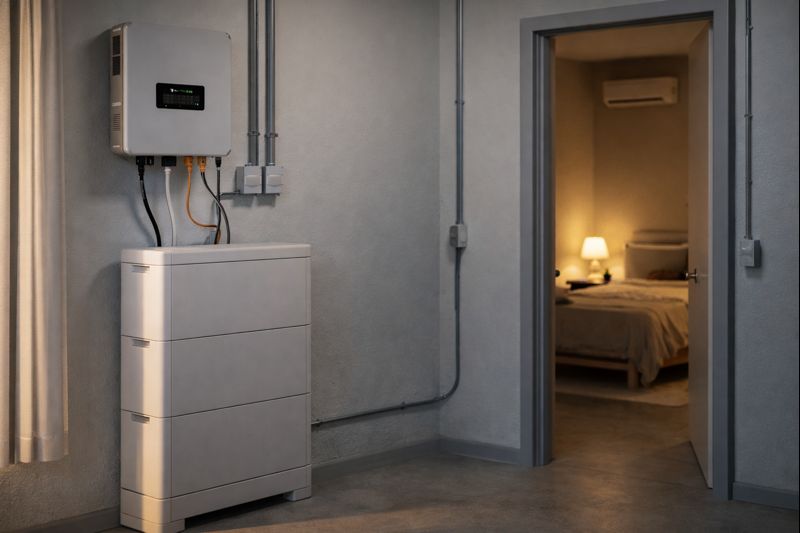
Solar covers daytime use and charges a battery. The battery can keep one “cool zone” room running during outages.
3) Off-grid
Dedicated panels + battery + inverter for a cabin, tiny home, shop, or rural office. Totally doable—just don’t guess on sizing.
How much power your AC needs
Solar sizing starts with watts and hours, not vibes.
Typical running power (rough ranges; model + humidity matter a lot):
- Efficient inverter window AC (8k–12k BTU): ~500–1,200W
- Inverter mini split (9k–12k BTU): ~300–1,000W
- Portable AC: often ~900–1,500W for similar comfort
Two key gotchas:
- Startup surge (a quick spike when a compressor starts)
- Duty cycle (a good inverter unit ramps down once the room is stable)
BTUs, room size, and humidity: sizing without guesswork
Right-sizing saves energy and feels better.
A fast sizing mindset
Room size is the starting point, then adjust for:
- direct sun on windows
- insulation
- ceiling height
- humidity (dehumidifying can be a big slice of the workload)
Cheat code: before you buy more panels, reduce the heat load—shade curtains, seal gaps, and use a fan to mix air (tiny watts, noticeable comfort).
Solar math without the headache: panels + “sun hours”
Use this shortcut:
Average AC watts × hours/day = watt-hours/day
Then add ~20–30% for inverter and system losses.
Example: 800W average × 6 hours = 4.8kWh/day
Add 25% overhead ≈ 6.0kWh/day.
If you get ~4.5 “good sun hours,” you’d want about:
6.0kWh ÷ 4.5h ≈ 1.3kW of solar (roughly 3–4 × 400W panels).
Batteries: the make-or-break part of comfort
If you want a Solar Power Air Conditioner to run after sunset, you’re really buying battery time.
A quick runtime estimate
Usable battery energy (kWh) ÷ average AC draw (kW) ≈ hours of runtime.
So, ~2kWh usable with an AC averaging ~0.8kW is roughly 2.5 hours—before you factor in heat, surge, and real-life losses.
A handy strategy: pre-cool while solar production is high, then bump the thermostat 1–2°C at night and let a fan do the gentle work. You’ll often feel just as comfortable, but your battery lasts noticeably longer.
Choosing the AC style: mini split vs window vs portable
Mini split (efficiency king)
Mini splits (especially inverter models) often deliver the best comfort per watt.
Window AC (best “one-room” solution)
High-efficiency inverter window units can be a sweet spot: simpler install, lower cost, and friendly to many solar generators.
Portable AC (best when you can’t install)
Portable units can be the only option for renters or awkward rooms—just expect higher watt use.
Inverter tech: why it changes everything
Inverter ACs ramp up, then cruise—instead of constantly slamming ON/OFF.
For solar, that usually means:
- lower average watts
- smoother battery draw
- less stress on your inverter
If you’re building any Solar Power Air Conditioner setup, “inverter” is one of the most valuable words on the spec sheet.
Off-grid vs grid-tied setups
Grid-tied is easiest (solar offsets usage). Hybrid adds resilience (solar + battery). Off-grid is doable but requires honest expectations.
A good rule: for off-grid air conditioning, design a cool zone first. Cooling an entire house all night is a much bigger (and pricier) system.
Safety note: anything involving high-current wiring, rooftop work, or permits is a “call a pro” situation.
A few realistic setup examples
Renter “relief kit”
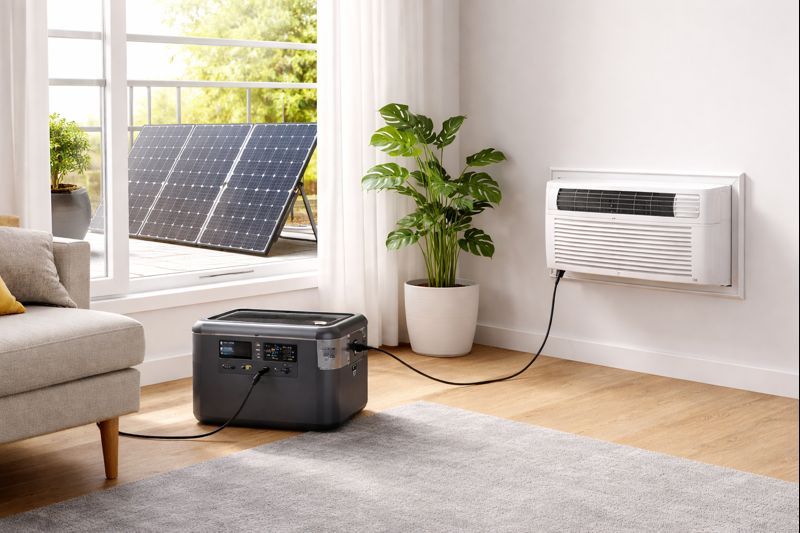
Inverter window unit + a solar generator you can charge from a balcony panel (and top off from the wall when needed). Use it during peak heat, not 24/7.
Outage-prone home
Keep one bedroom as the cool zone. During outages, you’re protecting sleep and comfort—not powering the whole house.
Off-grid tiny home
High-efficiency mini split + real insulation + smart habits (pre-cool before sunset, then coast).
Costs, savings, and what affects payback
A Solar Power Air Conditioner setup is really a system (AC + solar + storage + sometimes install).
Payback depends on:
- your electricity price
- how many months you run AC
- AC efficiency (SEER/SEER2)
- whether you’re offsetting peak-rate usage
Sometimes the best “return” is comfort during outages and fewer miserable nights.
Research-backed: what experts say about solar + cooling
Solar and cooling make a surprisingly good team, because the hours you want AC the most (hot, bright afternoons) often overlap with the hours your panels are producing the most power.
The International Energy Agency points out that if current trends continue, electricity demand from air conditioners is expected to more than triple by 2050—and it also stresses that better efficiency is one of the biggest levers for keeping cooling affordable and manageable. See the 2018 report: IEA “The Future of Cooling” (2018).
A peer-reviewed review in Energy Reports also explains how solar-powered AC (including PV-driven and solar-thermal options) can reduce stress on the grid during peak demand—especially when systems are paired with storage and efficient equipment. Here’s the study: solar-powered cooling and air-conditioning systems review (Energy Reports, 2022).
Maintenance and common mistakes to avoid
Simple maintenance that pays off
- Clean filters regularly
- Keep outdoor coils clear on mini splits
- Make sure window units drain properly
Common mistakes
- Buying panels before doing watt-hour math
- Ignoring startup surge (your inverter must handle it)
- Choosing a power-hungry portable AC when a window unit would work
- Trying to cool the whole house off-grid on day one
- Skipping shading/insulation (cheap upgrades, big impact)
If startup surge is a problem, a soft-start device can sometimes help—but always verify compatibility with your specific AC.
Product picks: 5 Amazon-friendly options
These meet your intent (solar-friendly use case + strong review history). Ratings/review counts can shift, so treat them as “at time of research.”
Before you choose storage, this battery guide can help you buy smarter: Best Solar Batteries for AC + backup setups
1) Midea 8,000 BTU Smart Inverter Window AC (with heat)
- Why it’s useful: efficient single-room cooling without a complicated install
- Best for: bedrooms, small home offices, rentals
- Low refund-risk angle: inverter efficiency tends to mean smoother comfort (less harsh cycling)
2) MRCOOL EasyPro 12,000 BTU Ductless Inverter Mini Split
- Why it’s useful: strong comfort-per-watt for steady daily cooling
- Best for: small homes, workshops, tiny homes
- Buyer intent: when you want quieter, more consistent cooling than most window/portable units
3) EcoFlow DELTA 2 Portable Power Station (1,024Wh)
- Why it’s useful: portable “solar generator for air conditioner” option
- Best for: outage cooling, renters, travel setups
- Practical use case: daytime cooling plus short backup windows
4) Jackery Explorer 2000 Plus Portable Power Station (2,042Wh)
- Why it’s useful: more battery runtime for longer cooling sessions
- Best for: longer outages, cabins, heavier use
- Buyer intent: you want more “evening runway” without building a whole-house system
5) Renogy 200W Monocrystalline Solar Panel
- Why it’s useful: dependable solar input for charging batteries or power stations
- Best for: balconies, RVs, off-grid sheds, topping off backup systems
- Buyer intent: panels are the “fuel pump”—under-sizing them makes everything feel disappointing
Quick safety note: Some window AC lines (including certain Midea U-shaped models) have had mold-related recall notices; if you’re buying used or installing long-term, check the manufacturer recall guidance and keep drainage clean.
FAQs
Is it possible for a solar-powered air conditioner to operate at night?
Yes—if you have enough battery storage (or you’re grid-tied and accept using grid power after sunset). Night cooling is mostly a battery-sizing question.
How many solar panels do I need to run a solar power air conditioner?
It depends on your AC’s average running watts and hours of use. Many single-room setups land roughly around 800W–2,000W of panels, plus storage if you need evening runtime.
What kind of solar generator do I need to run a window AC?
Check running watts and startup surge. Many inverter window units are easier to run than older compressor units, but always verify specs.
Is a mini split better than a window unit for solar?
Often yes for efficiency and comfort, especially inverter mini splits. Window units can be cheaper and simpler for one “cool zone” room.
Do I need a soft starter for running AC on solar?
Not always, but it can help when your inverter/generator struggles with compressor startup.
Final thought: a Solar Power Air Conditioner isn’t about powering everything at once. Make one space comfortable in a smart, scalable way—then build up as you go.